
QCP Capital says the US-Iran talks collapse pushed oil back into triple-digit territory and triggered a risk-off reset across crypto, with bitcoin failing at resistance and ether weakening even as ETF demand stayed constructive.
In its April 13, 2026 market note, QCP said negotiations between the United States and Iran had broken down, sending oil back above $100 and turning the broader tape defensive.
That macro framing was echoed in AOL’s mirrored NBC report on the Strait of Hormuz blockade threat, which said oil prices surged after President Donald Trump said the United States would move to block the waterway following failed peace talks with Iran.
Why QCP Capital Says Failed US-Iran Talks Triggered the Risk-Off Move
Key Points
- QCP ties the failed diplomatic push to triple-digit oil and a broader de-risking wave.
- Bitcoin failed at resistance while ether reset faster, preserving QCP’s cautious near-term read.
- ETF inflows remained positive, but macro headlines became the dominant catalyst.
How geopolitics transmitted into crypto pricing
For traders, the combination of oil above $100 and Trump’s referenced 10:00 ET enforcement window matters because it raises the chance that energy security headlines, not crypto-native flows, set intraday volatility.
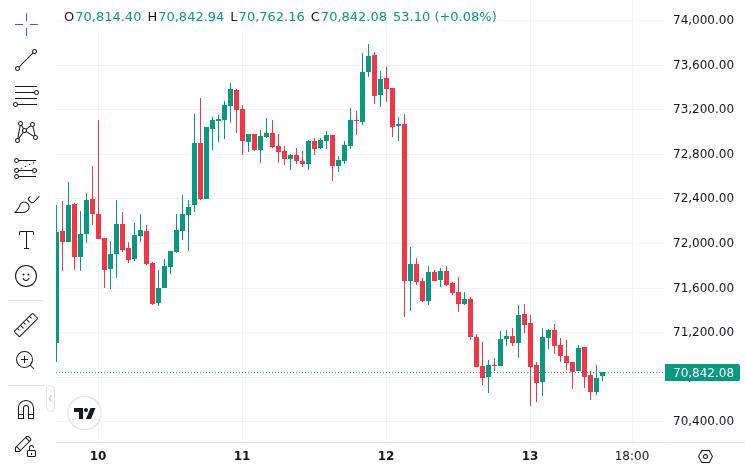
That helps explain why directional beta faded across the same session. QCP wrote that BTC met resistance at $74K while ETH fell from $2,330 to $2,180, a reset that points to tighter macro positioning rather than a project-specific breakdown.
The broader backdrop has already been sensitive to policy shocks across the region, a pattern also visible in Asia’s Weekly Top 10 Crypto News: Russia Ban, Japan Rules, where sanctions and rule changes likewise moved sentiment faster than token-specific fundamentals.
How Bitcoin’s Rejection and Ether’s Reset Fit the QCP Capital Outlook
QCP’s crypto-specific read is that steady ETF demand could not overpower the geopolitical tape. The desk said bitcoin stalled at resistance while ether slid from $2,330 to $2,180, leaving ETH framed as the higher-beta leg of the move rather than a leader.
Same-day reporting from Cointelegraph’s market coverage of the sell-off tied the move to the same geopolitical shock, saying bitcoin briefly traded below $71,000 as war-risk headlines hit risk assets.
QCP added that BlackRock’s IBIT drew $612.1 million of inflows over the past week, suggesting institutional demand was still present even as macro risk prevented spot from converting that support into a breakout.
Bitcoin was trading near $70,778, leaving it with a market capitalization of about $1.42 trillion and reinforcing that the market remained below the rejection zone QCP identified.
What traders may watch next if risk-off persists
If oil stays in triple digits and bitcoin remains below that resistance band, QCP’s framework implies traders will keep treating crypto as part of the same macro hedge basket as equities and commodities, not as an isolated beta trade.
That is also why capital rotation matters more than headline optimism. Recent AICryptoCore coverage such as Chainalysis Says Stablecoin Volume Could Hit $719T by 2035 points to the role of settlement rails when speculative positioning cools, while Hackers Minted 1 Billion Fake DOT on Ethereum, CertiK Says showed how quickly altcoin confidence can fracture when risk appetite is already thin.
For the AI-crypto segment, the data point to correlation rather than decoupling. With QCP tracking bitcoin’s rejection at resistance and ether’s drop from $2,330 to $2,180, decentralized compute and agent-token narratives are likely to stay subordinate to macro liquidity until the oil shock fades or ETF flows reassert control.
Disclaimer: This article is for informational purposes only and does not constitute financial advice.
Disclaimer: This article is for informational purposes only and does not constitute financial or investment advice. Cryptocurrency and digital asset markets carry significant risk. Always do your own research before making decisions.