The U.S. Department of Justice has charged a German citizen alleged to be the main administrator of Dream Market, one of the largest darknet marketplaces in history, with laundering over $2 million in cryptocurrency proceeds by converting them into gold bars.
What the DOJ alleges in the Dream Market crypto-to-gold laundering case
The U.S. Attorney’s Office for the Northern District of Georgia announced on May 13, 2026 that Owe Martin Andresen was indicted on federal charges. Prosecutors allege Andresen operated Dream Market under the moniker “Speedstepper” as the platform’s main administrator.
The indictment contains 12 federal counts: six counts of international concealment money laundering and six counts of concealment money laundering. Dream Market operated from 2013 until 2019 and hosted close to 100,000 listings at any given time, making it one of the largest darknet marketplaces of that era.
According to prosecutors, Andresen accessed dormant Dream Market wallets in November and December 2022. He then allegedly used an Atlanta-based cryptocurrency service provider in August 2023 to purchase gold bars with funds traced to those wallets.
The alleged laundering activity spanned from August 2023 through April 2025, totaling over $2 million. German authorities executed searches on May 7, 2026 and reportedly recovered approximately $1.7 million in gold bars, over $23,000 in cash, and evidence of approximately $1.2 million in additional proceeds held in bank accounts and wallets.
The case represents a notable example of crypto-to-physical-asset laundering, where digital currency proceeds are converted into hard assets like gold to obscure their origin. This method complicates traditional blockchain tracing because once funds leave the crypto ecosystem for physical goods, the on-chain audit trail ends.
Cybersecurity commentator Graham Cluley characterized the alleged conduct bluntly.
“If the claims of prosecutors are true, it was a massive error by the man suspected of being the Dream Market kingpin.”
— Graham Cluley, writing for Bitdefender
Why the case matters for crypto compliance and darknet enforcement
The DOJ’s timeline reveals how investigators connected years-old dormant wallets to fresh laundering activity. The gap between Dream Market’s 2019 shutdown and Andresen’s alleged wallet reactivation in late 2022 shows that law enforcement can maintain surveillance on inactive infrastructure indefinitely, a warning for anyone sitting on illicit crypto proceeds.
The conversion into gold is significant because it represents an exit from the blockchain altogether. Unlike peer-to-peer crypto transfers or mixer services, purchasing physical gold creates a gap in digital traceability. However, using a regulated Atlanta-based service provider to make that purchase apparently left enough of a paper trail for the DEA and IRS Criminal Investigation to build a case, similar to how investigators have pursued cross-border crypto fraud schemes through financial intermediaries.
The federal grand jury returned the indictment on January 13, 2026, four months before the public announcement. German authorities arrested Andresen on May 7, 2026 on parallel charges, demonstrating the kind of international coordination that has become standard in major crypto enforcement actions.
For exchanges and crypto service providers, the case reinforces that facilitating conversions from cryptocurrency to physical assets requires robust know-your-customer procedures. The Atlanta-based provider that allegedly processed Andresen’s gold purchases now sits at the center of a federal money laundering case.
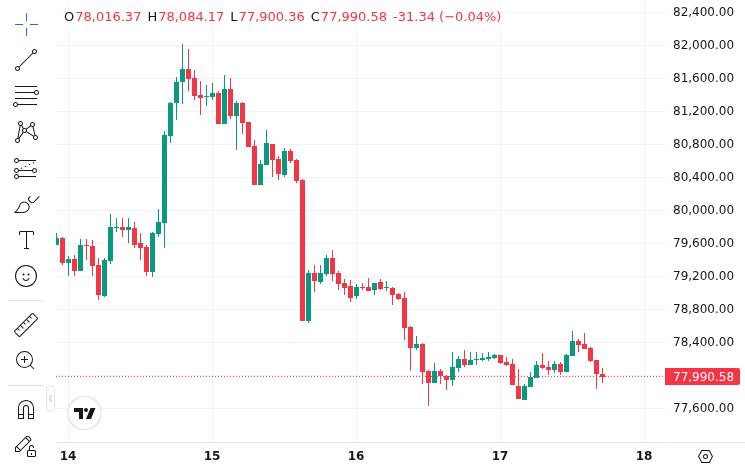
Bitcoin traded near $78,004 at press time, with the broader market sentiment index sitting at 27, firmly in “Fear” territory. While the Dream Market case is historical rather than market-moving, it adds to a pattern of enforcement actions that remind market participants of ongoing regulatory scrutiny over institutional crypto holdings and illicit fund flows alike.
Each count of international concealment money laundering carries a maximum sentence of 20 years in prison. Andresen remains in German custody, and extradition proceedings have not yet been publicly detailed.
Disclaimer: This article is for informational purposes only and does not constitute financial or investment advice. Cryptocurrency and digital asset markets carry significant risk. Always do your own research before making decisions.