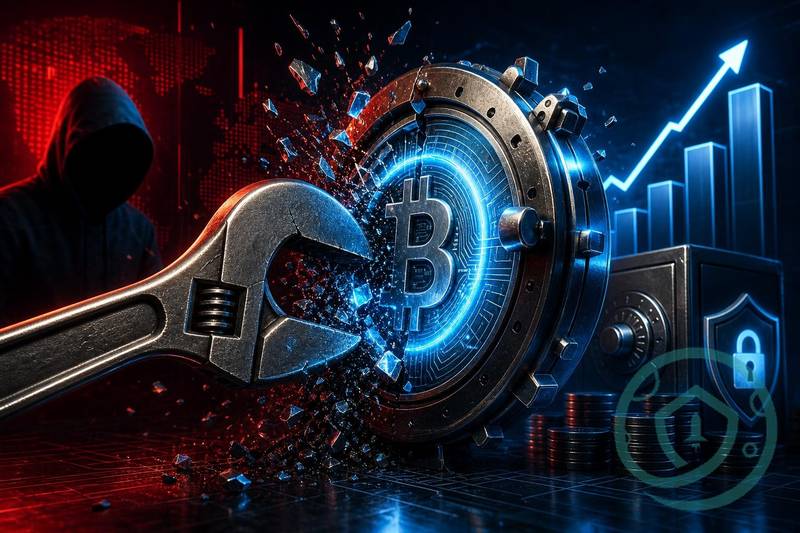
Rising physical attacks targeting cryptocurrency holders and executives are pushing security spending higher across the industry, according to Bloomberg reporting on a wave of kidnappings in France that prompted a government response.
A “wrench attack” refers to the use of physical force or threats to coerce a crypto holder into transferring digital assets. Unlike phishing or malware, the attack vector is a person, not code. The term comes from the idea that no amount of encryption can stop someone threatening you with a wrench.
Why Physical Threats Are Changing Crypto Security Budgets
Bloomberg reported that French authorities moved to shield crypto executives after a spree of kidnappings tied to digital asset holders. The incidents prompted coordination between law enforcement and the crypto sector at the national level.
France’s Interior Ministry convened a meeting with crypto industry representatives to address the threat. The government response signals that physical attacks on crypto holders have reached a scale requiring institutional intervention, not just individual precaution.
AP News coverage provided additional context on the broader rise in physical threats against crypto targets. These incidents are not isolated to France; they reflect a global pattern as crypto wealth becomes more visible.
A TRM Labs analysis documented the rise of wrench attacks and crypto-related violent crime as a distinct threat category. The blockchain intelligence firm noted that attackers increasingly view physical coercion as a faster path to funds than digital exploits.
The spending response spans personal security, secure custody arrangements, and travel precautions for conferences and public events. For high-profile founders and large holders, the cost of bodyguards and hardened operational security is becoming a routine line item, according to earlier Bloomberg reporting on crypto executives investing in personal protection.
What Better Security Looks Like Against Physical Coercion
For Individual Holders
The core defense against wrench attacks is making it impossible to transfer large sums under duress. Multisignature wallets requiring multiple parties to approve transactions, time-locked withdrawals, and geographic distribution of signing keys all reduce the risk that a single point of physical coercion can drain funds.
Reducing public exposure matters as much as custody design. Holders who publicly discuss portfolio sizes, display wealth on social media, or attend events without planning create targeting opportunities. The French kidnapping cases reportedly involved attackers who identified victims through their visible crypto activity.
For Firms and Executives
Companies holding significant crypto assets are reassessing threat models to include physical scenarios alongside the traditional focus on digital intrusion. This means incident response plans that account for executive kidnapping, duress codes integrated into custody workflows, and security audits that cover physical office and travel vulnerabilities.
The shift toward physical security also applies to blockchain infrastructure operators. Even technical upgrades like BNB Chain’s recent post-quantum stress test carry implications for how custody and signing protocols must evolve to resist both digital and physical attack vectors.
The French Interior Ministry meeting illustrates a move toward public-private coordination on these threats. Firms operating in jurisdictions with high-profile attack patterns are now expected to demonstrate physical security controls, not just cybersecurity compliance. The operational security posture of newer hybrid exchanges reflects this evolving threat landscape, where platform risk extends beyond code.
The trend also intersects with custody decisions that affect institutional flows. As recent ETF movement data shows, large capital shifts in regulated vehicles depend partly on investor confidence that custodial infrastructure can withstand both digital and physical attack vectors.
As long as blockchain assets remain bearer instruments that can be transferred irreversibly, physical coercion will remain a viable attack path, and the cost of defending against it will keep rising.
Disclaimer: This article is for informational purposes only and does not constitute financial or investment advice. Cryptocurrency and digital asset markets carry significant risk. Always do your own research before making decisions.