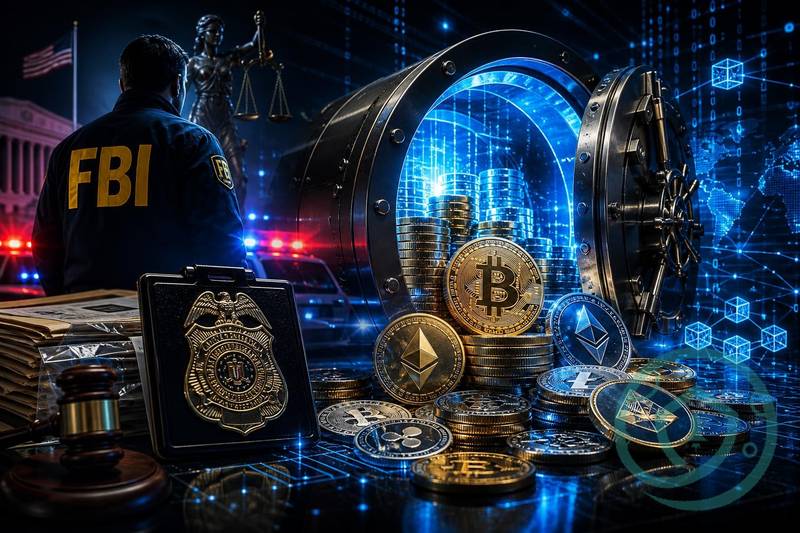
The FBI has reportedly seized more than $8 billion in cryptocurrency in what is being described as the largest forfeiture action in U.S. history, tied to a sprawling crypto confidence scam operation.
The U.S. Attorney’s Office for the District of Columbia announced what it called the largest-ever seizure of funds related to crypto confidence scams. The case centers on schemes that lured victims into fraudulent cryptocurrency investments, a category of fraud that has surged in recent years.
A separate federal indictment in the Eastern District of New York charged the chairman of the Prince Group with operating Cambodian forced-labor scam compounds engaged in crypto fraud. The parallel actions suggest a broader, coordinated federal crackdown on international crypto confidence operations.
What Is Confirmed vs. What Remains Unclear
KEY POINTS
- The FBI reportedly seized more than $8 billion in crypto, described as the largest U.S. forfeiture of its kind.
- The seizure is linked to crypto confidence scams, sometimes called “pig butchering” schemes.
- Specific asset breakdowns, token types, wallet addresses, and case timelines have not been independently confirmed at this time.
The reported figure would dwarf previous federal crypto seizures by a wide margin. However, key details, including which cryptocurrencies were seized, how many victims were affected, and the exact legal mechanism used, remain unconfirmed in available public documents.
It is also important to distinguish between a seizure and a final forfeiture. A seizure means law enforcement has taken custody of assets, but those assets are not permanently forfeited to the government until a court issues a final order. Defendants can contest seizures, and the process can take months or years.
Why This Could Matter for Crypto Enforcement and Market Sentiment
A seizure of this scale, if confirmed at the reported amount, would represent a significant escalation in U.S. law enforcement’s capacity to trace and recover illicit crypto funds. Federal agencies have steadily expanded their blockchain forensics capabilities, and this case could serve as a benchmark for future enforcement actions.
For crypto investors and traders, large government-held crypto positions have historically raised questions about potential market impact. When seized assets are eventually liquidated, the method and timing of sales can influence prices, particularly for less liquid tokens. Readers following how large holders approach potential sales may find relevant context in Michael Saylor’s recent comments on why he may sell Bitcoin.
The connection to forced-labor scam compounds in Cambodia also underscores the human cost behind crypto fraud. These operations have drawn attention from international law enforcement and have been the subject of growing regulatory discussions at events such as the AI summit in Indonesia, where cross-border digital crime has been a recurring topic.
The coordinated nature of these federal actions, spanning multiple districts and international jurisdictions, mirrors the kind of institutional coordination discussed at forums like GovXcellence Jakarta. The next steps to watch include formal indictments, forfeiture proceedings, and any public disclosure of wallet addresses or on-chain evidence.
Disclaimer: This article is for informational purposes only and does not constitute financial or investment advice. Cryptocurrency and digital asset markets carry significant risk. Always do your own research before making decisions.