CoinShares: Professional Bitcoin Holdings Fell to 261,000 BTC in Q1 Thumbnail
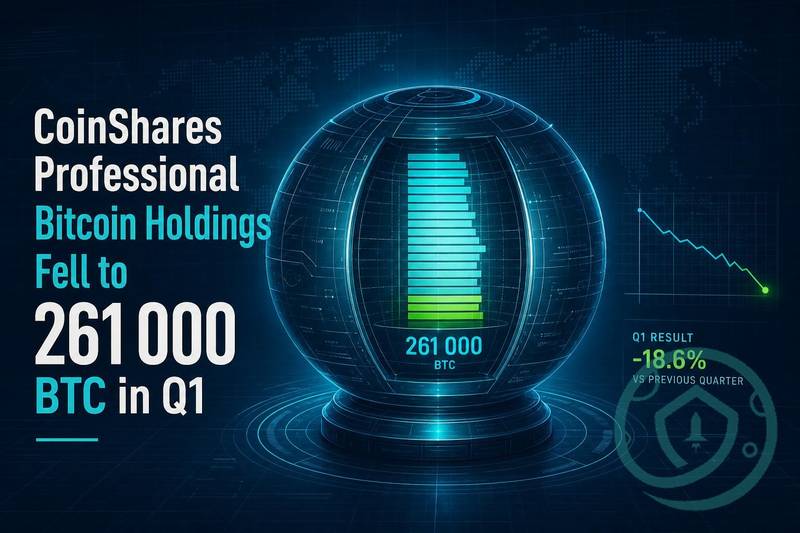
Professional bitcoin holdings tracked through U.S. regulatory filings fell to 261,000 BTC in the first quarter of 2026, down 17% from the prior quarter, according to a new report from digital asset investment firm CoinShares.
The decline represents a loss of roughly 52,500 BTC in exposure among institutional investors required to file Form 13F with the Securities and Exchange Commission. The dollar value of those positions dropped even more sharply, falling 35% to $17.8 billion, as bitcoin’s price also fell during the quarter.
What the CoinShares Data Shows
CoinShares analyzed quarterly 13F filings to track how large investment managers adjusted their bitcoin ETF positions. Professional holdings had stood at 313,000 BTC at the end of Q4 2025 before dropping to 261,000 BTC by March 31.
Hedge funds and brokerages were responsible for 95% of the exposure reduction. Hedge fund holdings fell 39% quarter over quarter, while brokerage positions dropped 53%.
The 13F share of total U.S. spot bitcoin ETF assets under management also contracted, slipping from 24.7% to 20.8%. That means professional investors lost ground relative to non-institutional holders within the ETF complex.
Key Points
- Professional bitcoin holdings fell 17% to 261,000 BTC in Q1, per CoinShares’ analysis of 13F filings.
- Hedge funds and brokerages drove 95% of the reduction, with brokerages cutting exposure by more than half.
- Institutional holders’ share of total U.S. spot bitcoin ETF AUM shrank from 24.7% to 20.8%, even as non-13F ownership grew.
Who Files Form 13F
Form 13F is required by the SEC for institutional investment managers exercising discretion over $100 million or more in qualifying securities. U.S. spot bitcoin ETF shares are among those reportable holdings, making 13F data a useful, if incomplete, window into large-scale professional positioning.
The dataset does not capture the full bitcoin ETF ownership base. Retail investors, smaller institutions below the filing threshold, and non-U.S. holders are excluded.
Why the Shift in Professional Holdings Matters
The Q1 pullback is notable less for the raw decline than for the structural shift it reveals. CoinShares found that 13F holders grew only 2.7% year over year, while non-13F holders expanded by roughly 16%. Professional investors are not just trimming, they are losing relative share of the bitcoin ETF market to smaller and retail participants.
Market Context
The reduction came during a quarter of broad risk-off sentiment. Bitcoin traded at $61,151 at press time, and the crypto Fear and Greed Index sat at 12, a reading classified as “Extreme Fear.” Separate reports have flagged that a drop below $60,000 could trigger further liquidations across derivatives markets.
The professional selloff contrasts with continued infrastructure investment in the bitcoin mining and data center space. Hut 8 recently priced $4.25 billion in notes to fund a Texas data center, suggesting that some institutional capital is rotating from ETF exposure toward direct infrastructure plays.
What the Data Does Not Show
A decline in 13F-reported holdings does not necessarily mean professional investors turned bearish on bitcoin. Some managers may have shifted from ETF wrappers to direct custody or derivatives. Others may have rebalanced in response to portfolio-level drawdowns rather than a directional view on bitcoin itself.
The CoinShares report also does not capture activity after March 31. ETF flow data for more recent months, including net inflow patterns across spot crypto ETFs, may show a different trajectory as market conditions have continued to evolve into Q2.
The next round of 13F filings, covering Q2 2026, is due by August 14 and will show whether the professional drawdown was a one-quarter adjustment or the start of a longer repositioning.
Disclaimer: This article is for informational purposes only and does not constitute financial or investment advice. Cryptocurrency and digital asset markets carry significant risk. Always do your own research before making decisions.