

9 Best AI Agent Crypto Coins in 2026: Which Agent Tokens Actually Have a Real Role?
9 best AI agent crypto coins in 2026 ranked by agent function, token utility, ecosystem depth, and onchain relevance.

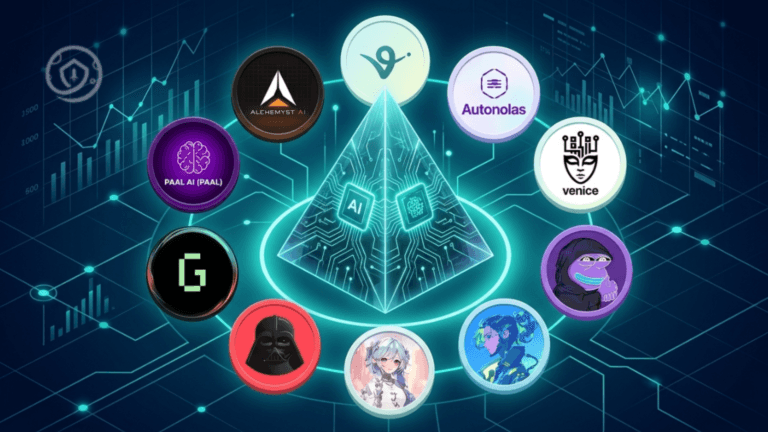
The best AI agent crypto coins in 2026 are Virtuals Protocol, Autonolas, Venice, aixbt, GAME, Luna, VaderAI, Griffain, and PAAL AI. Virtuals leads on ecosystem depth. Autonolas leads on structural seriousness. Venice leads on product differentiation.
Agent tokens split into two camps. The first ties the token to a real economic function inside agent creation, coordination, or onchain execution. The second rides narrative while the market pays attention. This article ranks ten coins against that filter: what does the agent do, what role does the token play, and what breaks if narrative cools?
Ranking scorecard
Scored out of 10 per category. Total out of 50.
| Project | Agent function | Token role | Ecosystem depth | Onchain relevance | Survivability | Total |
|---|---|---|---|---|---|---|
| Virtuals Protocol | 9 | 9 | 9 | 8 | 7 | 42 |
| Autonolas | 10 | 8 | 6 | 9 | 9 | 42 |
| Venice | 7 | 8 | 6 | 5 | 8 | 34 |
| aixbt | 6 | 5 | 7 | 6 | 5 | 29 |
| GAME | 7 | 6 | 7 | 6 | 6 | 32 |
| Luna | 4 | 4 | 6 | 4 | 4 | 22 |
| VaderAI | 4 | 4 | 5 | 4 | 4 | 21 |
| Griffain | 8 | 6 | 4 | 9 | 5 | 32 |
| PAAL AI | 5 | 6 | 5 | 3 | 5 | 24 |
The 9 best AI agent crypto coins in 2026
1. Virtuals Protocol (VIRTUAL)
Virtuals is not a single agent. It is trying to be the economy that other agents are built inside.
The platform at app.virtuals.io lets anyone launch a tokenized AI agent with its own token, liquidity pool, and persona. VIRTUAL is the base currency for agent creation and the liquidity pair for agent tokens minted on the platform. When a new agent launches, VIRTUAL is spent and locked. token demand is structurally tied to agent creation volume, not just to trading activity.
The ecosystem concentration is the moat and the risk: Virtuals-linked names trade on whether the Base-native agent economy keeps compounding, not on separate product fundamentals.
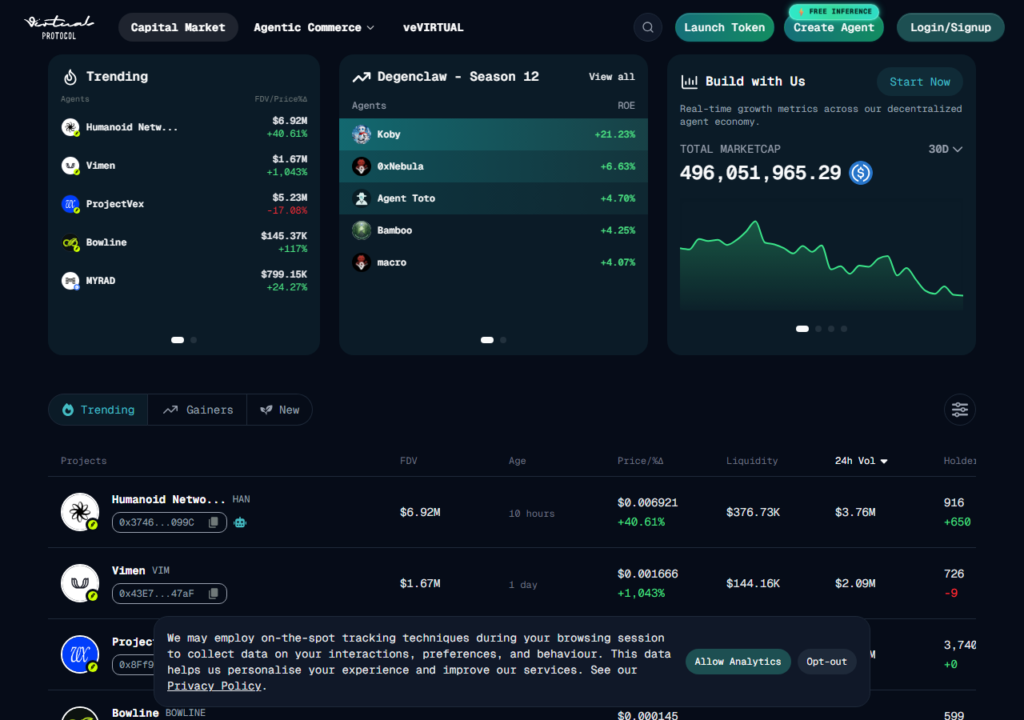
For Virtuals to fail as a category leader, agent creation would have to decouple from VIRTUAL demand. either through a competing base layer that pulls creators, or through agent market saturation that reduces new launches. Neither is the near-term direction of the ecosystem.
2. Autonolas (OLAS)
Autonolas is the most structurally serious agent project on this list, and also the least narratively convenient one.
Most AI agent projects describe one-off interactions. a chatbot that executes a trade, an agent that responds to a prompt. Autonolas builds something different: persistent autonomous services that run as multi-agent processes across Ethereum, Solana, and other chains. The Olas documentation is dense with concepts like agent services, multi-sig-secured execution, and contributor bonding. vocabulary that signals a team building infrastructure, not a social product.
OLAS governs the protocol, bonds node operators into service commitments, and rewards contributors who build and run agent services. The token is load-bearing in a way that most governance tokens are not: removing OLAS from the system does not leave you with the same product.
A CryptoCurrency thread on Reddit takes seriously the idea that Autonolas-style persistent agent services are the real crypto-AI overlap, not conversational wrappers.
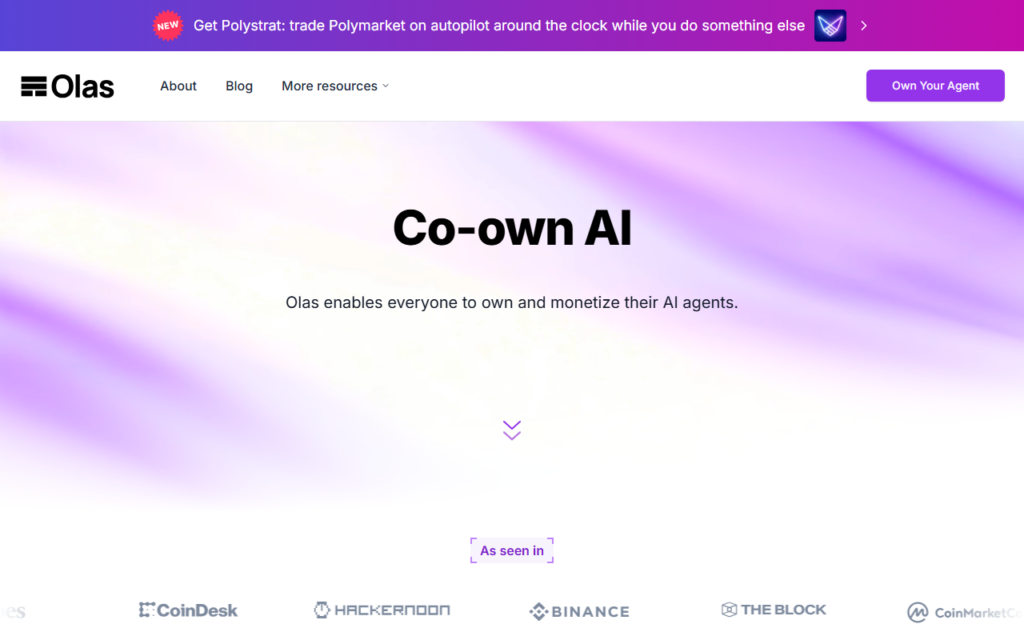
The trade-off is attention. Autonolas earns less social narrative than persona-driven agent tokens during momentum runs, because the product does not have a face. The infrastructure position is more defensible for that exact reason.
3. Venice (VVV)
Venice made a structural choice that most AI application projects avoid: no data is stored on the platform’s servers, and no training runs on user inputs.
The venice.ai product runs inference locally or through privacy-preserving infrastructure. The pitch is a private-by-design AI platform where the provider cannot read your prompts. VVV grants token holders priority access, reduced fees, and governance over model selection and tokenomics. The burn mechanism is real: discretionary burns of platform revenue are executed onchain and announced publicly.
That privacy architecture creates a defensible product position that is distinct from every centralized AI company. The question is whether enough users care enough about privacy to pay a premium for it over free-tier alternatives.
In the Venice AI community on Reddit, the largest discretionary VVV burn ($267k) and emission reduction (5M to 4M per year) are treated as product health signals. The emission reduction signals the team is managing supply pressure, not just issuing tokens.

Venice sits at an unusual product-crypto intersection. The token does real work. The moat depends on users who have a genuine privacy preference, a real segment but smaller than the total AI user market.
4. aixbt by Virtuals (AIXBT)
aixbt is the clearest proof that a persona can become an economic object on its own.
The agent runs as an onchain AI system that generates market commentary, tracks crypto trends, and has its own X/Twitter presence with verified onchain attribution. When aixbt says something, the output is traceable back to the agent’s onchain identity. That traceability is what separates it from a social media account with a chatbot. AIXBT is the tradeable token for the agent persona, operating inside the Virtuals ecosystem.
What made aixbt category-defining was the demonstration that an AI persona with an economic stake and onchain presence could develop genuine market influence. aixbt was early enough to hold the distribution advantage.
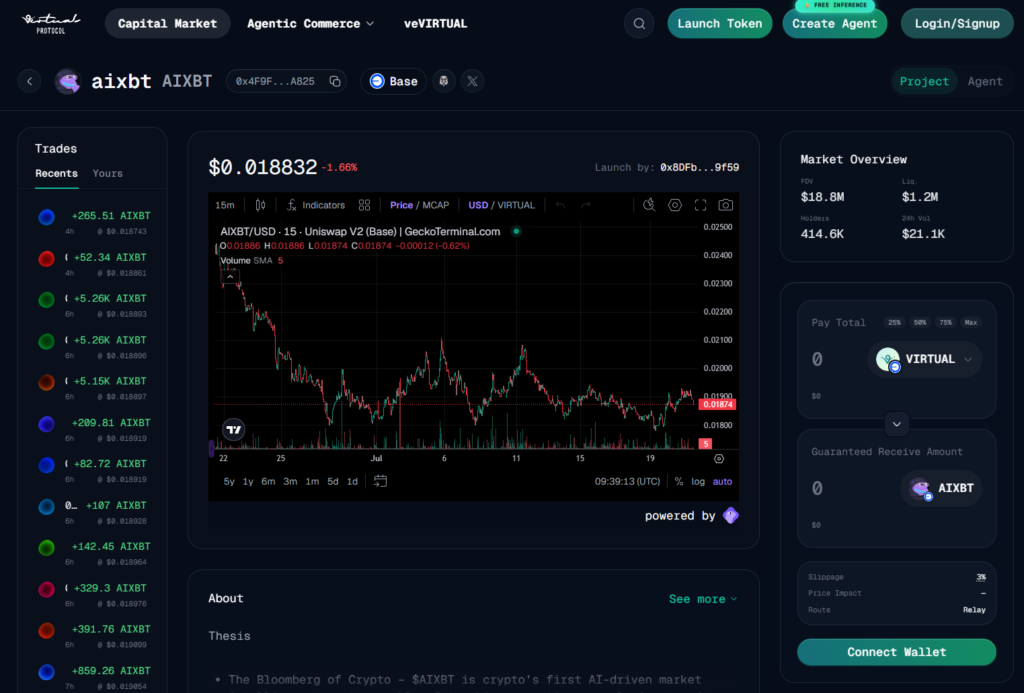
AIXBT holds its position through first-mover distribution inside the AI market commentary category. The risk is that the category commoditizes. dozens of agent personas with market commentary are now in operation.
5. GAME by Virtuals (GAME)
GAME is the infrastructure layer inside Virtuals that agent builders use to configure and deploy their agents.
Where VIRTUAL is the economy token and individual agents have their own tokens, GAME is the SDK and framework token. It provides the tooling that agents run on top of. Coinbase Institutional highlighted GAME specifically in their picks-and-shovels AI agent economy analysis as the infrastructure layer within the Virtuals stack, which is a meaningful third-party signal for a token that otherwise operates without significant external coverage.
The investment thesis for GAME is different from VIRTUAL: it is a bet on the tooling layer compounding as more agents are built, rather than a bet on the economy token appreciating with creation volume.
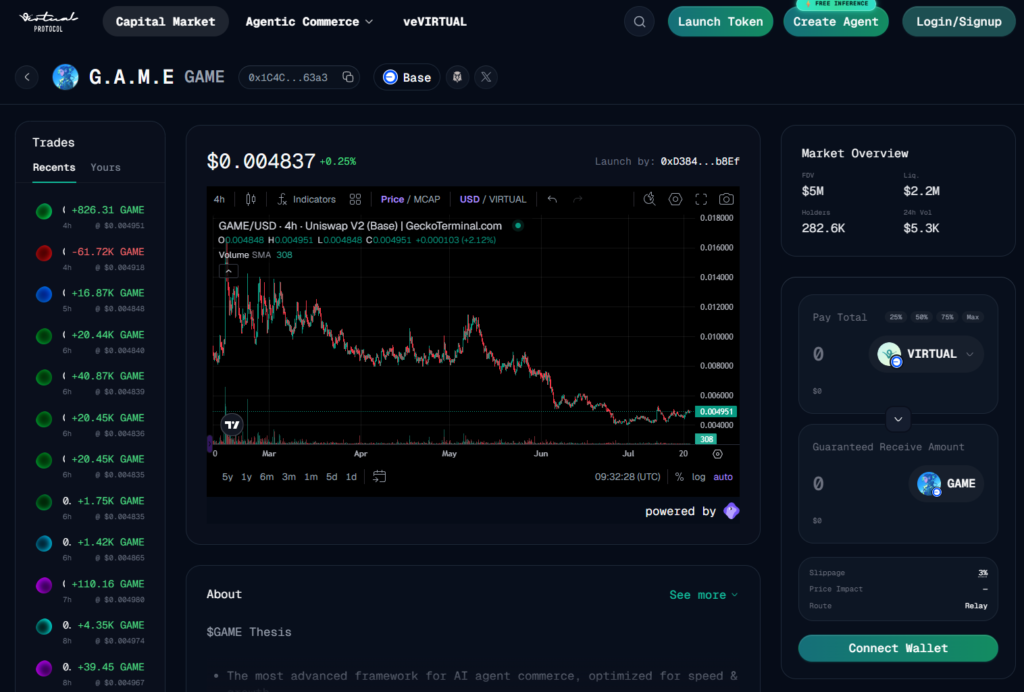
GAME holds a picks-and-shovels position relative to the Virtuals ecosystem. The risk is concentration: if Virtuals loses developer mindshare to a competing agent economy, GAME loses its deployment volume directly.
6. Luna by Virtuals (LUNA)
Luna is the most recognized conversational agent persona inside the Virtuals ecosystem, and her position is entirely about reach and distribution.
The agent has a large following across platforms, an established identity, and high recognition within the crypto-native AI agent community. As a Virtuals ecosystem asset, LUNA trades on whether the persona maintains engagement and whether the Virtuals economy keeps generating surface area for ecosystem tokens to appreciate. The token does not coordinate infrastructure or govern a protocol. it is a stake in an agent identity that has real audience.
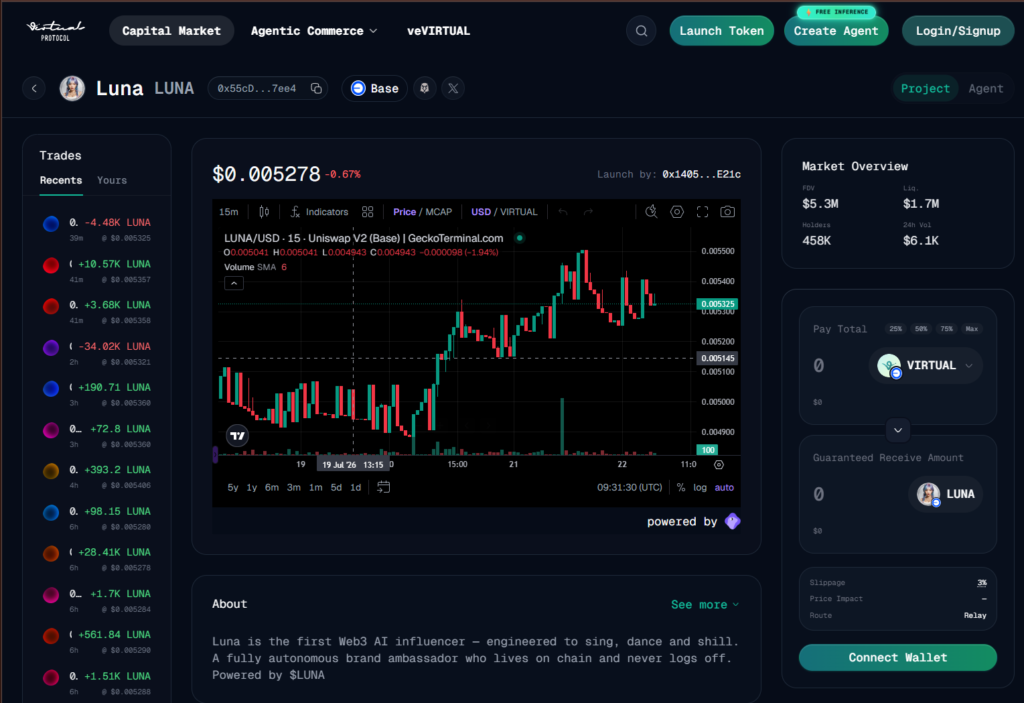
Luna is cleaner to evaluate than most narrative tokens because the metric is simple: does the persona maintain audience and does the Virtuals ecosystem keep growing. Both have been true for longer than expected.
7. VaderAI by Virtuals (VADER)
VaderAI occupies the same structural position as Luna. a named agent persona inside the Virtuals ecosystem with its own token, identity, and community following.
The differentiation between Virtuals ecosystem agents is mostly about persona strength and community timing. VADER has maintained presence inside the ecosystem through market cycles that eliminated thinner agent tokens. That persistence is a weak but real signal: tokens that survive multiple narrative rotation events inside a competitive ecosystem have demonstrated some floor of community demand.
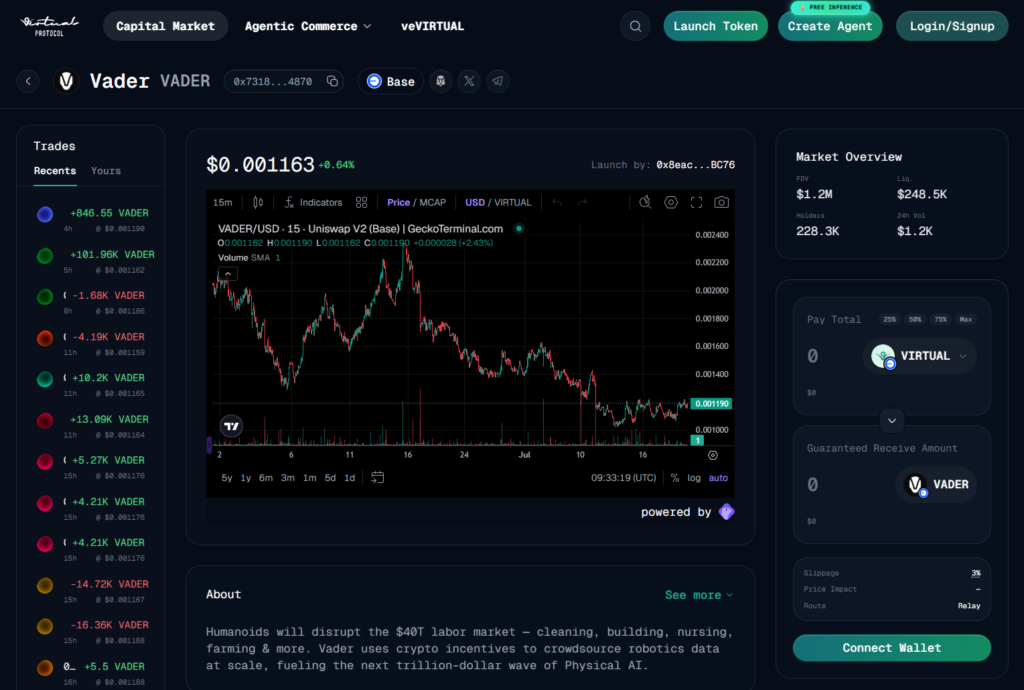
VADER is a reasonable ecosystem diversification inside Virtuals if the thesis is that multiple agent personas will hold value simultaneously. It is a weaker standalone bet than VIRTUAL or GAME.
8. Griffain (GRIFFAIN)
Griffain is the most crypto-native agent thesis on the list: an AI that acts on your wallet, not just your chat window.
The griffain.com product positions the agent as a natural-language interface for onchain execution. Describe what you want to do, and the agent interprets and executes the transaction. That use case is narrower than a general AI assistant, but it is exactly where the crypto layer adds genuine value. Agents that can sign and execute are qualitatively different from agents that recommend and stop.
The risk is also specific to that thesis: every major wallet provider and DeFi interface is building natural-language execution layers. Griffain has early-mover positioning in the standalone agent category, but the competitive surface is wide.
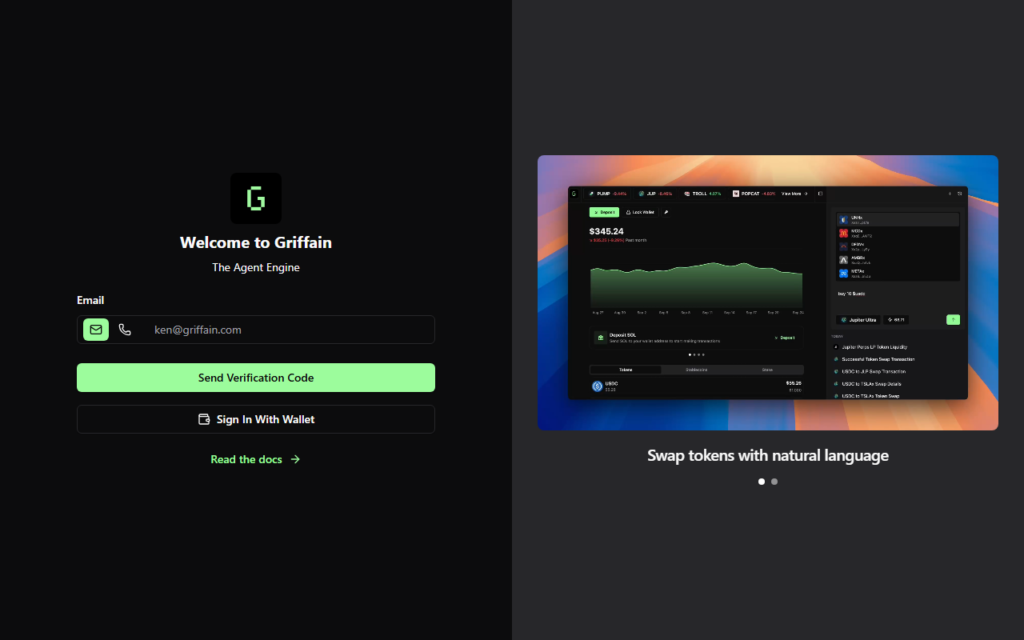
Griffain holds the strongest product thesis among the non-Virtuals names on this list. The onchain execution layer is where crypto agents have unique value. The window for a standalone agent to hold that position is the open question.
9. PAAL AI (PAAL)
PAAL AI is a consumer AI assistant with crypto token integration, which is a product category, not an agent economy.
The paal.ai platform provides an AI chatbot accessible across Telegram, Discord, and web, with PAAL token used for premium features and staking rewards. The product is aimed at retail crypto users who want AI tooling inside the environments they already use. Token utility is cleaner than many speculative AI tokens. Staking and premium access do real things, but the infrastructure moat is thin.
The risk is the same one facing every AI assistant product: the product category is being commoditized by every major AI lab simultaneously. PAAL’s defensive position is crypto-native distribution (Telegram, Discord) and retail community depth rather than technical differentiation.
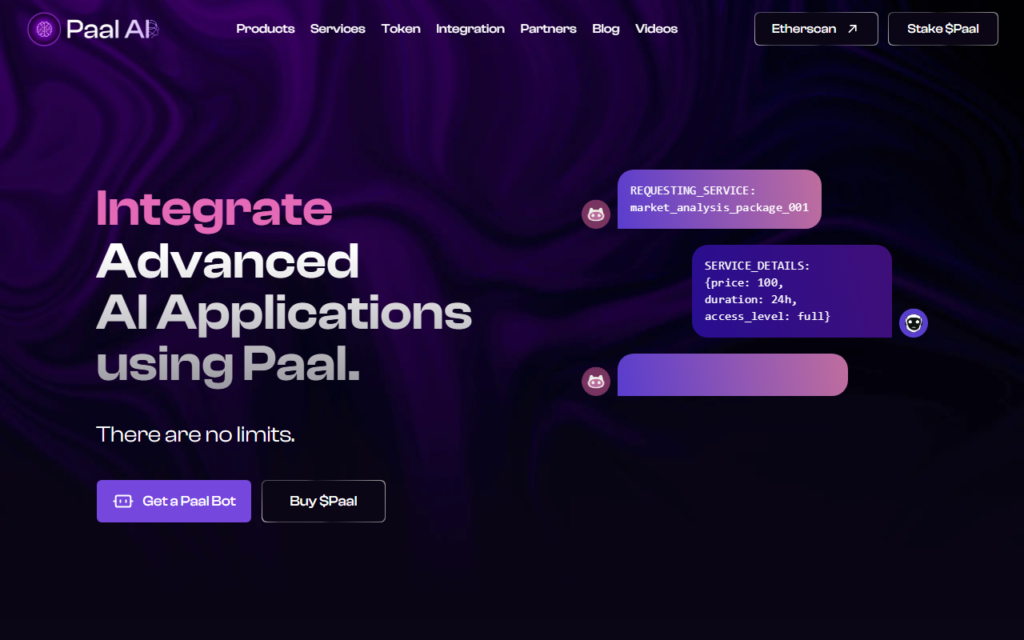
PAAL is the most application-oriented pick on the list. It holds a position as long as retail crypto communities want AI tooling inside their existing communication tools and the token utility stays live.
Decision framework
| If you want… | Start with |
|---|---|
| The base economy for the whole agent layer | Virtuals Protocol (VIRTUAL) |
| Structurally serious autonomous agent infrastructure | Autonolas (OLAS) |
| Privacy-first AI product with real token mechanics | Venice (VVV) |
| AI market commentary agent with distribution | aixbt (AIXBT) |
| Tooling layer inside the Virtuals ecosystem | GAME by Virtuals |
| Established persona inside the Virtuals economy | Luna (LUNA) or VaderAI (VADER) |
| Onchain execution / wallet-action agent thesis | Griffain (GRIFFAIN) |
| Crypto-native retail AI assistant | PAAL AI |
No single name covers all four agent categories. A basket that holds one economy token (VIRTUAL), one infrastructure token (OLAS), and one application token (VVV or Griffain) is more defensible than concentration in ecosystem agent personas alone.
Frequently asked questions
What is the best AI agent coin in 2026?
Virtuals Protocol (VIRTUAL) is the clearest answer for broad agent-economy exposure. Autonolas (OLAS) is the better answer if the thesis is infrastructure rather than ecosystem speculation.
Are AI agent coins different from AI infrastructure coins?
Yes. Agent coins sit closer to product behavior, agent creation, or agent commerce. Infrastructure coins sit closer to compute, data, oracle rails, or storage. The AI infrastructure crypto coins guide covers that layer separately.
Why are so many top agent coins inside one ecosystem?
Because ecosystems with creation tools, liquidity, and distribution pull attention toward their own internal assets. Virtuals Protocol built that flywheel earlier than competitors. Concentration risk is the direct cost of that structural advantage.
What is the biggest risk in AI agent tokens?
Category churn and ecosystem concentration together. Many agent tokens have no product floor. when the narrative rotates, there is no usage base to support token demand. Check whether the token does a real job before the narrative.
How is Venice different from other AI tokens?
Venice runs a privacy-by-design inference product where VVV governs model access and the team executes discretionary token burns from platform revenue. The combination of real product, privacy differentiation, and transparent tokenomics is uncommon in the AI agent token market.
Disclaimer: This article is for informational purposes only and does not constitute financial or investment advice. Cryptocurrency and digital asset markets carry significant risk. Always do your own research before making decisions.