
Morpho borrowers paid roughly $170 million in interest over the past year, a Token Terminal-linked datapoint that points to real demand for onchain credit while leaving open a harder question about how much of that activity actually accrues to the protocol itself.
Key Points
- CoinGecko's Morpho page attributed a trailing-year borrower-interest total to Token Terminal, framing the story as a lending-usage signal rather than a price-only narrative.
- Token Terminal's public Morpho page shows the protocol's share of fees at 0, which complicates any assumption that borrower payments equal DAO revenue.
- CoinGecko's financial panel showed $381,444 in 24-hour fees and $0.00 in 24-hour revenue when fetched.
What the Borrower Interest Figure Actually Shows
CoinGecko's Morpho page, citing Token Terminal, said borrowers paid about $170 million in interest over the past year, which is a measure of what users spent to access lending liquidity rather than a direct read on DAO income.
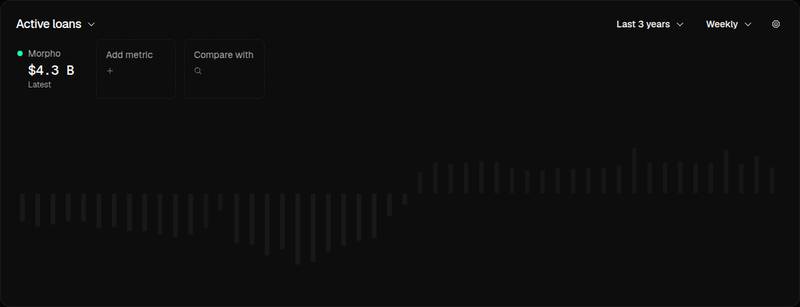
In lending protocols, borrower-paid interest tracks the cost of borrowing capital, not the amount MORPHO tokenholders automatically receive. That distinction matters because Token Terminal's public Morpho page labels the demand side as borrowers, defines fees as interest plus third-party incentives, and shows Morpho's share of fees at 0.
CoinGecko also said the trailing-year total implies about $17 million in annual DAO revenue according to a single-source summary, but that extension remains unconfirmed because Token Terminal simultaneously describes tokenholder fee capture as 0.
CoinGecko's Token Terminal-powered financial panel listed $381,444 in 24-hour fees and $0.00 in 24-hour revenue when fetched, reinforcing that borrower activity is generating measurable fee flow even if the protocol is not currently taking a cut.
PROTOCOL SNAPSHOT
- Demand side: Borrowers
- Protocol fee share: 0
- 24-hour fees: $381,444
- CoinGecko community mood: 20% bullish and 80% bearish
Why the Morpho Data Matters Beyond a Single Dashboard Reading
In an April 4, 2025 blog post, Morpho said lenders on the protocol had already generated more than $100 million in interest. The same update said Coinbase's Morpho-powered loan product reached nearly $100 million in collateral, $50 million in borrowing, and more than 2,500 wallets.
That official progress report fits the borrower-demand framing on Token Terminal: Morpho is attracting credit usage at scale, while monetization remains a separate governance question. For DeFi traders, lenders, and AI-linked treasury systems that route capital automatically, that makes the datapoint more useful as evidence of capital utilization than as a finished valuation thesis.
At press time, MORPHO traded near $1.74 with a market cap of $965 million on CoinGecko, giving the token a liquid market backdrop even as the protocol story is being driven more by lending usage than by fee capture.
That same verification-first approach also shaped coverage in Weekly Project Updates: Ethereum Stablecoin Supply Hits All-Time High, Bhutan Sells 70% of Bitcoin Holdings Over 18 Months, Arkham Data Shows, and Polymarket Protocol Upgrade and pUSD Plans: What the Docs Say, where the strongest conclusions came from live dashboards, blockchain records, or primary documentation rather than extrapolated narratives.
In a Dec. 3, 2024 report, Messari argued that Morpho's isolated pool architecture gives lenders and borrowers more flexible risk controls than pooled models such as Aave and Compound.
"Morpho's isolated lending pools provide enhanced flexibility and risk management compared to traditional pooled models like Aave and Compound."
Kinji Steimetz, Messari
Outlook
That same report modeled a path to $11 billion in TVL by 2026 and a fully diluted valuation of $2 billion, but those figures remain a scenario analysis rather than observed protocol output.
The exact trailing-year Token Terminal metric behind the claim was not directly exposed on the public page without authentication, so the headline number is best treated as a CoinGecko-attributed Token Terminal datapoint corroborated by Morpho's own growth update, not as a fully open dashboard printout. That narrower framing still gives DeFi observers and AI-linked capital allocators a reason to watch whether borrower demand eventually translates into protocol revenue.
Disclaimer: This article is for informational purposes only and does not constitute financial or investment advice. Cryptocurrency and digital asset markets carry significant risk. Always do your own research before making decisions.