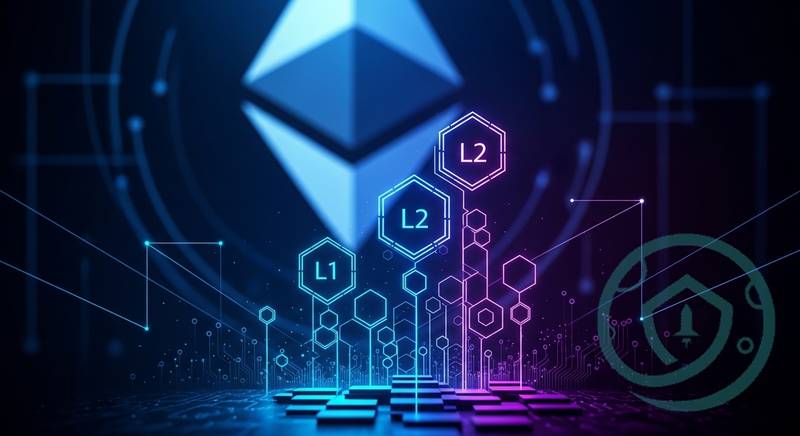
The Ethereum Foundation has published a detailed roadmap outlining its future vision for the Ethereum L1 and L2 ecosystem, reorganizing protocol development into three focused tracks for 2026 and scheduling two major hard forks that target scalability, user experience, and post-quantum security.
The 2026 Protocol Priorities Update, published on February 18, lays out a strategy that shifts Ethereum away from a purely L2-centric scaling approach toward a balanced model where both layers strengthen each other. The Foundation framed the effort around three development tracks: Scale, Improve UX, and Harden the L1.
Ethereum Ecosystem — Key Stat
$40B+
Total Value Locked across Ethereum Layer 2 networks
Source: L2Beat — reflecting the scale of the ecosystem the Ethereum Foundation’s new L1/L2 roadmap aims to unify.
What the Ethereum Foundation’s L1 and L2 Vision Outlines
The Scale track, led by Ansgar Dietrichs, Marius van der Wijden, and Raul Kripalani, targets pushing the gas limit beyond 100 million. Ethereum’s gas limit was raised from 30 million to 60 million in 2025, the first significant increase since 2021. The long-term goal is reaching approximately 10,000 TPS at the L1 level, a benchmark the Foundation labels “Gigagas.”
The Improve UX track, led by Barnabe Monnot and Matt Garnett, focuses on native account abstraction and cross-L2 interoperability. The Foundation’s stated goal is to make every Ethereum wallet a smart contract wallet by default, building on EIP-4337 and EIP-7702. EIP-7702 was already delivered through the Pectra upgrade in May 2025.
The Harden the L1 track, led by Fredrik Svantes, Parithosh Jayanthi, and Thomas Thiery, covers post-quantum readiness, censorship resistance, and what the Foundation calls the “Trillion Dollar Security Initiative.” This track signals awareness that institutional-grade security requirements will grow as Ethereum scales toward larger financial use cases.
Two Hard Forks Scheduled for 2026
The roadmap schedules two major upgrades. Glamsterdam, planned for H1 2026, includes enshrined PBS, blob increases, and parallel execution. Hegota, planned for H2 2026, targets censorship resistance, account abstraction, and post-quantum progress.
These upgrades build on 2025 achievements. The Pectra upgrade in May 2025 delivered EIP-7702, while the Fusaka upgrade in December 2025 implemented PeerDAS with an 8x increase in theoretical blob capacity. Validator balance limits were also raised to 2,048 ETH through Pectra.
A New Platform Team to Unify L1 and L2
A companion post published on February 17 announced the creation of a new Platform team within the Ethereum Foundation. The team’s mandate is to “deliver the strongest possible Ethereum platform, where L1 and L2s are best positioned to support users, apps, and all organizations building on Ethereum.”
The Platform team is organized around three pillars: Protocol Development, Protocol Integration, and Strategy and Tracking, with health metrics and public dashboards. This structure formalizes the Foundation’s commitment to treating L1 and L2 as a “mutually reinforcing system across each layer” rather than separate ecosystems.
What This Means for the Ethereum Ecosystem
The roadmap represents a direct competitive response. Solana and other high-throughput chains currently offer significantly higher native TPS than Ethereum’s roughly 15 to 30 transactions per second at L1. The Gigagas and Teragas targets, aiming for millions of TPS across L2 networks, are Ethereum’s answer to that gap while attempting to maintain decentralization.
The cross-L2 interoperability focus addresses a persistent pain point. Ethereum’s L2 ecosystem, spanning major rollups like Arbitrum, Optimism, Base, and zkSync, has grown rapidly but created a fragmented user experience. The emergence of DeFi platforms across multiple L2s has made seamless cross-chain interactions a practical necessity, not just a theoretical improvement.
The Open Intents Framework, which reached production in 2025, is one early step toward that interoperability. Combined with native account abstraction, the Foundation envisions a future where users interact with Ethereum without needing to know which layer they are on.
Market Context and Community Reaction
ETH traded at $2,141.49 on March 23, 2026, up 2.68% over 24 hours, with a market cap of approximately $233 billion. Despite the technical ambition of the roadmap, the broader market remains under pressure, with the Fear and Greed Index sitting at 11, firmly in “Extreme Fear” territory.
Community reaction to the 2026 roadmap has been broadly positive on technical grounds. The Platform team announcement has drawn particular interest as a signal that the Foundation is taking L1-L2 cohesion more seriously. However, ETH price remains suppressed by macro recession fears and earlier reports of significant ETH sales by Vitalik Buterin.
For developers building on Ethereum or its L2s, the practical takeaways are concrete. Smart contract wallet adoption will accelerate as native account abstraction matures through the Hegota upgrade. Projects relying on fee structures across Ethereum-based platforms should anticipate changes as gas limits increase and blob capacity expands through Glamsterdam.
The Foundation’s roadmap sets specific milestones rather than open-ended aspirations. With Glamsterdam targeting H1 2026 and Hegota targeting H2 2026, the next twelve months will test whether Ethereum can execute on this unified L1-L2 vision while competitors continue to close the gap on market positioning.
Disclaimer: This article is for informational purposes only and does not constitute financial or investment advice. Cryptocurrency and digital asset markets carry significant risk. Always do your own research before making decisions.