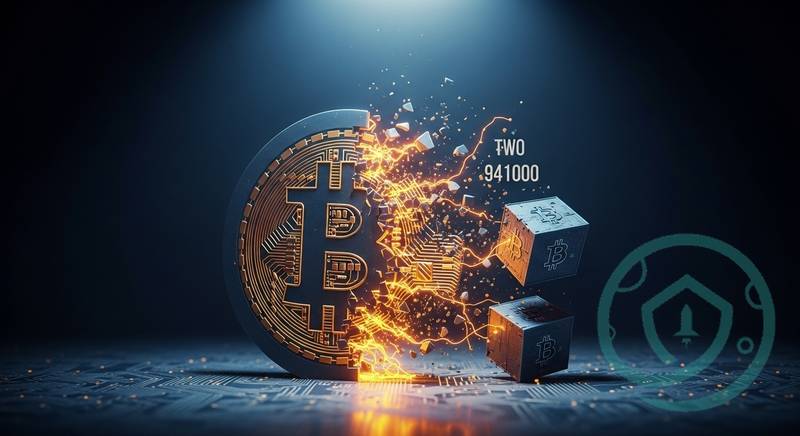
The Bitcoin network experienced a rare two-block reorganization on March 23, 2026, near block height 941,880, after mining pools AntPool and Foundry USA produced competing valid blocks within 12 seconds of each other. Foundry’s chain ultimately prevailed by accumulating more proof-of-work, orphaning blocks from both AntPool and ViaBTC in the process.
How Two Mining Pools Split the Chain at Block 941,880
A blockchain reorganization, or “reorg,” occurs when two miners independently find valid blocks at nearly the same time, temporarily creating two competing versions of the chain. The network resolves this by following the heaviest chain, the one backed by the most cumulative proof-of-work, and discarding the other.
In this case, AntPool mined block 941,881 at 15:49:35 UTC, and Foundry USA mined its own competing version just 12 seconds later at 15:49:47 UTC. Both blocks were valid, but the network had not yet settled on which chain to extend.
2-Block Reorg
Depth of the Bitcoin chain reorganization detected near block height 941,000 — among the deepest reorgs recorded on mainnet in recent years.
ViaBTC then extended AntPool’s chain by mining block 941,882 on top of it, while Foundry extended its own chain in parallel. This created two competing chains, each two blocks deep, a situation far rarer than the single-block forks that occur periodically on Bitcoin.
Foundry resolved the split by mining seven consecutive blocks (941,879 through 941,885), giving its chain decisively more cumulative work. The network converged on Foundry’s version, and the blocks produced by AntPool and ViaBTC became “orphaned,” or stale, earning those miners no block reward for that work.
Bitcoin researcher b10c confirmed the event:
“We just had a rare-ish two block fork/reorg between Foundry and AntPool+ViaBTC. Foundry mined six blocks in a row.”
~941,000
Bitcoin block height at which the two-block reorganization was observed, as reported by U.Today citing on-chain monitoring data.
Single-block reorgs happen a handful of times per year on Bitcoin, but two-block reorgs are substantially rarer. The event coincided with a period of shifting network dynamics: Bitcoin’s mining difficulty had dropped 7.76% on March 22, the second-largest downward adjustment of 2026, and the network hashrate had retreated to approximately 920 EH/s from its 1 zetahash peak reached in 2025.
What This Means for Transaction Finality and Network Security
The immediate practical question is whether any transactions were reversed. In a two-block reorg, transactions included in the orphaned blocks are returned to the mempool and typically re-confirmed in subsequent blocks. No evidence of double-spending has been reported in connection with this event.
This is precisely why exchanges and payment processors require multiple confirmations before crediting deposits. The industry standard of six confirmations exists as a buffer against exactly this type of scenario. A transaction buried under six blocks of proof-of-work would require an attacker to outpace the entire honest network, something that grows exponentially more difficult with each additional confirmation.
Bitcoin’s reorg resistance remains strong by historical standards. While smaller proof-of-work chains have experienced deep reorganizations involving dozens or even hundreds of blocks, Bitcoin’s massive hashrate makes anything beyond a shallow reorg extraordinarily unlikely without controlling a majority of the network’s mining power.
A deliberate deep reorg would require a so-called 51% attack, where a single entity controls more than half the network’s hashrate. At current levels of approximately 920 EH/s, the capital and energy costs of sustaining such an attack make it economically irrational. The miner incentive structure, where honest mining is more profitable than attacking the network, reinforces this security model.
That said, the event highlights a trend worth monitoring. Growing hashrate concentration into fewer large pools increases the probability of competing chains when blocks are found nearly simultaneously. Foundry USA’s run of seven consecutive blocks illustrates how dominant a single pool’s share can become during short time windows.
The broader context adds another layer. Bitcoin was trading near $68,951 at the time of the reorg, while the spot ETF market logged $167 million in net inflows on the same day. The Crypto Fear & Greed Index sat at 10 out of 100, deep in “Extreme Fear” territory, marking 46 consecutive days in that zone, the longest such streak since late 2022.
Mining economics are also under pressure. With Bitcoin’s estimated average production cost around $88,000 per coin and the market price well below that level, many miners are operating at a loss. This financial stress is accelerating consolidation into large, well-capitalized pools like Foundry, the same dynamic that can make simultaneous block discoveries, and the resulting reorgs, more likely.
The reorg is not evidence of a bug, an attack, or a protocol failure. It is Bitcoin’s proof-of-work consensus doing exactly what it was designed to do: resolving temporary chain splits by following the heaviest chain. For users and developers building across blockchain ecosystems, the takeaway is straightforward. Confirmation thresholds exist for a reason, and this event validated their purpose.
The next scheduled Bitcoin difficulty adjustment will reflect whether the hashrate decline that preceded this reorg continues or reverses. Miners, exchanges, and market participants tracking on-chain activity will be watching closely.
Disclaimer: This article is for informational purposes only and does not constitute financial or investment advice. Cryptocurrency and digital asset markets carry significant risk. Always do your own research before making decisions.