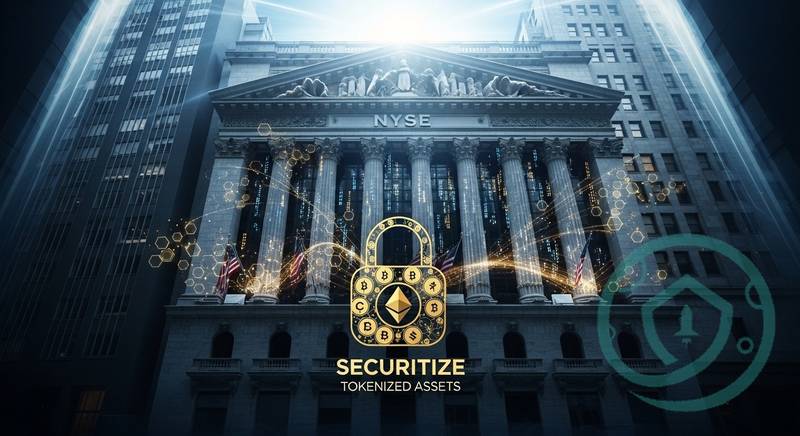
The New York Stock Exchange is developing a tokenized securities platform in partnership with digital asset firm Securitize, a move that would bring round-the-clock trading of blockchain-based assets to the world’s largest equities exchange. The partnership signals a concrete step by Wall Street’s most iconic institution into the infrastructure layer of tokenized finance.
The Wall Street Journal first reported the partnership, which pairs NYSE’s unmatched institutional reach with Securitize’s established tokenization technology. NYSE, operated by Intercontinental Exchange, lists companies with a combined market capitalization of roughly $25 trillion, making this one of the most consequential traditional finance entries into the digital asset space to date.
Securitize is a registered transfer agent and one of the leading platforms for issuing tokenized securities. The firm already powers tokenized funds for major asset managers including BlackRock, Hamilton Lane, and KKR, giving it a track record that few competitors in the space can match.
Key Points
- NYSE and Securitize are co-developing a 24/7 tokenized asset trading venue
- Securitize already powers tokenized funds for major asset managers including BlackRock
- The platform targets real-world assets (RWAs) such as equities, bonds, and fund shares
Inside the NYSE-Securitize Partnership: How 24/7 Tokenized Trading Would Work
Tokenization, in plain terms, means representing ownership of a real-world asset as a token on a blockchain. Instead of clearing a stock trade through layers of intermediaries over one to two business days, a tokenized security can settle in minutes on a distributed ledger, with ownership recorded transparently on-chain.
The platform under development would target real-world assets including equities, bonds, and fund shares. According to an official announcement from Intercontinental Exchange, NYSE is building the infrastructure to support tokenized securities trading that operates beyond traditional market hours.
What Assets Could Be Traded on the Platform
The initial scope appears focused on tokenized versions of traditional financial instruments rather than cryptocurrencies themselves. This includes equity shares, fixed-income products, and fund interests, asset classes that collectively represent trillions of dollars in daily trading volume.
Securitize has been steadily expanding its institutional footprint. The firm reported 841% revenue growth as it prepared to go public through a business combination with Cantor Equity Partners II at a $1.25 billion valuation. That growth trajectory reflects rising institutional demand for tokenization infrastructure, a trend that broader developments in Ethereum’s evolving L1 and L2 ecosystem are also accelerating.
Why NYSE Is Moving Now
The timing aligns with an accelerating wave of institutional interest in tokenized assets through 2025 and into 2026. BlackRock launched its BUIDL tokenized fund on Ethereum, Franklin Templeton has operated an on-chain money market fund, and firms like Ondo Finance have built dedicated tokenization protocols.
NYSE entering the space converts tokenized trading from a crypto-native experiment into a Wall Street product category. For an exchange that has operated since 1792, the move reflects a strategic calculation that blockchain settlement infrastructure is mature enough to underpin regulated securities markets.
Crypto markets already trade around the clock, seven days a week. Traditional equities markets operate roughly 6.5 hours per day, five days a week, totaling approximately 1,638 hours annually. A 24/7 tokenized venue would operate 8,760 hours per year, more than five times the current window, eliminating the overnight gaps and weekend closures that create friction for global investors.
What the NYSE-Securitize Deal Means for Crypto and Real-World Asset Markets
The real-world asset tokenization market has been projected by Boston Consulting Group and other analysts to reach trillions of dollars in assets under management over the coming decade. The NYSE partnership represents perhaps the strongest institutional validation of that thesis to date.
Competing efforts are already underway. BlackRock’s BUIDL fund, Franklin Templeton’s on-chain money market fund, and dedicated platforms like Ondo Finance have each carved out positions. But none carry the brand weight of NYSE, which lends the partnership a unique credibility among traditional finance participants who have remained skeptical of crypto-native platforms. This institutional shift is happening alongside sustained inflows into U.S. Bitcoin spot ETFs, reflecting broader Wall Street engagement with digital assets.
Tokenized securities still fall squarely under SEC jurisdiction, and Securitize’s status as a registered transfer agent positions it to operate within existing regulatory frameworks rather than around them. That compliance-first approach, combined with The Block’s reporting on the platform’s development, suggests the partnership is designed to work with regulators rather than challenge them.
How This Affects Retail Crypto Investors
For retail participants in crypto markets, the NYSE-Securitize partnership could eventually bridge the gap between digital asset portfolios and traditional securities. Tokenized equities trading on blockchain rails could theoretically be held in the same wallets and platforms as cryptocurrencies, creating a unified investment experience.
The more immediate effect is narrative. When the world’s largest stock exchange builds on tokenization infrastructure, it reinforces the legitimacy of blockchain technology as financial plumbing, not just speculative assets. That institutional confidence has historically correlated with broader market strength, as evidenced by price reactions to milestones like key Bitcoin network events that draw institutional attention.
The Road Ahead: Timeline and Hurdles
The partnership is a development initiative, not a finished product. Regulatory approval from the SEC will be required before tokenized securities can trade on any NYSE-affiliated platform. The technical build-out of integrating blockchain settlement with NYSE’s existing infrastructure represents a significant engineering challenge.
Securitize’s planned public listing through its $1.25 billion SPAC combination with Cantor Equity Partners II could provide additional capital and public market accountability as it scales infrastructure to meet NYSE’s requirements.
No official launch date has been announced. The competitive landscape is moving quickly, with multiple institutional players racing to establish tokenized trading venues. NYSE’s entry raises the stakes for every participant in the RWA tokenization space, and the coming months will determine whether this partnership sets the standard for how traditional securities migrate to blockchain rails.
Disclaimer: This article is for informational purposes only and does not constitute financial or investment advice. Cryptocurrency and digital asset markets carry significant risk. Always do your own research before making decisions.