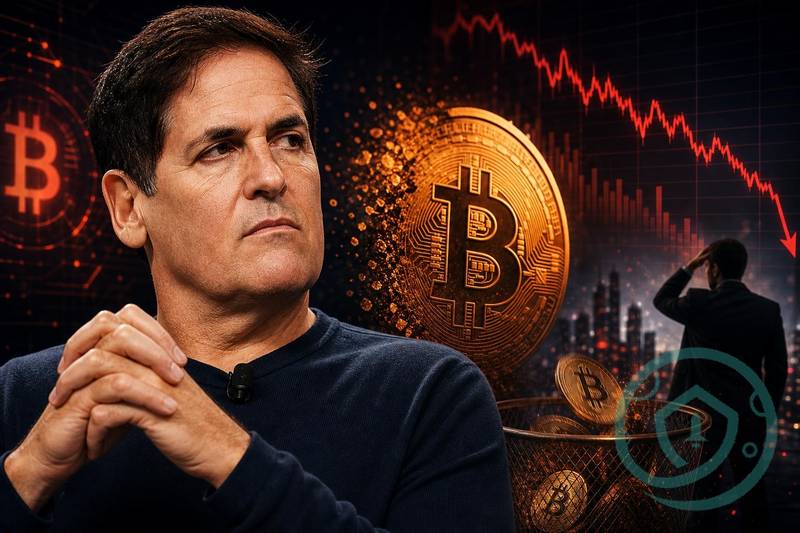
Billionaire investor Mark Cuban has revealed that he sold most of his Bitcoin holdings after concluding that the cryptocurrency failed to function as a hedge, adding a high-profile voice to the ongoing debate over BTC’s role in diversified portfolios.
Cuban’s comments, made during a recent interview, centered on his expectation that Bitcoin would act as a protective asset during periods of geopolitical uncertainty. When it did not perform that way in practice, he decided to reduce his exposure significantly.
Why Mark Cuban Says He Sold Most of His Bitcoin
KEY POINTS
- Mark Cuban said he sold most of his Bitcoin after it failed to act as a hedge during geopolitical stress.
- The move challenges Bitcoin’s widely promoted narrative as a store-of-value or “digital gold” asset.
- Cuban’s decision reflects actual portfolio action, not just commentary, giving the statement added weight.
The core of Cuban’s argument is that Bitcoin did not behave like a safe-haven asset when global tensions escalated. For years, Bitcoin advocates have positioned BTC as a hedge against inflation, currency debasement, and geopolitical risk, often drawing comparisons to gold.
Cuban’s experience contradicted that thesis. Rather than holding steady or appreciating during periods of stress, Bitcoin moved in ways that did not offer the downside protection he expected. Reporting from StockTwits noted that Cuban specifically framed his critique around Bitcoin’s failure as a war hedge, even as some data suggested BTC outperformed gold over certain timeframes.
That distinction matters. Cuban was not making a blanket claim that Bitcoin is a bad investment. He was saying it did not do the specific job he bought it to do: protect capital during turmoil.
What Cuban’s Bitcoin Exit Signals for the Hedge Debate
Bitcoin’s identity as “digital gold” has been one of the most persistent narratives in crypto markets. Institutional marketing materials, ETF pitches, and macro commentators have all leaned on the idea that BTC belongs in a portfolio as an uncorrelated or counter-cyclical asset.
Cuban’s sell decision complicates that framing. Unlike casual social media opinions, his statement reflects a portfolio action taken by an investor with significant capital at stake. When someone with Cuban’s profile acts on a thesis failure, it carries more weight than a tweet.
The Gap Between Narrative and Behavior
The hedge debate is not new, but it has grown more nuanced as Bitcoin has matured. BTC has at times traded in lockstep with risk assets like tech stocks, particularly during liquidity-driven selloffs. At other times it has diverged sharply from equities.
This inconsistency is precisely what Cuban appears to have reacted to. A hedge that only works intermittently is not a hedge in the traditional portfolio construction sense. For investors who entered Bitcoin specifically for its hedging properties, rather than for long-term appreciation or ideological reasons, that inconsistency is a dealbreaker.
The broader conversation around Bitcoin’s role in portfolios continues to evolve as institutional adoption grows. Developments in areas like stablecoin infrastructure and real-world asset tokenization in DeFi are reshaping how digital assets fit into traditional finance, but the fundamental question Cuban raised remains unresolved.
Investor Takeaway
Cuban’s position does not invalidate Bitcoin as an asset class. It does, however, underscore that the reason an investor buys Bitcoin matters as much as the decision to buy it. Those holding BTC as a long-term asymmetric bet may view volatility differently than those who expected it to behave like Treasury bonds or gold during a crisis.
As recent market data reports continue to show, crypto markets remain structurally different from traditional asset classes in their volatility profiles and correlation patterns. Cuban’s decision is a reminder that those differences cut both ways.
Additional source references: source document 1.
Disclaimer: This article is for informational purposes only and does not constitute financial or investment advice. Cryptocurrency and digital asset markets carry significant risk. Always do your own research before making decisions.