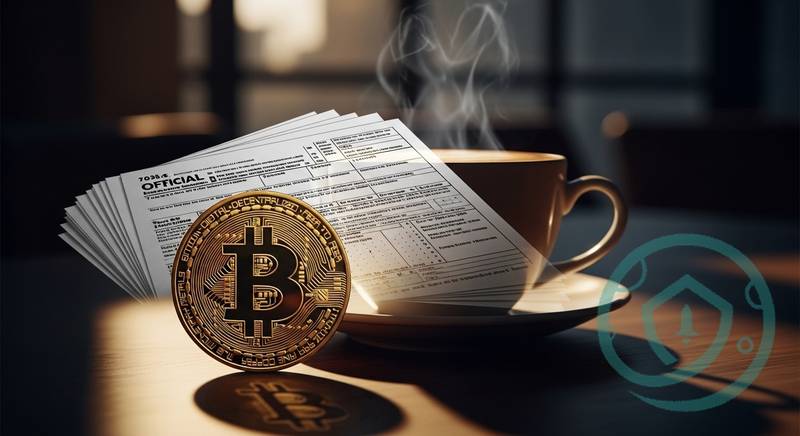
A report says buying coffee with Bitcoin every day in the United States could leave consumers facing more than 70 pages of tax paperwork, highlighting how federal tax treatment still makes routine BTC spending look more like asset disposal than cash-like payments. The friction comes from repeated small transactions, not from one large trade.
In an April 15, 2026 Cato Institute post, Nicholas Anthony wrote that a daily bitcoin coffee habit could generate over 100 pages of tax filings overall, including around 70 pages for Form 8949 alone. Because that post uses two different totals and does not publish the underlying worksheet, the figure is best read as a single-source estimate of burden rather than a reproduced filing model.
Key Points
- A Cato Institute analysis said daily bitcoin coffee purchases can create extensive paperwork because each spend may count as a taxable disposal.
- The IRS says virtual currency is treated as property for federal tax purposes, with most reportable transactions flowing through Form 8949 and Schedule D.
- Bitcoin Policy Institute says lawmakers are debating a de minimis exemption aimed at small purchases rather than large investment sales.
Why a Daily Bitcoin Coffee Habit Could Trigger So Much Tax Paperwork
The compliance problem starts with IRS Notice 2014-21, which says virtual currency is treated as property for federal tax purposes. That means spending bitcoin on coffee can realize a capital gain or loss even when the user never converts back into dollars.
The IRS says most sales and other capital transactions involving virtual currency belong on Form 8949 and are then summarized on Schedule D. The same IRS guidance says taxpayers should maintain records for each unit of virtual currency, including acquisition time, basis, disposal time, fair market value, and proceeds.
IRS Recordkeeping Checklist
- When each unit was acquired
- Its tax basis and fair market value
- When it was spent and what proceeds were received
Bitcoin Policy Institute illustrated the problem with a $4 latte purchased with bitcoin that had appreciated by 6 cents. Even that tiny gain still falls into the same tax framework as a much larger capital transaction, which is why repeated retail spending can snowball into a paperwork issue.
The complaint has also become a political talking point. Michael Saylor highlighted a 2024 post on X that echoed the same objection, asking why a bitcoin coffee purchase should trigger capital-gains tax treatment at all.
"They have them paying tax on crypto and I don't think that's right. #Bitcoin is money and you have to pay capital gains tax if you use it to buy a coffee? I was talking with a friend he said 'it really shouldn't be taxed' and I agree.” – @realDonaldTrump
— Michael Saylor (@saylor) October 30, 2024
What This Means for Bitcoin Payments and Crypto Adoption in the US
The practical effect is that passive exposure is easier than day-to-day use. Even as U.S. spot Bitcoin ETFs added $186M on April 15 as BlackRock IBIT led, consumers who try to spend BTC directly may still create a taxable event with each purchase.
That gap matters for adoption because the burden is administrative, not technical. The IRS guidance on basis tracking and disposal reporting means bitcoin works poorly as a seamless payment rail for ordinary U.S. consumers and merchants when every retail spend can require its own tax record.
The issue also sits beside other crypto market-structure frictions already shaping user behavior, including market maker disclosure falling to 0%, Novora says and token-specific events like BNB’s 35th quarterly burn destroying 1.57M tokens. Anthony’s point is different, because it focuses on a federal reporting rule that wallet design or merchant demand cannot easily bypass.
Outlook Depends on a Small-Transaction Tax Exemption
Policy advocates are pushing a narrower fix rather than a wholesale rewrite of crypto tax law. Bitcoin Policy Institute said Senator Cynthia Lummis filed a standalone de minimis bill with a $300 per-transaction threshold and a $5,000 annual cap aimed at exempting small purchases.
Until a carve-out like that becomes law, the data cited by Cato and the IRS recordkeeping checklist point in the same direction: spending bitcoin in the U.S. can be technologically simple, but tax compliance can still be heavy enough to discourage everyday use.
Disclaimer: This content is for informational purposes only and is not financial or tax advice.
Disclaimer: This article is for informational purposes only and does not constitute financial or investment advice. Cryptocurrency and digital asset markets carry significant risk. Always do your own research before making decisions.