DOJ Charges Google Engineer Over Alleged .2M Polymarket Insider Trading Thumbnail
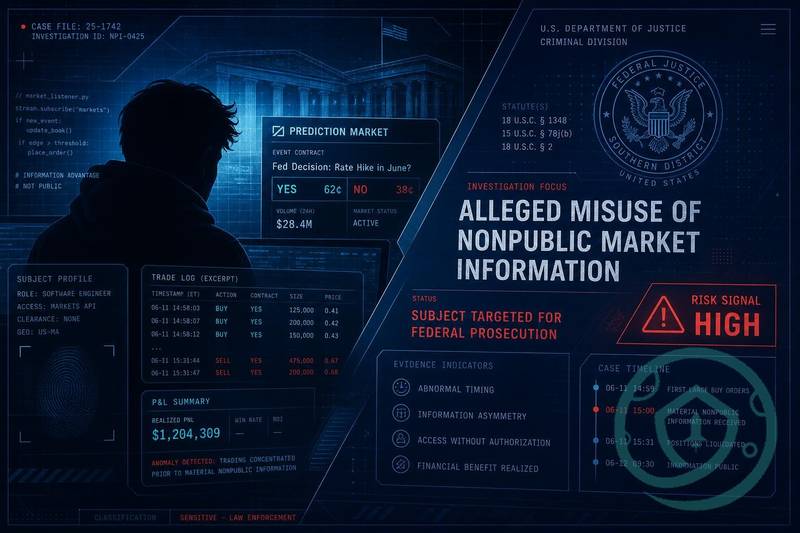
The U.S. Department of Justice has charged Google software engineer Michele Spagnuolo with commodities fraud, wire fraud, and money laundering over allegations that he used nonpublic information to earn approximately $1.2 million trading on Polymarket, the blockchain-based prediction platform.
What the DOJ alleges in the Google engineer Polymarket case
Key Points
- Federal prosecutors allege a Google engineer traded on insider knowledge of the company’s Year in Search 2025 results, netting roughly $1.2 million on Polymarket.
- The CFTC filed a parallel civil action on the same day, seeking restitution, disgorgement, and trading bans.
- Google placed the employee on leave, while Polymarket said it cooperated with investigators.
The criminal complaint, unsealed on May 27, 2026 by the Southern District of New York, identifies Spagnuolo by the Polymarket handle “AlphaRaccoon.” Prosecutors allege that between approximately October 15, 2025 and December 4, 2025, the account risked approximately $2,754,092 across roughly 25 Google Year in Search 2025 outcome contracts.
Soon after Google publicly released the Year in Search rankings on December 4, 2025, the AlphaRaccoon account allegedly profited approximately $1.2 million.
The complaint details specific wagers: approximately $937,688 on the NO side of Bianca Censori being the top searched person, roughly $613,587 against Pope Leo XIV holding that spot, and about $509,149 against Donald Trump. Google’s published Year in Search 2025 page ultimately listed d4vd as the No. 1 trending person, with Pope Leo XIV at No. 5 and Bianca Censori at No. 8, confirming that none of those figures took the top position.
The wager structure suggests the account holder knew which public figures would not rank first, an edge prosecutors describe as unusually asymmetric. The specific NO-side bets aligned precisely with the final results Google later published.
Dual enforcement and what it signals for prediction markets
The CFTC filed a parallel civil complaint on the same day, seeking restitution, disgorgement, civil monetary penalties, trading and registration bans, and a permanent injunction. The agency described the activity as spanning at least twenty-three contracts.
“Today’s action further underscores our commitment to rooting out insider trading and promoting market integrity in prediction markets.”
— Michael S. Selig, CFTC statement
The coordinated criminal and civil actions signal that U.S. authorities are treating prediction-market trading based on corporate nonpublic information as insider trading subject to commodities-fraud enforcement, not as a regulatory gray area unique to crypto platforms. For an industry already navigating questions around legislative clarity and regulatory boundaries, the case sets a concrete precedent.
Google said it placed the employee on leave. Polymarket said it worked closely with prosecutors and the CFTC throughout the investigation.
“Blockchain trading is transparent, traceable, and bad actors leave footprints.”
— Polymarket spokesperson, via TechCrunch
Polymarket’s response highlights a tension at the heart of blockchain-based markets: the same on-chain transparency that enabled investigators to trace the alleged trades also makes these platforms attractive to regulators building enforcement cases. That traceability could become a selling point for platforms seeking to demonstrate compliance readiness to global regulators.
The case also raises questions about information barriers at major technology companies. Google’s Year in Search data, while eventually public, carries significant predictive value on platforms like Polymarket before release. Whether other tech firms with similar consumer data products will tighten internal access controls remains an open question, particularly as prediction markets and trading platforms continue to grow.
Readers tracking this case should watch for the outcome of Spagnuolo’s initial court appearance, any response from his legal counsel, and whether the CFTC’s civil action yields additional details about how the alleged trades were structured and settled on-chain.
Disclaimer: This article is for informational purposes only and does not constitute financial or investment advice. Cryptocurrency and digital asset markets carry significant risk. Always do your own research before making decisions.