
The Ethereum Foundation said it is working with security firms to make smart contract audits more accessible for teams bringing new applications to Ethereum, a move that supports the market narrative around an Ethereum Audit Subsidy while leaving the exact standalone program name only partially verified in the recovered primary evidence.
Key Points
- An April 14, 2026 Ethereum Foundation post tied the audit-access effort to the Trillion Dollar Security Initiative and named Areta, Nethermind, and Chainlink Labs.
- security.xyz says eligible ecosystem teams can receive 10+ audit quotes per project and may qualify for up to 100% audit subsidy.
- A single secondary report used the exact label “Ethereum Audit Subsidy Program,” but the recovered official post did not show that standalone wording.
What the Ethereum Foundation Actually Confirmed
In an April 14, 2026 post, the Ethereum Foundation said that alongside Areta, Nethermind, and Chainlink Labs, its Trillion Dollar Security Initiative reviews applications to make audits accessible to builders bringing CROPS and new use cases to Ethereum.
That framing matters because the Foundation’s May 14, 2025 Trillion Dollar Security Initiative announcement positioned Ethereum security as a long-term effort to harden the network for higher-value applications, not simply a one-off grant program.
This is also a verification issue, not just a branding issue. A single secondary summary described the rollout as the “Ethereum Audit Subsidy Program,” but the safer reading from the recovered primary post is an audit-access initiative operating under the Trillion Dollar Security Initiative until a fuller official thread or policy page appears.
The Foundation’s post is the core proof point for the news, so it is worth seeing in its original form before drawing bigger conclusions about scope or branding.
2/ Alongside @areta_io, @nethermind, and @chainlinklabs, EF's Trillion Dollar Security Initiative reviews applications to make audits accessible to builders bringing CROPS and new uses cases to Ethereum.
— Ethereum Foundation (@ethereumfndn) April 14, 2026
The Foundation post and the Trillion Dollar Security Initiative framing show this is not a regulator action or a protocol upgrade. It is an ecosystem support measure aimed at lowering one of the biggest pre-launch costs for teams shipping contracts on Ethereum, especially as more user-facing products and AI-agent privacy and payment systems move closer to production.
How the Audit Subsidy Appears to Work for Builders
security.xyz shows the operational layer behind the announcement: a team can submit a project, collect 10+ audit quotes, and, if it is building within an ecosystem grant, may qualify for up to 100% audit subsidy.
Who may qualify
The eligibility language points most directly at builders already inside ecosystem grant programs, which means the subsidy is less about retroactively rewarding mature apps and more about getting earlier-stage teams to independent review before mainnet deployment.
The same marketplace says it supports audits for Ethereum, Base, Bera, Polygon, Arbitrum, Optimism, Solana, and more, suggesting that the Ethereum Foundation is plugging into an existing procurement rail rather than inventing a bespoke audit marketplace from scratch.
Why this matters for Ethereum security
Because the marketplace advertises 10+ quotes and potential up to 100% subsidy, the practical effect is easier price discovery and less upfront cash burden for teams that might otherwise skip external review. That becomes more relevant as end-user surfaces expand, including products like self-custodial wallets, where contract failures are harder to absorb after launch.
That cost-reduction argument was already circulating before the Foundation’s post. In a February 12, 2026 discussion, Runtime Verification argued that first audits do not have to cost $50,000 and pointed builders toward subsidy marketplaces such as Areta and security.xyz, adding that Ethereum Foundation support was coming soon.
— Runtime Vеrification (@rv_inc) February 12, 2026
A live Base-branded deployment makes that operating model more concrete by showing Base Foundation branding and a $2,500 grant-applied example, evidence that the subsidy rail already exists as a working marketplace flow rather than a slide-deck concept.
The Base-branded deployment and the security.xyz workflow also help explain why the announcement matters beyond Ethereum marketing. As more institutional rails, including exchange and settlement partnerships, push crypto deeper into mainstream finance, security review becomes part of infrastructure quality, not just developer hygiene.
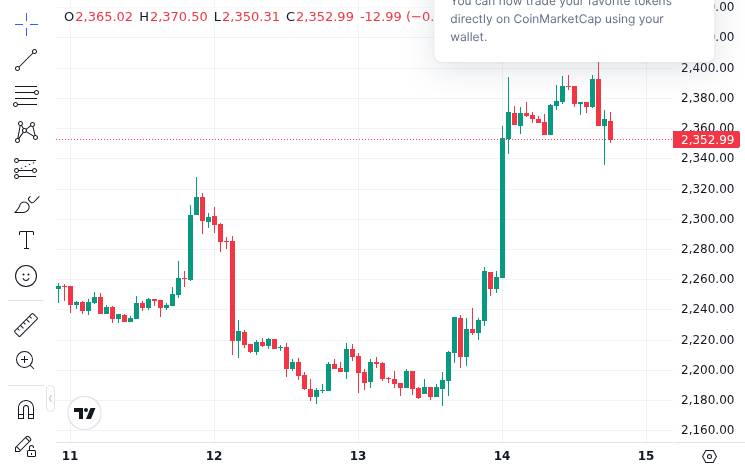
Ethereum’s broader market backdrop was still mixed while the security story developed, with ETH trading near $2,362.45 and carrying roughly $285.17 billion in market cap, a reminder that ecosystem hardening is advancing even while risk appetite remains uneven.
Outlook
The next useful confirmation would be a fuller Ethereum Foundation post or policy page that states the exact program name and spells out application criteria. Until then, the strongest confirmed facts are the partner list, the Trillion Dollar Security Initiative framing, and the live marketplace mechanics visible on security.xyz.
For builders, that still amounts to a meaningful change. If Ethereum teams can actually combine 10+ quotes with potential subsidized audit coverage, the network could see more contracts reviewed before launch, a benefit that matters for DeFi, wallets, and AI-linked applications alike.
Disclaimer: This article is for informational purposes only and does not constitute financial or investment advice. Cryptocurrency and digital asset markets carry significant risk. Always do your own research before making decisions.