
Core Foundation and Z Protocol announced a partnership on March 31, 2026, to build a programmable privacy platform powered by Zcash and secured by a Zcash-based implementation of the Satoshi Plus consensus mechanism. The deal positions Z Protocol as what secondary reporting has called a "franchise" of Core's consensus model, with an expected launch in Q2 2026.
What Core Foundation and Z Protocol Announced
The partnership centers on adapting Core's Satoshi Plus consensus mechanism for a Zcash-native environment. Z Protocol describes itself as a programmable privacy platform that will combine ZEC miners, ZEC holders, and Z token stakers to secure the network, according to the official announcement.
The platform plans to launch with an initial product suite covering private trading, lending, stablecoin issuance, yield generation, and staking. Z aims to bring programmable smart contract capabilities to the Zcash ecosystem, a chain that has historically lacked DeFi infrastructure comparable to Ethereum or its Layer 2s.
Core currently has over $150 million in BTC staked on its network. That existing validator base provides the reference model Z Protocol intends to replicate with Zcash-native participants.
Brendon Sedo, a Core Foundation contributor, framed the partnership as part of a broader monetization strategy.
"Core's Revenue Roadmap centers on powering revenue-generating systems."
— Brendon Sedo, Core Foundation contributor (source)
Why the Partnership Matters for Core, Zcash, and CORE Holders
The structural details extend beyond a standard cross-chain integration. The Block reported that the deal includes a licensing agreement under which a portion of Z Protocol's transaction fees will flow back to Core. CORE token holders would also receive preferential access to Z tokens, including planned airdrops.
That fee-sharing model creates a recurring revenue channel tied to Z Protocol's on-chain activity. It gives CORE holders a financial stake in the privacy platform's adoption, a structure that resembles the token launch models discussed at EthCC earlier this year but applied at the consensus layer rather than the application layer.
Kieran Dennis, a Z Protocol contributor, described the project's technical ambition directly.
"Z represents the first attempt to bring native EVM capabilities to Zcash."
— Kieran Dennis, Z Protocol contributor (source)
If successful, Z would allow developers to deploy Ethereum-compatible smart contracts on a privacy-focused chain. That combination could appeal to DeFi applications requiring confidential execution, as well as emerging AI-agent transaction use cases where on-chain privacy is a prerequisite rather than a feature.
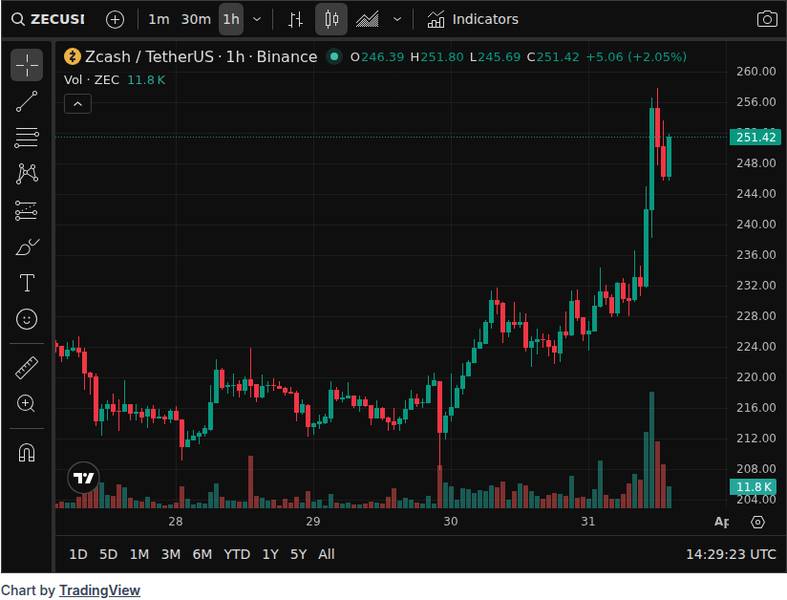
Zcash itself trades at roughly $248.35 with a market cap of approximately $4.11 billion and 24-hour trading volume near $435.2 million. That market footprint gives Z Protocol a sizable base ecosystem to build on, though the platform itself has no live metrics yet.
According to a single source, Z Protocol has been described as Core's first "franchise protocol," though that specific framing did not appear in the official press release. The franchise label, if accurate, would signal a new expansion model for Layer 1 consensus mechanisms where proven security architectures are licensed to purpose-built chains rather than forked or rebuilt from scratch. As blockchain conferences have increasingly explored, modular consensus design is becoming a competitive differentiator.
The Q2 2026 launch window will be the first test of whether Satoshi Plus can generate meaningful adoption and fee revenue outside its original Bitcoin-secured environment.
Disclaimer: This article is for informational purposes only and does not constitute financial or investment advice. Cryptocurrency and digital asset markets carry significant risk. Always do your own research before making decisions.