
Token launch failures are taking center stage at EthCC today, where 21Shares researcher Darius Moukhtarzade is scheduled to present a session titled "Why Token Launches Fail — and How to Get Them Right in 2026," amid growing evidence that the vast majority of newly issued tokens fail to sustain any meaningful trading activity.
What EthCC and 21Shares Actually Confirmed
The EthCC speaker page lists Moukhtarzade's session for March 31, 2026, running from 10:50 to 11:10. The official session description states that token launches are failing at record rates and frames the talk around why tokens underperform and how token-economy design can improve outcomes.
It is worth noting that the "record rates" language comes from the conference abstract, not from a published 21Shares research report or dataset. No slide deck, transcript, or methodology behind that claim was publicly available at the time of writing. The session may provide those details, but the underlying data has not yet been independently verified.
The topic echoes concerns raised at other recent industry gatherings. The Blockchain Futurist Conference returning to Toronto for its ninth year has similarly spotlighted token sustainability as a recurring theme across panels and workshops.
Why Token Launch Failures Matter for 2026 Issuers
Independent data supports the broader concern Moukhtarzade's session addresses, even without the specific 21Shares methodology. Chainalysis reported that more than 2 million tokens were launched in 2024, with roughly 0.87 million, or 42.35%, ever listing on a decentralized exchange.
The survivorship numbers are starker. Of those 2 million tokens, only 1.7% had been actively traded in the 30 days prior to the Chainalysis analysis. That means more than 98% of tokens launched in 2024 were effectively dormant within months of issuance.
Manipulation compounds the problem. Chainalysis found that approximately 94% of DEX pools involved in suspected pump-and-dump schemes appeared to be rugged by the same address that created the pool. These figures do not come from 21Shares and do not independently prove a new "record" failure rate, but they paint a consistent picture of a market where most token launches end in abandonment or fraud.
For projects building in the AI-crypto space, including AI-agent tokens, decentralized compute networks, and data marketplaces, weak launch mechanics pose the same risks. A poorly designed token economy can undermine an otherwise viable protocol, regardless of the underlying technology. The recent wave of prediction market launches on platforms like Binance Wallet illustrates how new token categories still depend on sound issuance frameworks to retain participants.
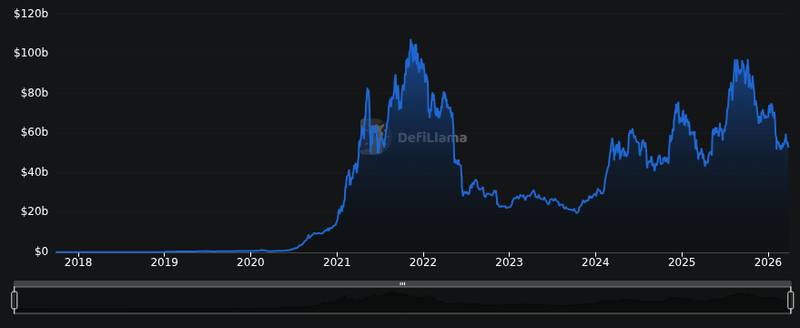
Ethereum remains the primary venue for much of this launch activity. DeFiLlama currently shows Ethereum total value locked at roughly $107.56 billion, underscoring the scale of the ecosystem in which these token launches succeed or fail.
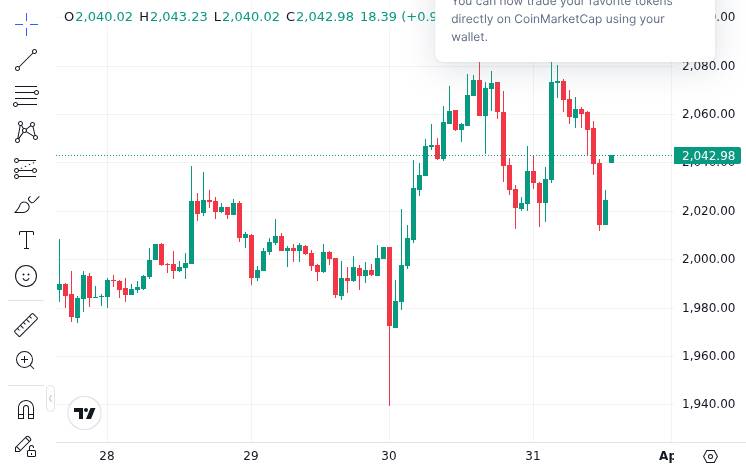
ETH itself traded at $2,039.99 at press time, with a market cap of approximately $245.94 billion and 24-hour trading volume near $17.44 billion. The token was down roughly 1.4% over the prior 24 hours, part of a broader pullback that also saw Bitcoin and Ethereum ETFs post $296 million in net outflows during the week of March 23 to 27.
Moukhtarzade's session promises a framework for better token-economy design. Whether 21Shares releases the underlying dataset publicly after the talk will determine if the "record levels" claim can be independently evaluated. For now, the Chainalysis evidence confirms the direction: the overwhelming majority of token launches fail, and the 2026 issuance cycle has yet to show structural improvement.
Disclaimer: This article is for informational purposes only and does not constitute financial or investment advice. Cryptocurrency and digital asset markets carry significant risk. Always do your own research before making decisions.