Psy Protocol: Documented Portal Walkthrough of PARTH, Wallets and Psychonaut Points
NewsPsy Protocol review: PARTH parallel ZK-rollup design, MCP AI agent wallets, the Psychonaut points program, testnet steps we tried and the risks to weigh.


Author: Web3 Quantitative Research & Ecosystem Strategy Group
Target Protocol: Psy Protocol (@PsyProtocol| formerly QED Protocol | psy.xyz | psy.xyz/psychonaut | wallet-stg.psy-protocol.xyz | psy.xyz/developers | github.com/QEDProtocol)
Core Category: Psy-documented Layer 1, PARTH, local proving, and MCP wallet claims
Screenshot Observation Date: 16 November 2026
Screenshot-Displayed Psychonaut Details:
: Registered Psychonaut Tier:Level 0: Cadet(Progress:0/100 Points, Active Referrals:0/1)
: Official Referral Code:V3ND89CY
: Direct Invitation Link:https://psy.xyz/psychonaut?icode=V3ND89CY
Disclosure: This article includes a referral link. It is not disclosed whether use of the link generates points, compensation, or any other benefit for the author or publisher; readers should not assume that it does not.
: Official Wallet Framework: Psy Browser Extension (Manifest V3) & Native MCP Agent Wallet Runtime
: Open-Source Repositories: 39 active repos (plonky2.5,poseidon2-webgpu-demo)
Executive Summary & Protocol Overview
Attribution and scope: This is a screenshot-based documented portal guide, not a product test, technical review, or independent verdict. Unless explicitly identified as a screenshot observation, every description of Psy’s architecture, wallets, privacy, attestations, points, allocations, funding, performance, or participation outcomes is a Psy-documented or Psy-announced claim that has not been independently verified. Navigation steps reproduce portal prompts and are not evidence that an action was completed or that points, allocations, access, or other outcomes will result. No wallet, transaction, proving, MCP, fee, code-audit, or alternative-comparison test case was completed.
Psy Protocol (originally established as QED Protocol) is a Layer 1 protocol. Psy documentation describes PARTH and local zero-knowledge proving. This portal walkthrough does not independently verify these claims.
Psy documentation presents its approach as decoupling execution from consensus through the following claimed components, which this walkthrough has not independently verified:
- PARTH (Parallel Ascending Recursive Tree Hierarchy): Psy documentation describes independent Merkle-tree account states and parallel validation.
- Proof of Useful Work (PoW 2.0 / PoUW): Psy documentation describes miners generating and aggregating recursive zero-knowledge proofs (ZK-SNARKs).
- Local Proving & Software-Defined Keys (SDKeys): Psy documentation describes client-side proving using WebGPU hardware acceleration and broadcasts of proofs and encrypted state deltas.
Psy-Reported Positioning (5 Documented Claims)
The following summarizes Psy-reported positioning and documentation claims; it is not an independently assessed advantages analysis.
1. $9.0M Institutional Pedigree (Blockchain Capital & Arrington Capital)
Psy reports $9M in financing from Blockchain Capital and Arrington Capital. This walkthrough does not independently verify the funding or draw conclusions about Psy's cryptographic rigor.
2. Protocol-Reported PARTH Performance Claim
Psy makes performance claims for its PARTH architecture. This walkthrough does not independently assess or compare those claims, and no benchmark methodology, test environment, workload, comparison basis, or reproducibility information is provided here.
3. Psy-Documented Client-Side Proving and Privacy Design
Psy documentation describes transactions as proven locally via WebGPU compute shaders (poseidon2-webgpu-demo) and broadcasts of mathematical proofs and encrypted state deltas. This walkthrough has not independently tested what balances, counterparties, amounts, metadata, network-layer information, or MEV vectors may remain observable.
4. Built for Autonomous AI Agents (Native MCP Wallet Runtime)
Psy documentation describes Software-Defined Keys (SDKeys) and a native Model Context Protocol (MCP) Wallet through which developers can issue time-limited, policy-restricted execution tokens to AI agents (Claude Code, Cursor, Codex) for on-chain operations while keeping private keys in the user's local keystore.
5. 100% Free Sweat-Equity Community Positioning
Psy presents the Psychonaut Incubation Program as a 100% free model with zero token purchases, zero gas expenses, and zero capital lockups required to qualify. Psy documentation describes Psychonaut Points as accruing through community advocacy, social quests, and staging testnet exploration (wallet-stg.psy-protocol.xyz).
Screenshot-Based Portal Walkthrough (No Completed Test Cases)
The 8 steps below describe portal pages and interface elements shown in the screenshots, including a Psychonaut profile displaying Level 0: Cadet and referral code V3ND89CY. They are instructions and observations, not evidence that the listed wallet, proving, transaction, or agent actions were completed.
Step 1: Accessing the Psychonaut Incubation Command Center (psy.xyz/psychonaut)
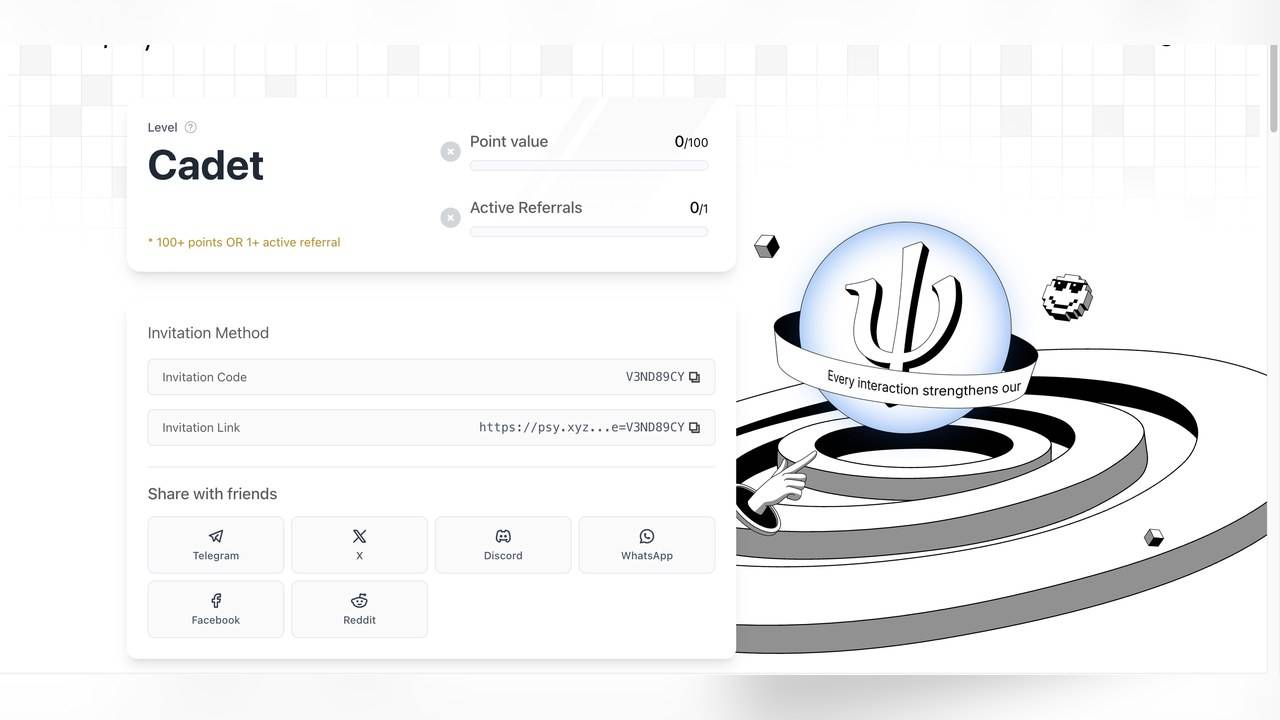
What you see: The official Psychonaut Incubation dashboard displaying active membership at Level 0: Cadet, point threshold progression Point value: 0/100, active referral progress 0/1, clear advancement criteria ('100+ points OR 1+ active referral to advance to the next level'), the user's authentic Invitation Code V3ND89CY, custom Invitation Link https://psy.xyz/psychonaut?icode=V3ND89CY, and top navigation tabs (Activities, My Records, Leaderboard, Manifesto, Rule, On-boarding Guide).
Why do this?
Accessing the Psychonaut dashboard is the mandatory genesis step for community participants. Registering your profile establishes your persistent cryptographic identity within Psy's off-chain attribution engine, linking your social accounts to your future on-chain testnet wallet address.
Architectural Context / Key Concept / Security Warning:
The Psychonaut Incubation Program utilizes a tiered rank matrix (Cadet → Specialist → Visionary) designed to reward long-term, organic advocacy while penalizing automated sybil bots. Advancing past Level 0 requires earning 100 points through verified social quests or securing at least 1 active referral, establishing a quality barrier for token conversion weighting.
How to execute:
- Navigate to
psy.xyz/psychonaut?icode=RZ1FB3E5. - Authenticate using your primary Web3 wallet, Google, or verified email address.
- Set your unique Psychonaut handle.
- Verify your dashboard status confirms initialization at
Level 0: Cadetand copy your Invitation CodeV3ND89CY.
Key Metrics & Best Practices / Checklist:
- Initial Rank: Level 0 (Cadet).
- Next Level Threshold: 100 Points OR 1 Active Referral.
- Referral Code:
V3ND89CY. - Cost: $0.00 (Completely free participation).
Step 2: Completing Psychonaut Quests & Social Verification Missions (psy.xyz/psychonaut/activity)
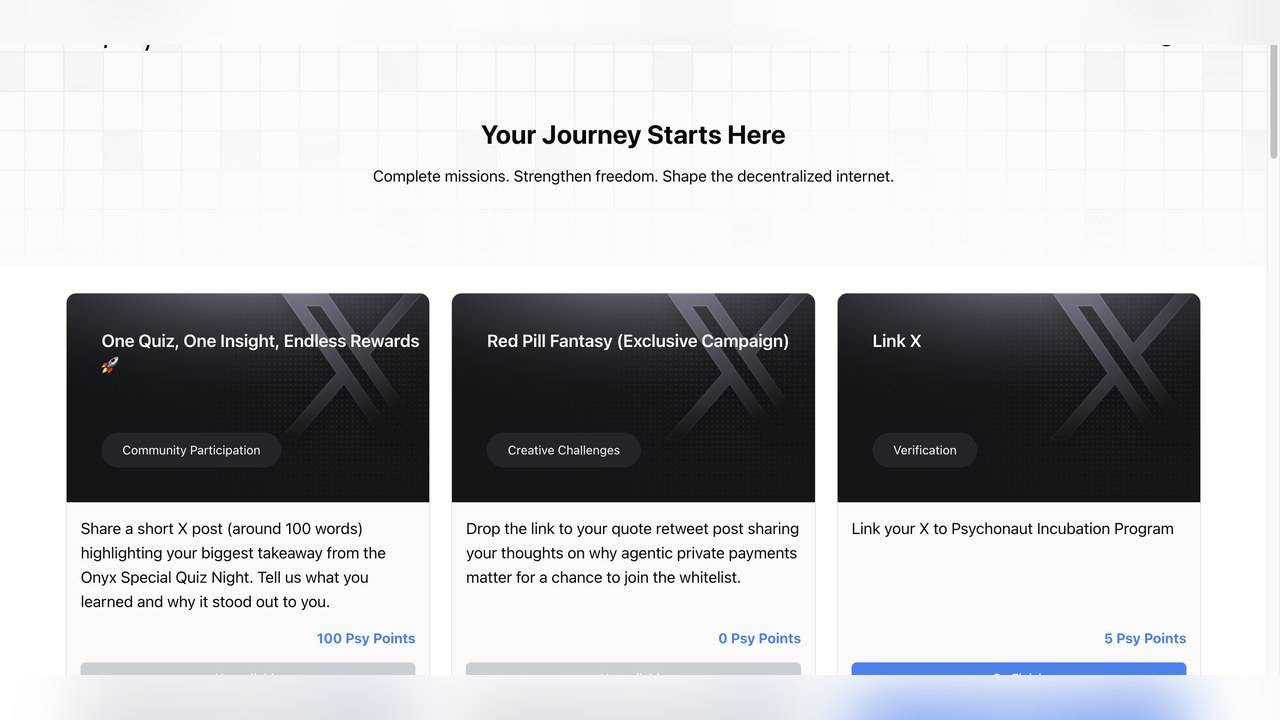
What you see: The official Psychonaut Activities command center under the headline 'Your Journey Starts Here: Complete missions. Strengthen freedom. Shape the decentralized internet.' Featured mission tiles display available bounties: 'Link X' (Link your X to Psychonaut Incubation Program for 5 Psy Points, with an active 'Go Finish' button), 'One Quiz, One Insight, Endless Rewards' (100 Psy Points bounty for community insights), and exclusive campaigns ('Red Pill Fantasy' Whitelist Quest), categorized across Community Participation, Creative Challenges, and Verification.
Why do this?
Engaging in Psychonaut activities and completing social verification tasks is the primary direct mechanism for accumulating Psy Points. Advancing beyond Level 0 Cadet requires crossing the 100-point threshold or securing active referrals; completing designated bounties (such as the 100-point Quiz Insight quest or linking your X profile for 5 points) directly propels your rank toward Specialist and Visionary tiers.
Architectural Context / Key Concept / Security Warning:
Psy Protocol utilizes an off-chain attestation engine that periodically snapshots completed social actions and binds them cryptographically to your user session. This sybil-resistant verification pipeline ensures only authentic community contributors receive high-tier testnet whitelisting and future governance weight. Ensure all quote-retweets and social submissions originate from the exact accounts linked in your Psychonaut profile.
How to execute:
- Navigate to the Psychonaut Activities portal at
psy.xyz/psychonaut/activity. - Locate the
Link Xtask tile and clickGo Finishto bind your X account and claim your first 5 Psy Points. - Review active campaigns under
Creative Challenges(e.g., share a 100-word insight from the Onyx Special Quiz Night to earn 100 Psy Points). - Submit your required post links or proofs in the verification box to update your point balance toward the 100-point Level 1 milestone.
Key Metrics & Best Practices / Checklist:
- Quest Categories: Community Participation, Creative Challenges, Verification.
- Initial Quick-Win: +5 Psy Points for linking X (
Go Finish). - High-Value Bounty: +100 Psy Points for quiz and ecosystem takeaways.
- Rank Impact: 100 points immediately unlocks graduation from
Level 0: Cadet.
Step 3: Deploying Psy Dual-Engine Wallets: Browser Extension for Humans & Native MCP Agent Wallet (wallet-stg.psy-protocol.xyz)

What you see: The unified Psy Wallet portal under the title 'PSY WALLETS: For You. For Your Agent. A browser extension for people and a local MCP wallet for AI agents, both built for Psy.' Side-by-side action cards provide access to both client applications: 'FOR HUMANS: Browser Wallet (Private transfers & client-side ZK proofs)' with direct Extension and Manual download links; and 'FOR AI AGENTS: MCP Agent Wallet (Scoped sessions & policy-based spending limits)' with direct MCP Runtime command integration.
Why do this?
Interacting with the Psy Staging Testnet requires native client tooling capable of generating zero-knowledge proofs and managing Software-Defined Keys (SDKeys). Psy uniquely consolidates human sovereign interaction and autonomous AI agent execution onto the same cryptographic layer: testing both the Browser Wallet and the Model Context Protocol (MCP) agent wallet positions your address across both human contributor and agentic developer airdrop tiers.
Architectural Context / Key Concept / Security Warning:
Unlike traditional EVM rollups where transactions are broadcast in plaintext, Psy decouples proving from consensus. Psy documentation describes ZK-SNARKs as synthesized locally via WebGPU compute shaders. This walkthrough has not independently tested what balances, recipient addresses, counterparties, amounts, metadata, network-layer information, or MEV vectors may remain observable. Psy documentation also describes a native MCP stdio runtime for autonomous tools (Claude Code, Cursor, Codex) with pre-defined cryptographic policy limits, without granting the agent raw private key custody.
How to execute:
- Navigate to
wallet-stg.psy-protocol.xyz. - Under
FOR HUMANS, clickExtensionorManual downloadto install the Manifest V3 Psy Browser Wallet on Chrome or Brave. - Initialize your testnet wallet, generate your local keypair, and securely backup your seed phrase.
- Under
FOR AI AGENTS, clickMCP RUNTIME ->to inspect local stdio integration commands for configuring agent spending limits in Claude Code or Cursor.
Key Metrics & Best Practices / Checklist:
- Client Architectures: Human Browser Extension (Manifest V3) + AI Agent Local MCP Runtime (stdio).
- Security Model: Local client-side ZK-SNARK generation + Programmable SDKey spending caps.
- Cost: $0.00 (Staging testnet environment).
Step 4: Tracking Point Accrual & Psychonaut Leaderboard Positioning (psy.xyz/psychonaut/leaderboard)
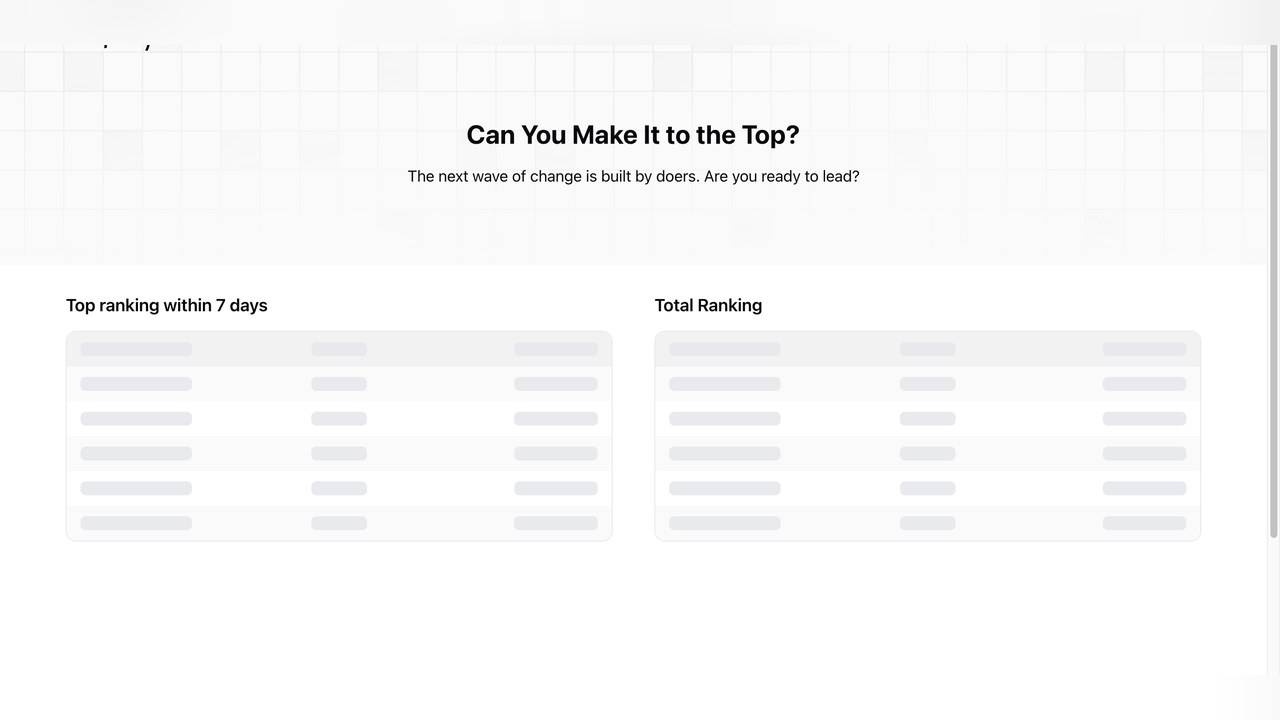
What you see: The live Psychonaut Leaderboard interface under the banner 'Can You Make It to the Top? The next wave of change is built by doers. Are you ready to lead?' Two primary metric filters categorize competitive performance: 'Top ranking within 7 days' and 'Total Ranking', tracking top community contributors, cumulative points earned, and active referral trees.
Screenshot context:
The screenshot shows leaderboard filters for rolling 7-day and Total rankings. Psy documentation or portal materials may describe points, rankings, referrals, or participation outcomes, but this walkthrough does not verify that displayed rankings validate completed actions or produce allocation, incentive, or distribution outcomes.
Architectural Context / Key Concept / Security Warning:
Leaderboard state in Psy Protocol is compiled through off-chain attestation aggregators that verify cryptographic proofs of contribution before updating ranking indices. The dual-track ranking (7-Day Velocity vs. Total Cumulative Points) prevents early-farmer lock-in and gives active new participants an immediate runway to rank up. Always verify your points reflect in the dashboard after completing quests to prevent attribution desynchronization.
How to execute:
- Navigate to the Psychonaut Leaderboard terminal at
psy.xyz/psychonaut/leaderboard. - Toggle between
Top ranking within 7 days(recent momentum) andTotal Ranking(cumulative standing). - Search or verify your connected Psychonaut handle to confirm your position within the global ranking matrix.
- Use the competitive leaderboard benchmarks to set your weekly point targets (e.g., maintaining 100+ points to graduate past Level 0 Cadet).
Key Metrics & Best Practices / Checklist:
- Ranking Tracks: 7-Day Velocity Ranking & Total Cumulative Ranking.
- Core Metrics: Cumulative Psy Points, Validated Quests, Verified Referrals.
- Goal: Maintain consistent quest activity to secure top-percentile placement prior to mainnet snapshot.
Step 5: Auditing the Trustless Internet Manifesto (psy.xyz)
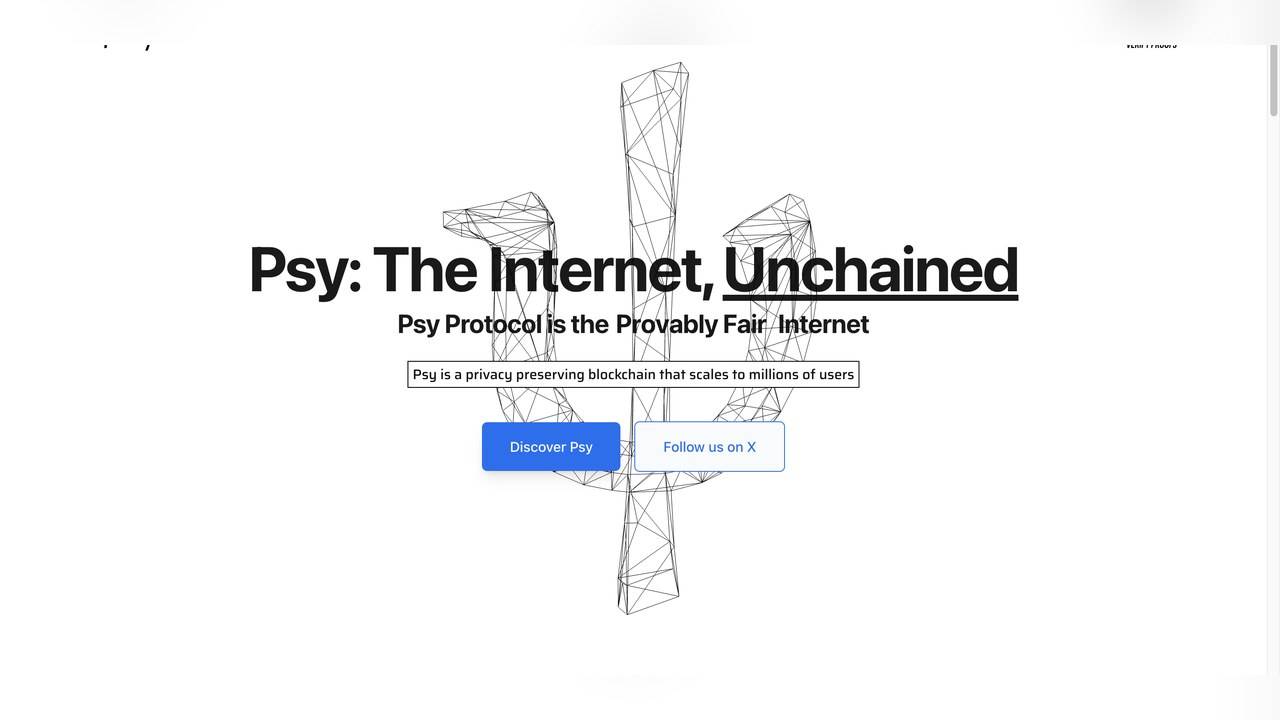
What you see: The official Psy Protocol homepage banner: 'Psy: The Internet, Unchained. Psy is the infrastructure for a provably fair internet at scale. Don't trust, verify proofs.' Prominently displayed metrics include zero-knowledge verification benchmarks and strategic calls-to-action for Vision, Developers, Docs, and Psychonaut community tracks.
Why do this?
Verifying the official vision and protocol documentation confirms that Psy is not another generic EVM copycat, but a fundamentally new Layer 1 paradigm built on recursive cryptographic verification. Early airdrop farmers must understand the core narrative, privacy-first scaling and machine-to-machine micropayments, to optimize their participation across relevant testnet initiatives.
Architectural Context / Key Concept / Security Warning:
Monolithic Layer 1s force all nodes to verify all computations sequentially, creating economic rent for block proposers and exposing user financial history. Psy re-architects this into an asynchronous proof-verification network where state verification is instantaneous ($O(1)$) and decoupled from transaction ordering. Always access official resources through the primarypsy.xyzroot domain to avoid phishing clones.
How to execute:
- Visit the protocol portal at
psy.xyz. - Review the core architectural tenets: Scalability without centralization, and privacy without trusted setups.
- Explore the
VisionandPrivacydeep-dives to understand how Psy solves global state contention.
Key Metrics & Best Practices / Checklist:
- Official Domain:
psy.xyz(verified SSL certificate). - Core Philosophy: 'Don't trust, verify proofs'.
- Technology Paradigm: Recursive ZK-SNARKs on Layer 1.
Step 6: Analyzing PARTH Parallel Execution Architecture (psy.xyz/developers)
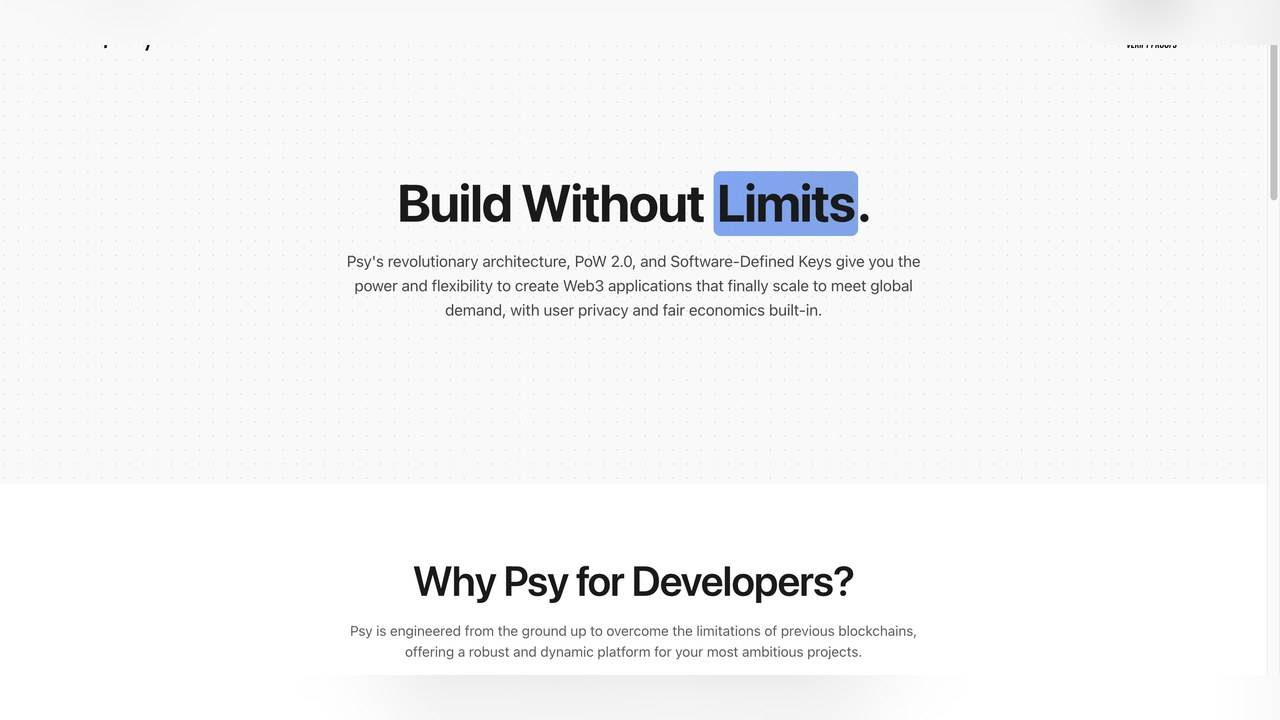
What you see: The official developer documentation portal highlighting core protocol specifications: 'Built for developers. Scale without limits.' Key architecture cards include: PARTH True Parallelism, Proof of Useful Work (PoW 2.0), Client-Side Proving via WebGPU, and SDK tooling for Rust and TypeScript.
Screenshot context:
Psy’s technical documentation describes protocol throughput, proving latency, and consensus design. Reading developer specifications does not independently confirm Psy performance claims or future testnet opportunities.
Architectural Context / Key Concept / Security Warning:
Psy documentation describes PARTH (Parallel Ascending Recursive Tree Hierarchy) as allowing transactions affecting disjoint state leaves to execute concurrently and independent Merkle branch proofs to be recursively aggregated into a root proof. This walkthrough did not test or verify that design.
How to execute:
- Open
psy.xyz/developers. - Read the architectural breakdown of PARTH parallel tree structures.
- Review the PoW 2.0 documentation detailing how miners generate recursive Plonky2.5 SNARKs instead of useless cryptographic hashes.
Key Metrics & Best Practices / Checklist:
- Parallelism Model: PARTH (Tree-structured state decomposition).
- Proving Engine: Plonky2.5 recursive SNARKs.
Step 7: Auditing Open-Source Cryptographic Repositories (github.com/QEDProtocol)
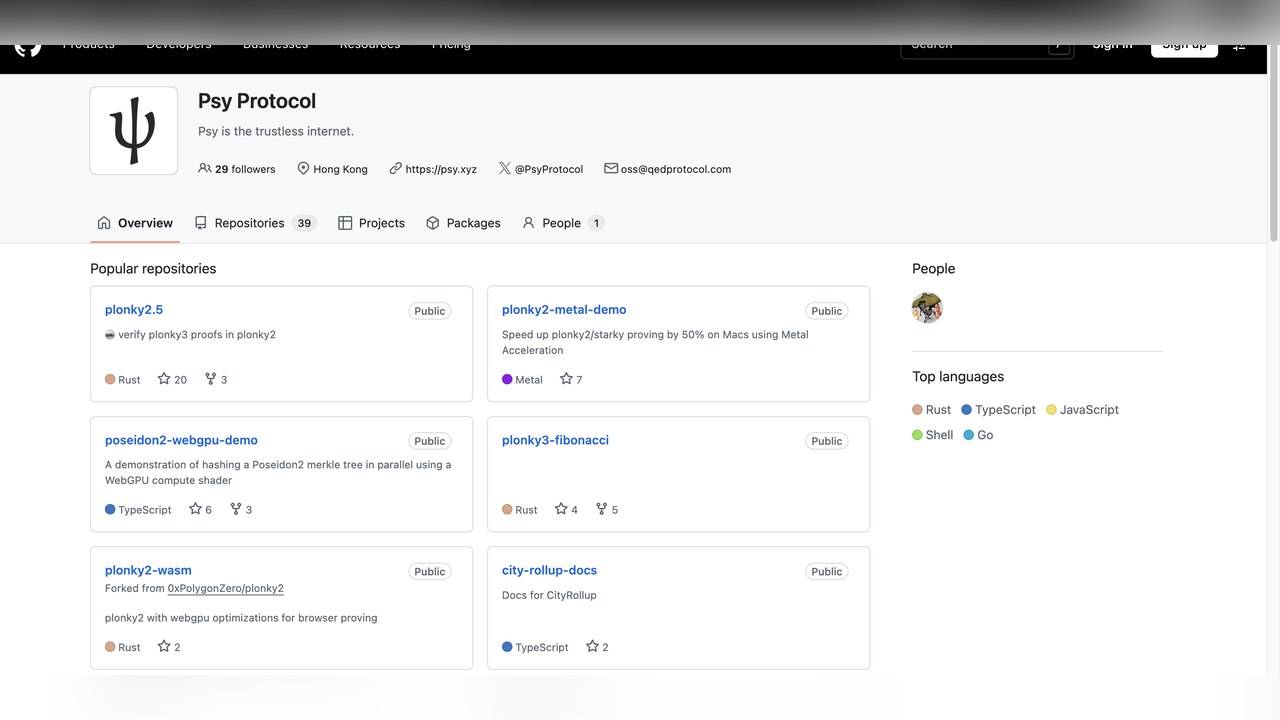
What you see: The official GitHub organization (github.com/QEDProtocol, formerly QED Protocol) displaying 39 public repositories, including foundational cryptographic libraries: plonky2.5 (optimized recursive SNARK implementation), poseidon2-webgpu-demo (browser-native hardware-accelerated zero-knowledge hashing), and SDK development tooling.
Why do this?
The displayed GitHub organization and repositories are portal observations. This walkthrough does not include a source-code audit and does not draw conclusions about implementation quality, legitimacy, or potential rewards.
Architectural Context / Key Concept / Security Warning:
The displayedposeidon2-webgpu-demorepository is presented as browser-native, WebGPU-accelerated Poseidon2 hashing for the proving stack. This walkthrough did not test proof generation, proving speed, privacy properties, or network behavior. Star and watch the official repositories to track developer testnet releases.
How to execute:
- Navigate to
github.com/QEDProtocol. - Inspect the core repository
plonky2.5to audit the recursive proving mechanics. - Review
poseidon2-webgpu-demofor its browser-based WebGPU Poseidon2 hashing implementation. - Star the repository to maintain visibility on official testnet release tags and SDK updates.
Key Metrics & Best Practices / Checklist:
- GitHub Org:
QEDProtocol(39 active public repositories). - Flagship Repos:
plonky2.5,poseidon2-webgpu-demo. - Cryptographic Primitive: Poseidon2 zero-knowledge friendly hash function.
Step 8: Validating Official Social Media & Milestone Roadmap (x.com/PsyProtocol)
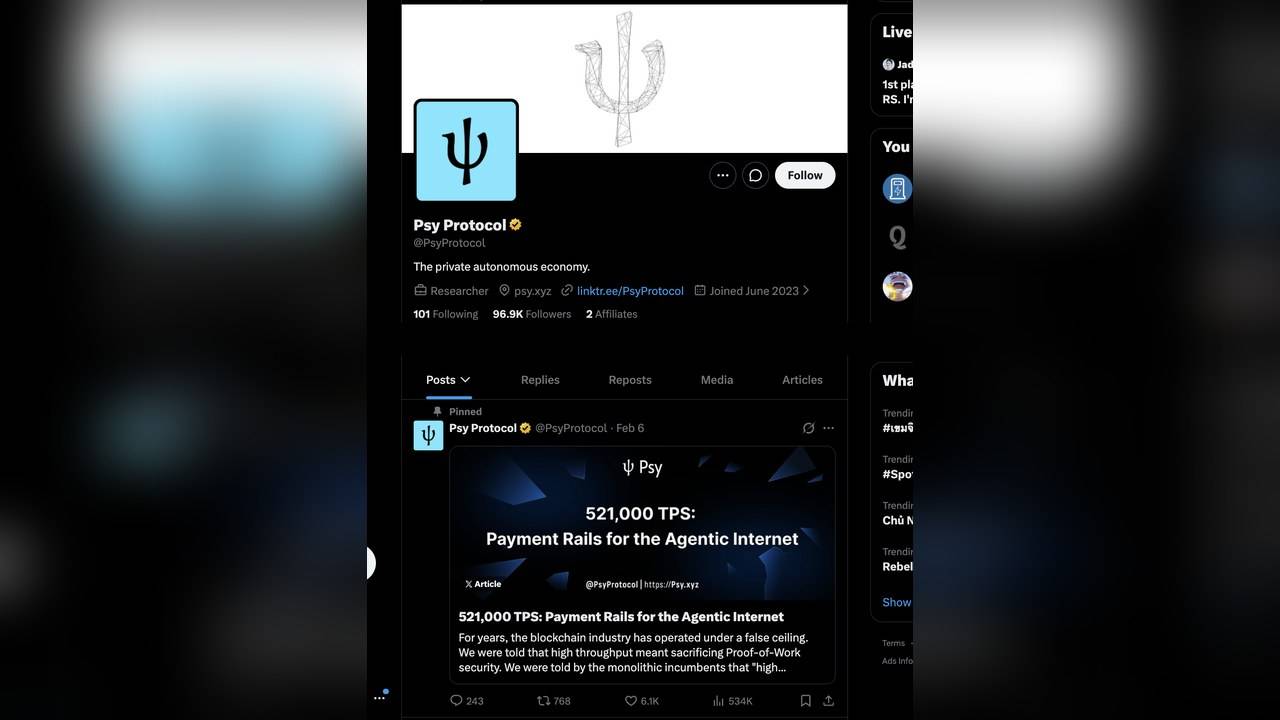
What you see: The screenshot displays the X profile @PsyProtocol, a follower count, the bio 'The private autonomous economy. Built by researchers. psy.xyz', and a featured research article about payment rails for the agentic internet. This walkthrough does not independently verify the account status, follower count, or performance claims in the featured material.
Why do this?
Verifying official communications prevents falling victim to fake testnet bridges, impersonation accounts, and phishing dApps. Staying synchronized with@PsyProtocolannouncements ensures you are immediately notified when new Psychonaut quest categories launch, staging testnet faucet allowances expand, or mainnet snapshot criteria are finalized.
Security note:
The screenshot displays@PsyProtocol, but this walkthrough does not independently establish an official-only communications policy, milestone schedule, or support practice. Treat unsolicited links and requests for private keys or seed phrases as high risk.
How to execute:
- Open
x.com/PsyProtocol. - Follow the account and turn on notifications for official announcements.
- Read the featured Long-Form Article: 521,000 TPS: Payment Rails for the Agentic Internet.
- Ensure your X account is connected within your Psychonaut profile to passively accumulate social influence points.
Key Metrics & Best Practices / Checklist:
- Official Handle:
@PsyProtocol(96.9K Followers). - Security Rule: Zero direct messages, zero unverified bridge links.
- Milestone Tracking: Watch for Staging Testnet Phase 2 announcements.
Psychonaut Points Participation Checklist
There is no guaranteed allocation, token distribution, or value associated with Psychonaut participation. The following is a portal-use checklist, not financial advice or allocation guidance.
Strategic Action Checklist
- Daily & Weekly Quest Hygiene: Check
psy.xyz/psychonaut/activityweekly for newly unlocked campaign bounties. - Referral Expansion: Every active referral directly satisfies the advancement criteria from Level 0 Cadet; prioritize sharing your link across trusted Web3 research communities.
- MCP Tooling Readiness: If you develop with Claude Code or Cursor, explore setting up local policy budgets on the MCP Agent Wallet to establish developer-tier positioning.
- No Capital Requirement Claimed: Psy presents participation as not requiring real capital, but testnet, phishing, wallet-security, privacy, social-account, and opportunity-cost risks remain.
Editorial credits
Checked by AiCryptoCore QC Team before publishing on November 20, 2026 for headline accuracy, original value, commercial disclosure, authorship claims and risk disclosure: our AI review system checks every article before it goes live, and our editor monitors it after publication.
AiCryptoCore uses AI for research, drafting and review. Our editorial team is responsible for every article and corrects or withdraws articles when needed. How we review.