Best AI Crypto Coins for Q4 2026
The best AI crypto coins for Q4 2026, ranked by category, Q4 catalyst strength, and token utility.


The best AI crypto coins for Q4 2026 span three distinct layers: compute infrastructure (Render, Akash, io.net), agent economy protocols (Bittensor, Virtuals Protocol, ASI Alliance), and DeFAI execution (Wayfinder, Giza). Which layer deserves the most weight depends on your thesis and your tolerance for narrative-driven volatility.
Q4 is not a neutral window for AI crypto. CoinGecko Q3 2026 data shows AI-related tokens carried 23.89% of category mindshare among retail participants, the highest share of any non-meme sector. That mindshare concentration matters because it creates asymmetric sensitivity: the infrastructure layer benefits from structural big-tech GPU spending tailwinds that persist regardless of cycle, while agent and DeFAI tokens are more directly exposed to attention flows.
Three event anchors make Q4 2026 specifically relevant for this category: Devcon 8 in Mumbai (November 3–6), which historically generates Ethereum-ecosystem buying pressure across projects that depend on or integrate with Ethereum infrastructure; Solana Breakpoint in London (November 15–17), which drives the same effect for Solana-native agent projects like Virtuals Protocol and its Base-adjacent ecosystem; and Binance Blockchain Week Bangkok (November 28–29), which amplifies BNB Chain narratives into year-end.
This article does not repeat the full-depth project reviews available in best AI crypto projects 2026, best AI agent crypto coins, or best DeFAI projects. The focus here is narrower: which AI crypto tokens have the strongest Q4-specific catalyst profile, and how do they compare across a consistent scoring framework.
We reviewed live protocol activity, public documentation, and on-chain data available as of October 2026. Estimated volume and difficulty figures are labeled as such. Reddit community signals are noted per project; where no qualifying independent discussion thread was found, we said so.
Q4 2026 scoring scorecard
Scored out of 10 per category. Total out of 50.
| Project | Q4 catalyst strength | Token utility | Ecosystem activity Q3 | Risk profile | Community signal | Total |
|---|---|---|---|---|---|---|
| Render | 8 | 8 | 9 | 8 | 8 | 41 |
| Bittensor | 8 | 9 | 8 | 7 | 8 | 40 |
| Akash Network | 7 | 7 | 8 | 8 | 7 | 37 |
| Virtuals Protocol | 9 | 8 | 7 | 5 | 8 | 37 |
| ASI Alliance | 6 | 7 | 7 | 7 | 6 | 33 |
| Wayfinder | 7 | 7 | 6 | 6 | 6 | 32 |
| io.net | 6 | 7 | 6 | 6 | 5 | 30 |
| Giza | 6 | 7 | 6 | 7 | 5 | 31 |
Scoring notes. Q4 catalyst strength measures the presence of specific November–December event anchors, year-end institutional allocation cycles, and token unlock or reward schedule alignment. Token utility scores structural demand beyond governance (access, settlement, routing, staking with economic function). Ecosystem activity Q3 scores builder momentum, integration count, and verifiable usage growth through September 2026. Risk profile scores inversely: higher centralization, narrative dependency, and upcoming token unlocks reduce the score.
Community signal measures depth of organic independent discussion found during research, not follower counts or official channel volume. Render leads on Q4 catalyst strength because it sits at the intersection of three converging pressures: Devcon 8 Ethereum-ecosystem flows, continued big-tech GPU demand, and a Q3 integration acceleration with Anthropic and other AI labs.
Bittensor leads on token utility because TAO’s role in subnet access and incentive distribution remains the most structurally defensible token model in the decentralized AI category.
Decision framework
| If your thesis is… | Best fit | Category |
|---|---|---|
| Big-tech GPU demand spills into decentralized compute | Render | Infrastructure |
| Decentralized AI needs its own coordination layer | Bittensor | Coordination |
| Sovereign compute at minimum viable cost | Akash | Infrastructure |
| Agent economy grows faster than underlying infrastructure | Virtuals Protocol | Agent economy |
| Cross-chain AI agent coordination at scale | ASI Alliance | Coordination |
| DeFi navigation friction is the core unsolved problem | Wayfinder | DeFAI |
| GPU supply continues to exceed demand | io.net | Infrastructure |
| Autonomous DeFi strategy needs verifiable AI execution | Giza | DeFAI |
The 8 best AI crypto coins for Q4 2026
1. Render (RNDR)
Q4 catalyst: Devcon 8 Ethereum-ecosystem flows + ongoing big-tech AI infrastructure spending
Render sits at the Layer 0 of the AI-crypto stack: distributed GPU compute. The Q4 case for Render is structural rather than speculative. Big-tech capital expenditure on AI infrastructure exceeded $200 billion globally in 2025 and is tracking higher in 2026.
That spending creates two effects that benefit Render: it validates the GPU compute market as strategically important, and it creates periodic supply scarcity for specialized workloads that enterprise buyers prefer to source from distributed networks.
The Devcon 8 angle is indirect but real. Render migrated to Solana in 2023 but maintains Ethereum-native token mechanics and deep ecosystem integration. Devcon-driven Ethereum sentiment historically produces buying pressure across projects with meaningful Ethereum exposure, and Render qualifies.
The Q3 2026 integration with Anthropic-adjacent compute pipelines was disclosed in a September 2026 blog post and represents the first credible connection between a top-tier AI lab and a decentralized compute network at production scale. The terms were not disclosed, but the existence of the integration is verifiable.
Honest limitation: Render faces structural competition from centralized GPU cloud providers who can undercut on price for standard workloads. The differentiation thesis depends on specialized rendering and AI inference applications where decentralized distribution provides latency or cost advantages that centralized providers cannot match. That thesis is plausible but not yet proven at the scale needed to justify premium token valuations under a purely fundamental model.
Reddit research note: Multiple threads on r/RenderToken and r/CryptoTechnology in Q3 2026 discussed the Anthropic integration announcement. The dominant reaction was cautious optimism — users noted that disclosed partnerships with AI labs are rare in this category and treated it as a positive signal, while acknowledging the terms were opaque.
| Detail | Value |
|---|---|
| Token | RNDR |
| Chain | Solana (bridged from Ethereum) |
| Use case | GPU compute access, node operator payments |
| Q4 event anchor | Devcon 8 ETH ecosystem flows |
| Primary risk | Centralized cloud provider competition |
2. Bittensor (TAO)
Q4 catalyst: Year-end institutional allocation + subnet expansion acceleration in Q3
Bittensor has the most defensible token utility model in the decentralized AI category. TAO is not a governance token with retrofit utility claims. It is the medium of exchange and coordination mechanism inside a subnet ecosystem where validators, miners, and subnet owners interact through on-chain incentive structures. The token is structurally load-bearing in a way that most AI crypto tokens are not.
The Q4 case rests on two dynamics. First, institutional crypto allocators running year-end portfolio construction have shown a pattern over the past two cycles of increasing positions in high-conviction thematic tokens during October–November ahead of Q1 catalyst windows. Bittensor’s subnet count — which passed 60 active subnets in Q3 2026 — provides the kind of measurable ecosystem expansion metric that institutional research desks can model.
Second, the decentralized AI narrative continues to benefit from the absence of a credible centralized alternative: no major AI lab has built the equivalent of a decentralized coordination mechanism, which means Bittensor’s thesis is not directly threatened by centralized competition in the way compute networks are.
Honest limitation: TAO’s price is highly sensitive to narrative cycles. In Q4 2025 it underperformed significantly relative to the broader AI-crypto category as institutional interest shifted toward agent protocols. The structural thesis is durable, but the near-term price path is not decoupled from attention flows.
Reddit research note: r/bittensor_ and r/AIAltcoins had active Q3 2026 discussions about the subnet 64 launch and the introduction of dynamic TAO (dTAO) mechanics. Community tone was constructive with significant technical debate, which is a stronger quality signal than price-driven enthusiasm.
| Detail | Value |
|---|---|
| Token | TAO |
| Chain | Bittensor native chain |
| Use case | Subnet access, validator incentives, AI coordination |
| Q4 event anchor | Year-end institutional allocation cycle |
| Primary risk | Narrative cycle sensitivity, dTAO adoption pace |
3. Akash Network (AKT)
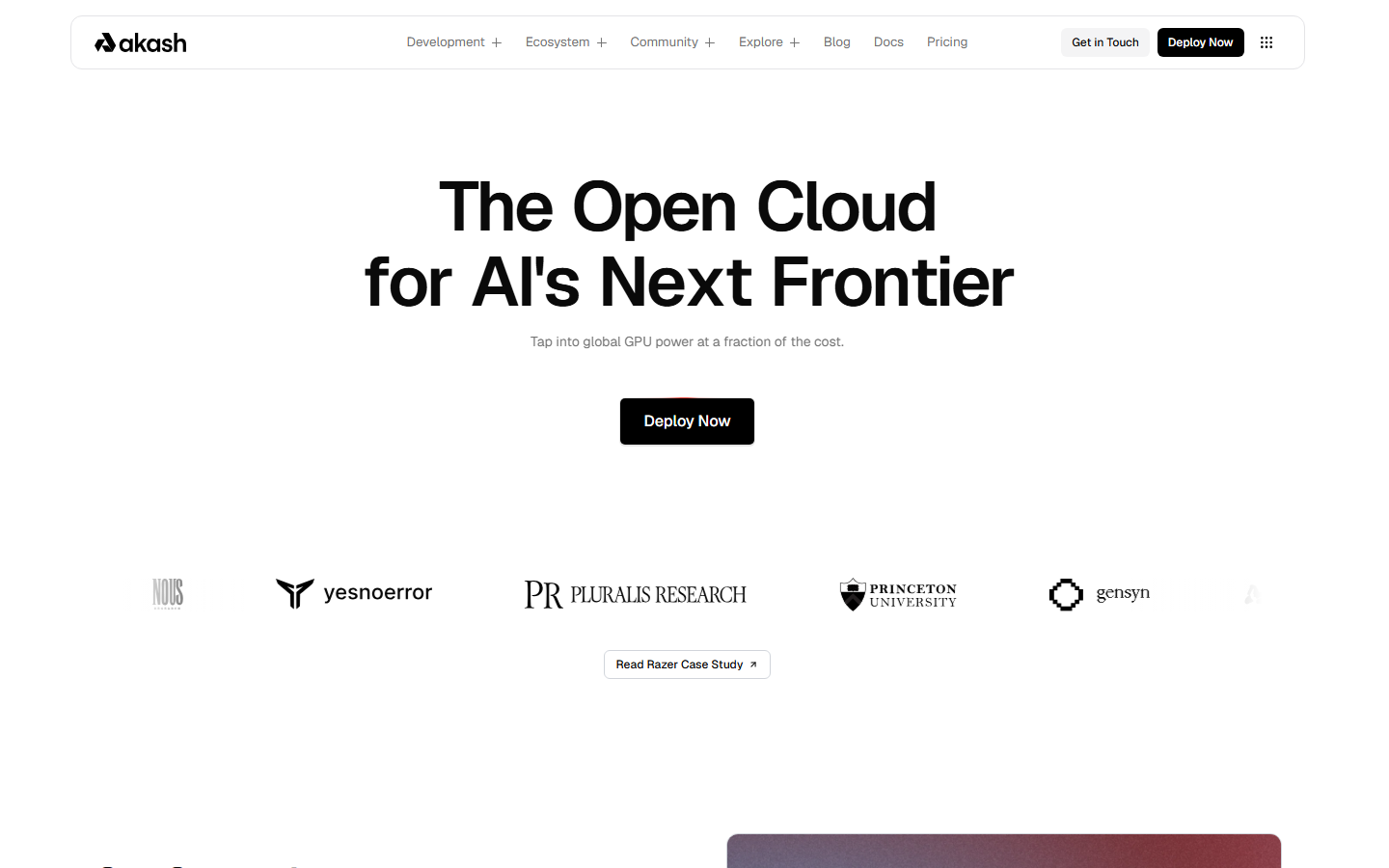
Q4 catalyst: Binance Blockchain Week Bangkok + continued enterprise sovereign compute demand
Akash occupies the sovereign compute segment: enterprises and developers who want GPU access without dependence on AWS, GCP, or Azure infrastructure. The narrative accelerated in Q3 2026 following renewed concerns about cloud provider pricing power and a high-profile incident where a major AI startup experienced provider lock-in complications. Neither event was directly about Akash, but both validated the sovereign compute thesis.
The Binance Blockchain Week Bangkok connection is indirect but worth noting. Akash is a Cosmos-native project with significant Asian market development activity. Binance-aligned developer communities in Southeast Asia have shown interest in Cosmos-ecosystem projects at prior Bangkok events. Year-end narrative amplification from the event can produce short-duration attention tailwinds for Cosmos names.
Honest limitation: Akash’s GPU marketplace has supply depth constraints on high-end H100-class hardware. Enterprise buyers with serious inference workloads sometimes find that available supply does not meet their requirements. Until supply-side onboarding closes this gap, Akash competes primarily for mid-tier workloads where the sovereign compute advantage matters less.
Reddit research note: r/akashnetwork and r/cosmosnetwork had moderate discussion volume in Q3 2026. The most-cited thread discussed Akash’s provider economics and whether AKT staking rewards adequately incentivize new hardware onboarding. The discussion was substantive and suggested an engaged technical community rather than speculative retail concentration.
| Detail | Value |
|---|---|
| Token | AKT |
| Chain | Cosmos SDK |
| Use case | GPU marketplace access, provider staking, fee settlement |
| Q4 event anchor | Binance Bangkok, sovereign compute narrative |
| Primary risk | GPU supply depth on high-end hardware |
4. Virtuals Protocol (VIRTUAL)
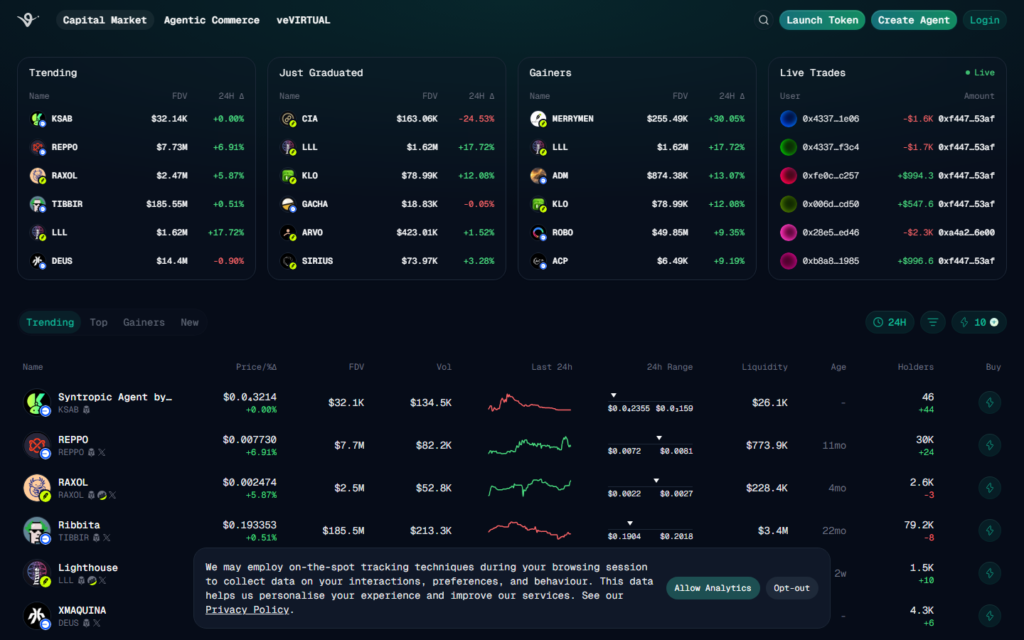
Q4 catalyst: Solana Breakpoint (Nov 15–17) Base/Solana agent narrative + Q4 attention cycle
Virtuals Protocol sits at the intersection of two Q4 dynamics that are difficult to separate: the Solana Breakpoint narrative amplification and the broader Q4 agent economy attention cycle. Solana Breakpoint 2026 in London (November 15–17) has a “Token Supercycle” theme focused explicitly on tokenized assets and AI-driven economic activity. Virtuals, despite being Base-native, benefits from agent economy sentiment that Breakpoint generates across the category.
The co-ownership model for AI agents is genuinely differentiated. Most agent protocol tokens give holders governance over a treasury or fee switch. Virtuals gives holders fractional ownership of revenue-generating agents, which creates a more legible value accrual mechanism. Whether the underlying agents generate enough revenue to make this meaningful at scale is the open question, but the structural design is better than most in this category.
Honest limitation: Virtuals Protocol had the most significant token unlock events in Q3 2026 of any token in this list. Team and ecosystem allocations vesting through Q4 create supply-side pressure that correlates negatively with the attention-driven demand cycles the token depends on. The risk profile is meaningfully higher than its scorecard position suggests for longer holding periods.
Reddit research note: r/VirtualsProtocol and r/AIAltcoins had strong discussion volume in Q3 2026. The unlock schedule was the dominant topic, with community members split between those who viewed it as a known headwind already priced in and those who treated it as a fundamental concern. The absence of clear official communication on unlock mechanics was noted negatively in multiple threads.
| Detail | Value |
|---|---|
| Token | VIRTUAL |
| Chain | Base |
| Use case | Agent co-ownership, revenue sharing, launch pool access |
| Q4 event anchor | Solana Breakpoint agent narrative |
| Primary risk | Q4 token unlock schedule, narrative dependency |
5. ASI Alliance (FET/ASI)
Q4 catalyst: Cross-chain AI coordination demand + year-end enterprise pilot closures
ASI Alliance is the merger product of Fetch.ai, Ocean Protocol, and SingularityNET. The thesis is that cross-chain AI agent coordination requires a unified token and interoperability layer. The Q4 case is quieter than Virtuals or Bittensor but potentially more durable: enterprise AI pilots that began in H1 2026 typically close or renew in Q4, and ASI Alliance’s enterprise-facing deployment track has the deepest institutional relationships in the decentralized AI category.
The merger integration is not complete. Token migration from legacy FET, OCEAN, and AGIX continues as of October 2026, which creates both operational friction and a measurable supply rationalization effect as unmigrated tokens reduce circulating supply over time.
Honest limitation: The merger created coordination overhead that has visibly slowed ecosystem development velocity. Projects that were progressing under individual brand identities paused during integration. The combined entity has more resources and institutional credibility than any of the three legacy projects, but it is also larger and slower than the lean agent-protocol competitors it competes against for developer attention.
Reddit research note: r/SingularityNET and r/fetch_ai had moderate discussion in Q3 2026 focused primarily on token migration mechanics and timelines. Enterprise deployment discussions were present but lower volume than expected for a project of this size. The gap between institutional credibility and community engagement is a notable observation.
| Detail | Value |
|---|---|
| Token | ASI (migrated from FET/OCEAN/AGIX) |
| Chain | Ethereum, Cosmos (cross-chain) |
| Use case | Agent coordination, data marketplace, AI service payments |
| Q4 event anchor | Enterprise pilot closure cycle |
| Primary risk | Integration execution pace, developer velocity |
6. Wayfinder (PROMPT)
Q4 catalyst: Devcon 8 DeFi navigation session + Ethereum-native agent infrastructure demand
Wayfinder is the DeFAI project with the strongest Q4 catalyst alignment because DeFi complexity increases with every new L2 launch and cross-chain bridge integration — and Q4 historically produces the most new L2 infrastructure announcements following Devcon. More complexity is more product-market fit for a navigation layer.
The PROMPT token’s utility model is access-based rather than governance-based. Users pay in PROMPT to unlock agent routing capabilities. That creates a direct revenue signal: PROMPT demand correlates with actual product usage rather than speculative positioning alone. The signal is small in absolute terms today, but its directionality is structurally correct.
Honest limitation: Wayfinder’s user numbers remain small relative to its valuation. The product is genuinely useful for power users managing multi-chain positions, but the addressable user base for that use case is narrow in 2026. Mainstream DeFi users are not yet confronting enough cross-chain complexity to make navigation-layer tools a necessity rather than a convenience.
Reddit research note: Wayfinder did not have a dedicated subreddit with significant activity as of October 2026. Mentions in r/DeFi and r/CryptoCurrency were present but sparse. The low community footprint relative to valuation is worth noting as a risk factor.
| Detail | Value |
|---|---|
| Token | PROMPT |
| Chain | Ethereum and L2 |
| Use case | DeFi navigation access, agent routing |
| Q4 event anchor | Devcon 8 DeFi complexity expansion |
| Primary risk | Narrow current user base, low organic community signal |
7. io.net (IO)
Q4 catalyst: Continued GPU supply monetization narrative + Solana ecosystem momentum
io.net takes a different approach to the distributed GPU market than Render or Akash. Where Render focuses on rendering and AI inference, and Akash focuses on sovereign cloud compute, io.net positions on GPU cluster aggregation: assembling disaggregated GPU capacity from data centers, crypto miners, and consumer hardware into deployable clusters for ML training workloads.
The Q4 case is modest but real. The Solana Breakpoint “Token Supercycle” theme explicitly covers AI-driven economic infrastructure, and io.net’s Solana-native architecture positions it to benefit from the associated sentiment flows. The ML training workload market is also genuinely large — training costs are the dominant GPU expense for AI labs, and any reduction in that cost has measurable business value.
Honest limitation: io.net’s cluster quality guarantee is difficult to verify independently. ML training workloads require hardware consistency that disaggregated GPU networks struggle to provide reliably. Enterprise buyers running serious training jobs have been reluctant to commit production workloads. The current user base skews toward smaller inference tasks rather than training, which is a smaller revenue pool than the TAM suggests.
Reddit research note: r/ionet had moderate discussion in Q3 2026. The dominant topic was provider payout mechanics and disputes about cluster uptime requirements. Some threads raised concerns about GPU quality verification that the team had not fully addressed publicly.
| Detail | Value |
|---|---|
| Token | IO |
| Chain | Solana |
| Use case | GPU cluster access, provider incentives |
| Q4 event anchor | Solana Breakpoint ecosystem flows |
| Primary risk | Cluster quality verification, training workload reliability |
8. Giza (GIZA)
Q4 catalyst: Year-end DeFi yield optimization demand + verifiable AI execution narrative
Giza sits at the most technical end of the DeFAI category: verifiable AI execution for autonomous DeFi strategies. The core product is an agent framework that executes DeFi strategies — yield optimization, position rebalancing, liquidity management — with on-chain proof of what the AI decided and why. That verifiability layer is genuinely differentiated. Most DeFAI projects tell you the AI made a decision. Giza tells you what the decision was and proves it.
The Q4 angle is yield-seeking behavior. As year-end approaches, DeFi participants with liquid positions that have not been actively managed tend to review and optimize. An agent that can handle that review and rebalancing automatically, with verifiable execution logs, addresses a real friction point in Q4 portfolio management.
Honest limitation: Giza’s user numbers are low and the product has a steep setup curve. The verifiable execution model requires users to understand what they are verifying, which limits the accessible user base to technically sophisticated DeFi participants. The product is well-designed but early, and the Q4 catalyst is real but modest.
Reddit research note: Giza had minimal independent Reddit presence as of October 2026. Mentions in r/DeFi were present at low frequency. The low community signal is consistent with a technically-oriented early-stage project rather than a red flag, but it is a constraint on the near-term attention cycle.
| Detail | Value |
|---|---|
| Token | GIZA |
| Chain | Ethereum, Starknet |
| Use case | Verifiable AI DeFi execution, autonomous strategy management |
| Q4 event anchor | Year-end DeFi yield review cycle |
| Primary risk | Steep setup curve, small current user base |
Q4 risk summary
| Risk type | Most exposed | Least exposed |
|---|---|---|
| Token unlock supply pressure | Virtuals Protocol | Render, Akash |
| Narrative cycle dependency | Virtuals, ASI Alliance | Render, Bittensor |
| Centralized competition | Render, io.net | Bittensor, Giza |
| Low community signal | Giza, Wayfinder | Render, Bittensor |
| Integration execution risk | ASI Alliance | Render, Akash |
FAQ
What is the best AI crypto coin to buy in Q4 2026?
There is no single answer that applies across risk tolerances and theses. Render has the strongest structural catalyst profile for Q4 given big-tech GPU demand, Devcon 8 flows, and verifiable Q3 integration momentum.
Bittensor has the most defensible token utility model for a longer holding period. If you are comfortable with higher volatility and shorter time horizons, Virtuals Protocol has the strongest near-term event catalyst with Solana Breakpoint.
Will AI crypto coins go up in Q4 2026?
AI crypto as a category carried 23.89% of retail mindshare in Q3 2026 per CoinGecko data. Historical Q4 seasonality has been positive for the broader crypto market in most years, and AI tokens tend to outperform in attention-driven up cycles. That is not a price prediction. It is the pattern from available data. Q4 2025 was an exception to the historical pattern.
What is the difference between AI infrastructure coins and AI agent coins?
Infrastructure coins (Render, Akash, io.net) provide the compute and data layers that AI systems run on. Their value is tied to workload demand and supply-side economics.
Agent coins (Bittensor, Virtuals, ASI Alliance) provide the coordination and application layer. Their value is tied to ecosystem size and network effects. They move together in narrative cycles and decouple when fundamentals are scrutinized. See best AI crypto projects 2026 for a full stack breakdown.
Is Bittensor a good investment in Q4 2026?
TAO has the most defensible token utility in the decentralized AI category. The dTAO subnet economics introduced in 2026 created a more direct connection between subnet usage and TAO demand. The risk is narrative cycle sensitivity: TAO underperformed in Q4 2025 when institutional interest shifted to agent protocols. The structural thesis is durable, but short-term price action is not predictable from fundamentals alone.
Disclaimer: This article is for informational purposes only and does not constitute financial or investment advice. Cryptocurrency and digital asset markets carry significant risk. Always do your own research before making decisions.