
Strategy has disclosed in an 8-K filing with the U.S. Securities and Exchange Commission that it plans to repurchase up to $1.5 billion in convertible notes, with bitcoin sales listed as a potential funding mechanism for the transaction.
What the 8-K Filing Says About the $1.5 Billion Repurchase
The company formerly known as MicroStrategy outlined the planned convertible notes buyback in an SEC filing dated May 2026. The repurchase targets up to $1.5 billion in outstanding convertible notes.
Notably, the filing lists bitcoin sales as one possible source of capital to fund the deal. This is not a confirmation that Strategy will sell bitcoin, but rather a disclosure that the option is on the table as part of its treasury management approach.
Strategy has built one of the largest corporate bitcoin treasuries in the world, a position detailed in its first-quarter 2026 financial results. The company has historically used debt instruments, including convertible notes, to finance bitcoin acquisitions.
The 8-K serves as a formal notification to investors and regulators. It does not specify a timeline for execution, a target price for the notes, or the exact volume of bitcoin that might be liquidated.
Why a Bitcoin-Funded Debt Buyback Matters
Any disclosure that links a potential bitcoin sale to a corporate treasury action carries weight for market participants. Strategy holds enough bitcoin that even a partial liquidation could register on exchange order books, similar to how spot Bitcoin ETF flow data can shift short-term sentiment.
Repurchasing convertible notes would reduce Strategy’s outstanding debt obligations and improve its leverage profile. For a company whose equity valuation is closely tied to its bitcoin holdings, deleveraging could be read as either prudent risk management or a signal of reduced conviction.
The conditional language in the filing, stating that bitcoin sales “may” fund the repurchase, introduces uncertainty rather than resolving it. Markets tend to react to the possibility of large-scale selling pressure even before any transaction occurs, a dynamic that has played out in past episodes involving large crypto asset movements.
Exchange reserve data offers one lens for monitoring whether Strategy-scale bitcoin moves materialize. On-chain trackers show aggregate exchange balances that can signal whether large holders are positioning to sell.
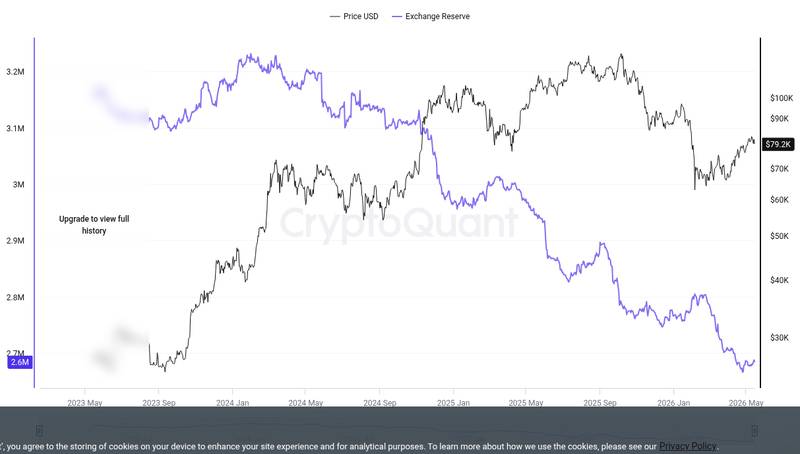
It is important to note that the filing does not confirm a sale size, a timeline, or any guaranteed market impact. Strategy retains full discretion over whether and how to execute. Investors tracking the company’s bitcoin position should watch for subsequent filings or press releases that specify concrete terms.
The broader context matters as well. The crypto market has seen renewed institutional activity in recent weeks, with compliance-focused research and consistent ETF inflows shaping the backdrop. Whether Strategy’s potential bitcoin sales would disrupt that trend or simply represent routine corporate finance remains an open question until further details emerge.
Disclaimer: This article is for informational purposes only and does not constitute financial or investment advice. Cryptocurrency and digital asset markets carry significant risk. Always do your own research before making decisions.