
The Verus-Ethereum bridge was exploited on May 17, 2026, draining more than $11 million in crypto assets through a hand-crafted proof payload that bypassed conventional smart contract defenses, raising fresh questions about whether AI-assisted security auditing could have flagged the attack vector before it was weaponized.
Key Points
- A single exploit transaction drained 1,625.37 ETH, 103.57 tBTC, and 147,658.84 USDC from the Verus-Ethereum bridge on May 17.
- The attacker consolidated stolen assets into roughly 5,402 ETH, worth approximately $11.4 million, and the funds remain traceable on-chain.
- Verus halted block-producing nodes and disabled DeFi functionality to contain further damage, a recovery sequence largely absent from competitor coverage.
What happened in the Verus-Ethereum bridge exploit
The attack struck at 11:55:23 PM UTC on May 17, when an exploiter interacted with the Verus: Ethereum Bridge contract at address 0x71518580f36FeCEFfE0721F06bA4703218cD7F63. A single transaction drained 1,625.37 ETH, 103.57 tBTC, and 147,658.84 USDC from the bridge to the attacker’s receiving wallet at 0x5aBb91B9c01A5Ed3aE762d32B236595B459D5777.
ON-CHAIN DATA
- Transaction hash: 0x6990f017…7eb321
- Assets drained: 1,625.37 ETH + 103.57 tBTC + 147,658.84 USDC
- From: Verus: Ethereum Bridge (0x7151…7F63) → Exploiter (0x5aBb…5777)
- Block timestamp: May 17, 2026, 23:55:23 UTC
The exploit was not a simple reentrancy bug, according to an official Verus community statement. The team identified a supplemental output from a Verus-side transaction that was later misused on Ethereum, describing the attack as a hand-crafted import and proof payload accepted against the latest confirmed Verus state root.
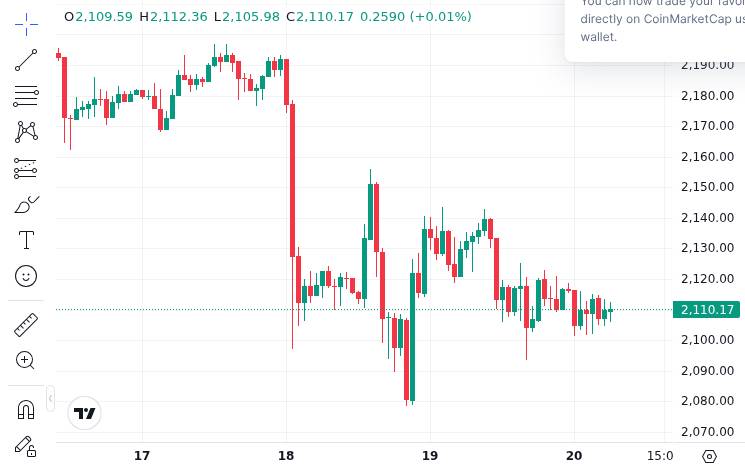
After the exploit, the stolen assets were converted into Ether. The attacker-controlled wallet accumulated roughly 5,402 ETH, valued at approximately $11.4 million. Ethereum was trading near $2,107 during this reporting window, down about 1.1% over 24 hours, a broader weakness that aligns with JPMorgan’s recent observation that ETH has lagged BTC since October 2025.
Most Verus block-generating nodes took themselves offline after encountering the attack’s byproducts, according to an initial Verus update on Reddit. The team later used an oracle notification to disable DeFi functionality and restore block production, a recovery step that competitor coverage largely missed.
According to the official Verus community statement, the attackers were “almost certainly aided by AI,” though that claim has not been independently verified. If accurate, it would mark one of the first documented cases of AI-assisted bridge exploitation, a development with significant implications for how protocols approach smart contract auditing.
Why the attack matters for cross-chain security and AI defense
Bridge exploits consistently rank among the largest loss events in crypto. The Verus-Ethereum bridge incident adds to a pattern that includes the Ronin bridge ($625 million, 2022) and the Wormhole exploit ($320 million, 2022), reinforcing that cross-chain infrastructure remains a high-value target.
This exploit is notable because it bypassed conventional vulnerability classes. Rather than exploiting a known reentrancy or signature validation flaw, the attacker crafted a proof payload that the bridge’s verification logic accepted as valid. That sophistication raises questions about audit coverage of smaller bridge protocols, particularly those connecting lower-cap chains to Ethereum’s ecosystem.
Security firms including Blockaid, PeckShield, and ExVul responded to the incident, though direct first-party statements from those firms were not available during this research pass. The AI-crypto intersection here is critical: automated exploit detection tools built on machine learning, like those deployed by Blockaid, are designed to flag anomalous proof submissions before they drain funds. The Verus case will likely become a benchmark for evaluating whether current AI security tooling can detect hand-crafted payloads.
For users who held assets on the bridge, cross-chain transfers carry smart contract risk distinct from holding tokens on a single chain. The Verus team’s decision to halt block production and disable DeFi functionality, while disruptive, limited further damage. That kind of rapid incident response is increasingly relevant as infrastructure operators like Zerohash navigate credibility challenges in the current market.
Transparency in post-incident disclosure matters. Verus published two Reddit updates explaining the exploit path, the affected transactions, and the network recovery steps. That level of detail, including specific transaction hashes on both chains, gives independent researchers the ability to verify claims rather than relying on the team’s narrative alone.
The crypto Fear and Greed Index sat at 27, in “Fear” territory, during this reporting window. Bridge exploits of this scale tend to amplify existing caution among traders, particularly when they involve assets like tBTC and USDC that touch broader DeFi liquidity. Incidents like this one, alongside shifts such as Truth Social’s withdrawal of its spot Bitcoin ETF filing, keep security and compliance risks in the foreground for institutional observers.
The attacker’s funds remain traceable on Ethereum. Whether the exploiter attempts to launder through mixers or negotiates a white-hat return will shape the next phase, but the deeper question for the AI-crypto stack is whether inference-driven monitoring tools can intercept these payloads in real time before bridges are drained.
Disclaimer: This article is for informational purposes only and does not constitute financial or investment advice. Cryptocurrency and digital asset markets carry significant risk. Always do your own research before making decisions.