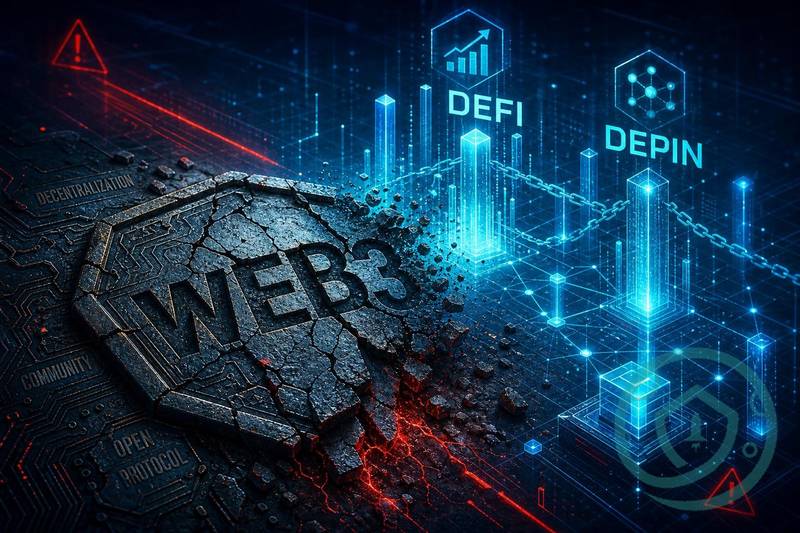
Kyle Samani Says Web3 Is Dead as DeFi and DePIN Lead Thumbnail
Multicoin Capital co-founder and Forward Industries Chairman Kyle Samani declared that “Web3 is dead,” arguing that only DeFi and DePIN remain as meaningful sectors in the cryptocurrency industry.
KEY POINTS
- Who: Kyle Samani, co-founder of Multicoin Capital and Chairman of Forward Industries
- What: Stated that “Web3 is dead” and that DeFi and DePIN are the only surviving sectors
- Why it matters: Signals a narrative shift among prominent crypto investors away from the broad “Web3” label toward specific use cases
What Samani’s Statement Signals for Crypto Narratives
Samani’s comment, reported by CryptoNews, draws a sharp line between the expansive vision of “Web3” and the narrower set of blockchain applications he considers viable. By naming only decentralized finance and decentralized physical infrastructure networks, he effectively dismisses years of investment theses built around broader Web3 categories like social tokens, decentralized identity, and metaverse projects.
As both a venture investor through Multicoin Capital and an industry executive through Forward Industries, Samani occupies a position where such statements carry weight. His framing suggests that capital allocation in the space may increasingly concentrate around protocols with measurable economic activity rather than speculative narratives.
The statement should be read as sector commentary, not a literal claim that all blockchain development has ceased. DeFi protocols continue to process billions in daily volume, while DePIN projects aim to build real-world infrastructure networks using token incentives. Both sectors share a common trait: they generate verifiable on-chain revenue or utility, unlike many projects that traded under the Web3 umbrella.
Why DeFi and DePIN Stand Apart
DeFi, which encompasses lending, trading, and yield protocols, has maintained its position as the most capital-intensive sector in crypto. It remains the primary driver of on-chain economic activity across Ethereum and competing Layer 1 networks, a trend that recent commentary from other crypto leaders like Eli Ben-Sasson has also underscored in their continued commitment to Ethereum’s ecosystem.
DePIN, by contrast, is a newer category that includes projects building decentralized wireless networks, compute marketplaces, and sensor grids. The sector’s appeal lies in its connection to physical infrastructure, which gives it a tangible value proposition that many earlier Web3 projects lacked.
Samani’s framing aligns with a broader sentiment shift visible across the industry. As institutional capital flows into crypto through vehicles like spot Bitcoin ETFs, investors have grown more selective about which sectors justify long-term allocation. The “Web3” label, once a catch-all for any blockchain-adjacent startup, has lost much of its utility as a differentiator.
This selectivity extends beyond venture capital. Retail traders and protocol developers are also gravitating toward sectors with proven demand. DeFi’s lending and trading volumes provide clear metrics, while DePIN projects can point to network coverage maps and hardware deployments as proof of traction.
The debate Samani’s comment has sparked is not whether blockchain technology has failed, but whether the industry’s branding kept pace with its evolution. As infrastructure challenges continue to test even well-funded ecosystems, the pressure to demonstrate real utility over narrative appeal is unlikely to ease.
For market participants watching how major exchanges expand into new markets, Samani’s statement serves as a reminder that the next phase of crypto adoption may be defined not by broad labels but by specific, measurable use cases.
Disclaimer: This article is for informational purposes only and does not constitute financial or investment advice. Cryptocurrency and digital asset markets carry significant risk. Always do your own research before making decisions.