

Best Decentralized AI Projects in 2026: The Control Points That Matter
Compare Bittensor, io.net, Gensyn, and Ritual by the control point each decentralizes, delivery evidence, and practical trade-offs.

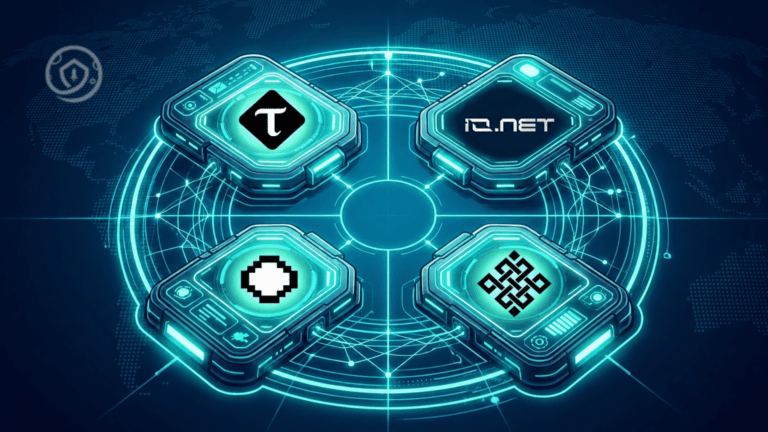
Bittensor is the strongest decentralized-AI candidate for incentive coordination around specialized intelligence tasks. io.net is the clearest distributed-provider candidate, Gensyn is the clearest decentralized machine-learning coordination candidate, and Ritual is the clearest model-execution and inference-verification candidate. Each distributes a different control point, which is why the broader AI crypto project comparison should not collapse them into one token narrative.
Decentralization is not a single product property. A network can distribute compute providers while centralizing the front end, distribute model execution while retaining a narrow verification boundary, or spread token ownership while leaving upgrades with a small operator group. The shortlist ranks projects by the specific boundary they move away from one operator.
Four decentralized AI projects at a glance
| Project | Distributed control point | Product role | Evidence that matters |
|---|---|---|---|
| Bittensor | Task incentives, miners, and validators | Specialized machine-intelligence markets | Subnet task, validator method, output quality, outside demand |
| io.net | GPU provider aggregation and routing | Distributed compute access | Provider availability, routing, workload completion, recovery |
| Gensyn | Machine-learning contribution and coordination | Distributed ML work | Reproducibility, contribution quality, completed task |
| Ritual | Model execution and verification boundary | AI model and inference workflows | Model access, proof scope, failure handling |
The table identifies the part of the stack each project actually distributes. It does not treat a token, an open repository, or a large node count as proof that every layer of the application is decentralized.
Project-by-project analysis
Bittensor
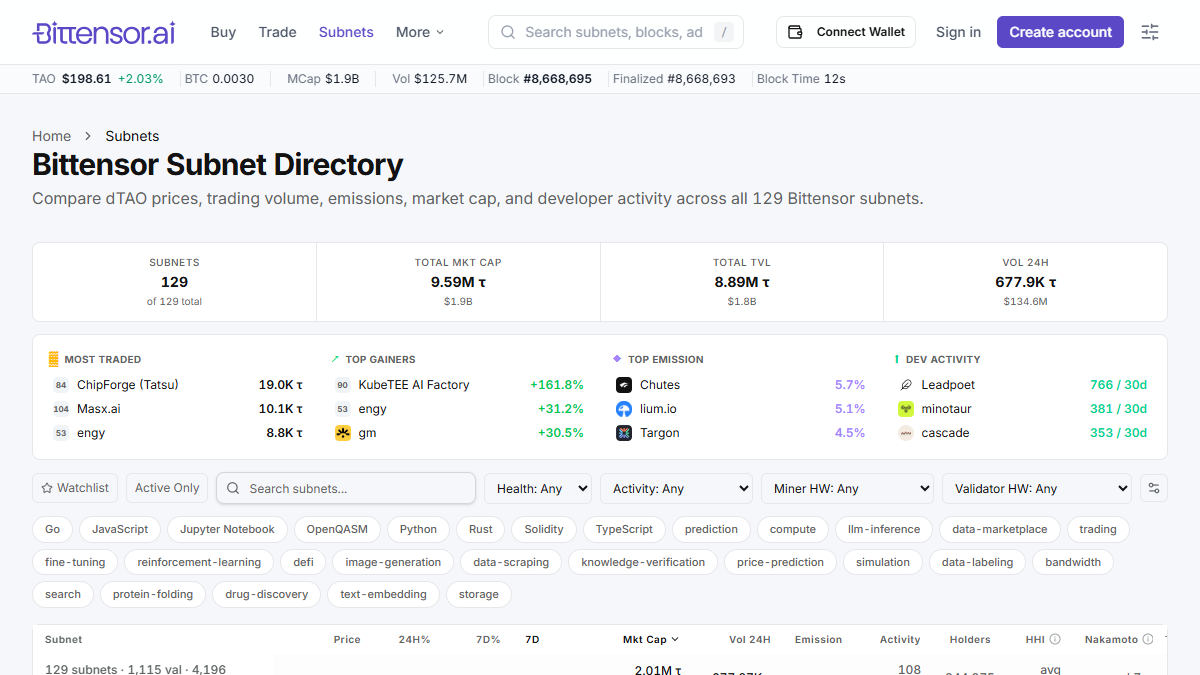
Bittensor distributes coordination around specialized subnets, miners, and validators. On the Bittensor network, a subnet creates a market for one class of intelligence work, then rewards contributors according to a scoring method. The result is a network where the task design and validator incentives matter as much as the number of participants.
The useful evidence is the subnet’s task definition, sample output, validator behavior, emissions structure, and outside demand for the result. A distributed miner set does not protect the reader from a weak benchmark or a validator process that rewards activity without useful output.
Bittensor’s main trade-off is quality control. The system can broaden contribution while making every subnet responsible for proving that its incentives track a result an outside user values. The Bittensor subnet guide provides the project-level follow-up.
Pros
- Organizes specialized intelligence work into separate incentive-driven subnets.
- Allows distinct subnet designs rather than forcing every use case into one model pipeline.
- Gives readers a task-level unit for judging demand beyond the TAO token.
Cons
- Validator quality can weaken the link between emissions and useful output.
- A busy miner set does not make a weak benchmark valuable to an outside user.
io.net
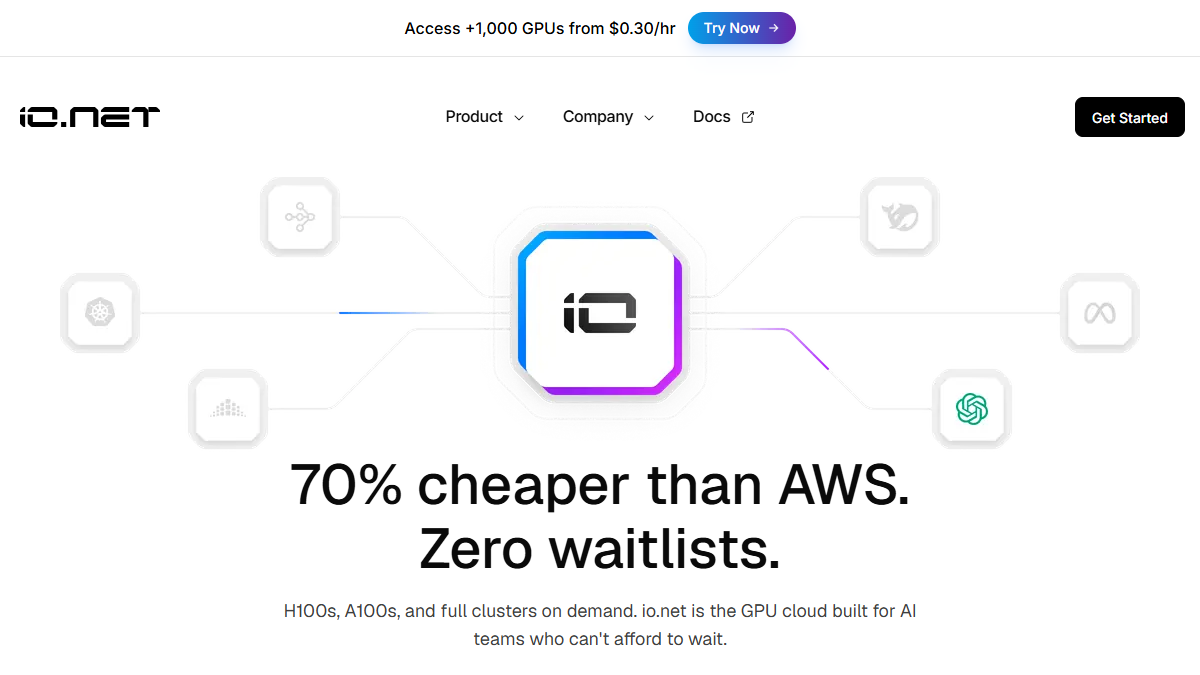
io.net distributes the supply side of compute by aggregating providers and routing workloads to them. The io.net marketplace makes its decentralization claim strongest when a buyer can obtain compatible capacity without relying on one cloud operator or one fixed provider relationship.
The relevant record names the requested hardware, the provider selected, the job completion result, the latency, and the recovery path. A headline capacity total is not enough when the needed GPU class is unavailable, the provider changes, or the workload cannot be restarted cleanly.
io.net’s main trade-off is consistency. Provider diversity can reduce dependence on one supplier while increasing routing, availability, and support complexity. The decentralized GPU network comparison provides the workload-level test for that provider diversity.
Pros
- Aggregates distributed GPU suppliers into a single compute-access layer.
- Routes workloads according to requested hardware and availability constraints.
- Makes provider diversity part of the supply model rather than a background statistic.
Cons
- The requested GPU class can be unavailable even when total capacity looks high.
- Provider changes and failed restarts can make a listed marketplace unsuitable for a time-sensitive workload.
Gensyn
Gensyn distributes machine-learning coordination rather than simply leasing idle hardware. The Gensyn network centers its claim on how a training or specialized ML task can be contributed to, completed, and checked across participants that do not need to trust one central operator.
The evidence boundary includes the workload definition, contribution method, reproducibility standard, verification process, and finished result. Participation statistics do not establish decentralized ML quality when the output cannot be reproduced or when the benchmark omits the conditions a buyer cares about.
Gensyn’s main trade-off is coordination overhead. Distributed contribution can create a broader supply base, but the project still needs to show that it produces a reliable result at a cost and timeline that a user can accept. The AI infrastructure comparison separates this task-completion test from a simple compute-marketplace comparison.
Pros
- Coordinates participants around distributed machine-learning work instead of simple resource resale.
- Treats the contribution path and verification process as part of the product surface.
- Makes a finished ML result the evaluation unit rather than provider count or token-market activity.
Cons
- Reproducibility claims matter only when the workload conditions can be independently repeated.
- Coordination overhead can make a distributed task slower or less economical than a centralized alternative.
Ritual

Ritual belongs to the model-execution and inference side of decentralized AI. The Ritual network focuses its relevant boundary on the path from an input to a model result and the evidence that the stated execution process occurred. This is narrower than proving the entire application is open or decentralized.
The profile should separate model access, proof coverage, data provenance, policy controls, and output delivery. A proof for one inference step does not establish that the input was correct, the model choice was appropriate, or the surrounding agent applied the result safely.
Pros
- Centers model execution and inference workflows rather than general-purpose cloud capacity.
- Treats proof scope as a bounded claim that can be matched to a delivered result.
- Lets teams inspect the path from a model request to an output claim.
Cons
- Proof for an inference step does not prove input quality, model selection, or safe agent policy.
- Verification value can arrive with additional latency and integration overhead.
Ritual’s main trade-off is scope. Verification can make a model-execution claim more credible while adding cost, latency, and integration work. The decentralized inference guide focuses on that proof and privacy boundary.
Research scorecard
The scorecard follows the profiles so decentralization is assessed at the actual control point, not as a generic label. It is editorial triage, not an investment rating.
| Project | Control-point clarity | Delivery evidence | Openness of participation | Main trade-off | Total |
|---|---|---|---|---|---|
| Bittensor | 9 | 8 | 8 | Subnet quality and validator incentives | 25/30 |
| io.net | 8 | 7 | 7 | Provider consistency and workload recovery | 22/30 |
| Gensyn | 8 | 7 | 7 | Reproducibility and coordination overhead | 22/30 |
| Ritual | 8 | 7 | 6 | Proof scope, latency, and integration cost | 21/30 |
Bittensor leads because the incentive boundary is explicit, although quality remains subnet-specific. io.net and Gensyn distribute supply and machine-learning work in different ways, while Ritual makes a narrower but useful model-execution claim. The scores reflect distinct properties rather than a universal definition of decentralized AI.
Control boundaries that change the ranking
| Project | Boundary moved away from one operator | Remaining concentration to disclose |
|---|---|---|
| Bittensor | Task contribution and validation across subnet participants | Validator concentration, emissions design, subnet governance |
| io.net | Provider supply and workload routing across hardware sources | Front end, routing policy, support, and billing dependencies |
| Gensyn | Machine-learning contribution and task coordination | Verification method, model constraints, task-owner control |
| Ritual | Defined model execution and verification path | Model choice, input provenance, surrounding application policy |
This is the practical comparison for decentralized AI. A project can be useful with remaining centralized components, but those components determine the real failure boundary and therefore the risk description.
Conclusion
Bittensor distributes intelligence-market incentives, io.net distributes access to provider capacity, Gensyn distributes machine-learning coordination, and Ritual distributes a defined model-execution boundary. These projects belong in the same category only when the reader keeps those distinctions intact.
The stronger project is the one that makes its distributed layer, remaining operator dependencies, and workload failure path visible. That standard produces a more useful shortlist than treating decentralization as a binary marketing claim, and it is consistent with the boundaries outlined in the Crypto x AI survey.
Frequently asked questions
What makes an AI project decentralized?
The answer depends on the control point. A project can distribute compute, data, validation, model execution, ownership, or governance without distributing every part of the application.
Are open-source AI projects decentralized?
Not automatically. Open code or model weights improve inspectability, while the service can still rely on one operator, API, dataset, payment rail, or deployment environment.
Is decentralized AI more reliable?
It can reduce dependence on one provider, but distribution also adds coordination, quality-control, and support challenges. Reliability is demonstrated at the workload level.
Why do decentralized AI projects use tokens?
Tokens can coordinate contributors, secure a network, reward work, or govern scarce resources. They do not prove that the underlying AI system is useful or fully decentralized.
Disclaimer:
The information provided on AiCryptoCore.com is for educational and informational purposes only and does not constitute financial, investment, or trading advice. Cryptocurrency investments involve risk and may result in financial loss. Always conduct your own research and consult with a qualified financial advisor before making any investment decisions.