

Circle CEO: Stablecoins Don’t Need Yield — But Must Offer Alternative Rewards
Circle CEO Jeremy Allaire argued on March 20, 2026 that stablecoins don’t have to pass yield to holders — but issuers must build alternative reward mechanisms to stay...


Circle CEO Jeremy Allaire argued on March 20, 2026 that stablecoins do not need to pass yield directly to holders, but that issuers must build alternative reward systems to remain competitive in a regulatory environment that increasingly separates stablecoins from bank deposits.
Allaire’s position comes amid a rapidly shifting U.S. regulatory landscape. The GENIUS Act, signed into law in July 2025, bans direct interest or yield payments from stablecoin issuers to holders, explicitly drawing a line between stablecoins and traditional bank deposits in Section 4 of the legislation.
A draft of the CLARITY Act, which surfaced in March 2026, proposed going further by barring rewards on passive stablecoin balances and any structure “economically equivalent to interest.” Circle shares (CRCL) fell approximately 20% on March 24, 2026 after the draft emerged, while Coinbase (COIN) dropped roughly 10%.
Rather than framing these restrictions as obstacles, Allaire described them as a “powerful tailwind” for USDC adoption, positioning Circle as a “network effect-driven business” built on transaction utility rather than passive yield.
Allaire’s Case for Transaction-Based Rewards Over Yield
During Circle’s Q1 2026 earnings call, Allaire laid out his vision for what replaces yield in a post-GENIUS Act world.
“It has to be based on real transactions, real payments volume, real activities, and that’s exactly the kind of incentivization that we want to see.”
— Jeremy Allaire, Circle CEO (Benzinga)
The alternative reward mechanisms Allaire outlined include cashback on transactions, merchant loyalty programs, and tiered benefits for high-volume users. Each ties incentives to active usage rather than passive holding.
“We are very focused on driving the utility value of this new form of money,” Allaire said, reinforcing that Circle’s strategy centers on payments throughput rather than competing with savings accounts.
The numbers support the utility thesis. USDC circulating supply reached approximately $77 billion at the end of Q1 2026, up 28% year-over-year. On-chain transaction volume hit $21.5 trillion in the same period, a 263% increase year-over-year.
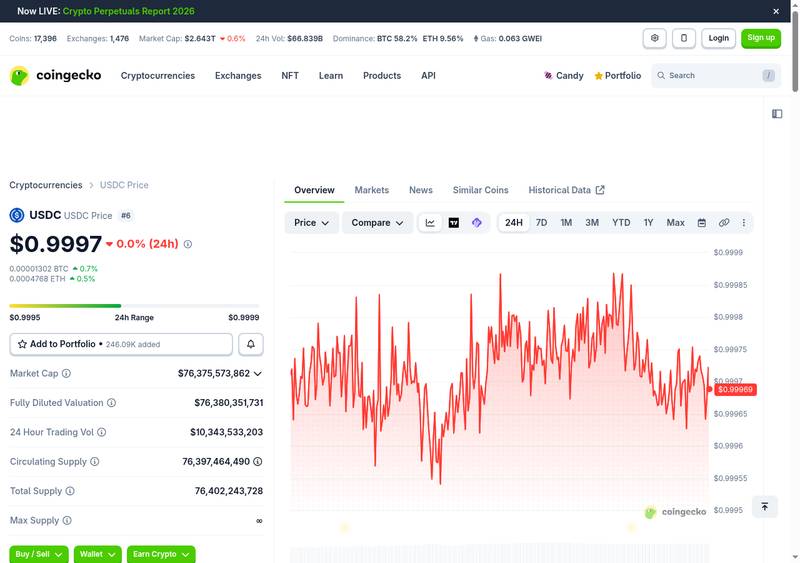
That volume growth dwarfs the supply increase, suggesting USDC velocity is accelerating independent of any yield incentive. Coinbase had previously structured USDC rewards at roughly 3.85% as third-party payments rather than issuer-paid yield, a workaround the CLARITY Act draft would close.
Why Alternative Reward Systems Matter for Stablecoin Adoption
The business model tension is straightforward: stablecoin issuers earn yield on the reserves backing their tokens. Under the GENIUS Act, they keep that yield. The question is whether holders stay without a direct cut.
Allaire’s answer is that transaction-based rewards create stronger retention than passive yield because they reward the behavior that grows the network. This framing also aligns with how the CLARITY Act carves out transaction-based and activity-based incentives as permissible, even as it restricts passive rewards.
Allaire told Yahoo Finance the CLARITY Act is “actually essential” to Circle’s ability to pay stablecoin rewards, suggesting the regulatory distinction between activity rewards and interest payments gives Circle legal cover to build the loyalty programs it wants.
Citi analysts offered an independent assessment, calling the CLARITY Act restrictions “potentially a scaling setback, but not a thesis killer” for Circle. The broader market remains cautious; the Fear & Greed Index sits at 34, firmly in Fear territory.
The competitive landscape adds urgency. Yield-bearing stablecoins from other issuers offer holders a direct return, and recent stablecoin depegging events have reminded the market that design tradeoffs carry real risk. Meanwhile, Tether’s expansion into new fiat-backed stablecoins shows that the largest issuer is competing on geographic reach rather than yield.
Circle is also investing beyond USDC itself. The company raised $222 million in a presale for its Arc Layer 1 blockchain at a $3 billion fully diluted valuation, with a16z crypto leading at $75 million alongside BlackRock, Apollo, Standard Chartered Ventures, and ARK Invest.
The regulatory boundaries between “rewards” and “interest” remain under active clarification by the OCC and Treasury. How those definitions settle will determine whether Allaire’s transaction-based reward model becomes the industry template, or whether regulatory uncertainty continues to weigh on stablecoin innovators across jurisdictions.
Disclaimer: This article is for informational purposes only and does not constitute financial or investment advice. Cryptocurrency and digital asset markets carry significant risk. Always do your own research before making decisions.


