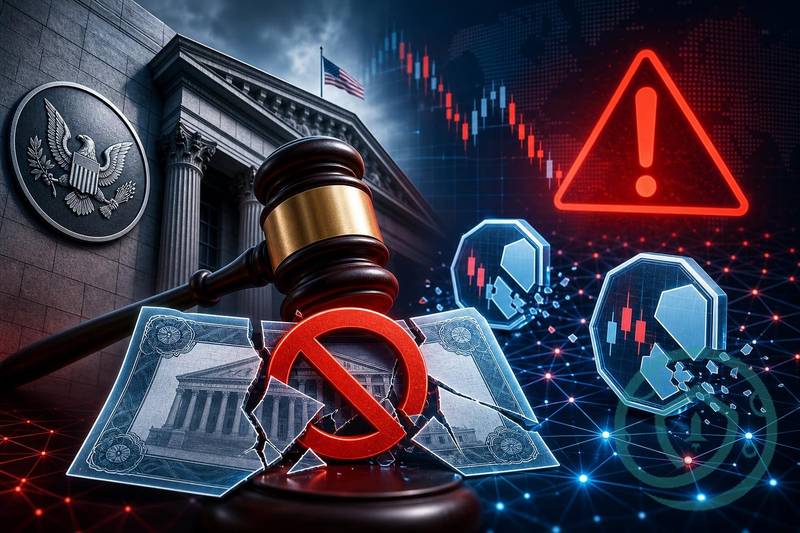
The U.S. Securities and Exchange Commission has delayed its planned exemption framework for tokenized stock trading, citing concerns over unauthorized equity tokens that could circumvent existing securities regulations.
The SEC’s Division of Corporation Finance issued a statement on tokenized securities outlining the agency’s position on blockchain-based representations of traditional equities. The delay signals that regulators are not yet satisfied with safeguards against tokens that replicate stock ownership without proper registration.
Unauthorized equity tokens, in plain terms, are digital assets that mirror the economic exposure of a publicly traded stock without the issuer’s consent or SEC registration. These tokens can be created on permissionless blockchains by third parties, effectively allowing synthetic stock trading outside regulated venues.
Why the SEC Paused the Tokenized Stock Exemption Plan
Key Points
- The SEC delayed, rather than approved or rejected, its tokenized stock exemption framework.
- Unauthorized equity tokens, digital assets that replicate stock exposure without issuer consent, are the stated concern.
- The pause raises compliance uncertainty for platforms building tokenized equity products.
The exemption plan was expected to create a regulatory pathway for platforms to offer blockchain-based versions of registered securities. Reports from Cointelegraph had indicated that the SEC was moving toward an innovation-friendly exemption for tokenized stock trading.
The core regulatory risk is straightforward: if third parties can issue tokens that track a company’s stock price without authorization, investors face counterparty risk with no recourse through traditional securities protections. The SEC’s mandate to protect investors makes this a threshold issue before any exemption can proceed.
The Unauthorized Token Problem
The concern is not hypothetical. OpenAI, for instance, has published a policy explicitly addressing unauthorized equity transactions involving its shares, highlighting how even private companies face exposure to unsanctioned tokenization.
SEC Commissioner Hester Peirce, known for her pro-crypto stance, has pushed back on the view that a crypto-friendly rule would inherently foster synthetic token creation. Her position suggests internal disagreement at the Commission over how to balance innovation with enforcement.
What the Delay Means for Tokenized Stocks and Crypto Markets
For platforms and issuers building tokenized equity products, the delay introduces a period of added regulatory uncertainty. Projects that were structuring offerings in anticipation of an exemption framework now lack a clear timeline for approval.
The pause also fits a broader pattern of cautious regulatory engagement with digital assets. Much like the House Oversight Committee’s insider trading probe into prediction markets, regulators are increasingly scrutinizing how blockchain-based financial products interact with existing securities law. Even large-scale crypto transactions by public companies are drawing heightened attention from lawmakers.
What Market Participants Will Watch Next
The immediate question is whether the SEC will issue revised guidance that addresses the unauthorized token concern while preserving a path for compliant tokenized securities. Any forthcoming rulemaking could also affect decentralized platforms that facilitate synthetic asset trading.
Industry observers will track whether the Commission’s internal divisions, particularly between Peirce’s innovation-oriented approach and more cautious factions, produce a compromise framework or further delays. The outcome could set a precedent for how traditional financial instruments are represented on public blockchains.
Disclaimer: This article is for informational purposes only and does not constitute financial or investment advice. Cryptocurrency and digital asset markets carry significant risk. Always do your own research before making decisions.