

How Do Crypto AI Signals Work? Timing, Accuracy, and Risk in 2026
Learn how crypto AI signals turn market data into timed alerts, how to read entry and invalidation levels, and how to test accuracy after latency and fees.


Crypto AI signals convert market data into a time-stamped trade hypothesis, such as a bullish BTC setup, an ETH exchange-inflow warning or a volatility alert. A useful signal identifies the asset, direction, entry condition, time horizon and invalidation point. It does not guarantee a price move and does not become a trade until a person or execution system decides how much risk to take.
The process usually starts with price, volume, order-book, derivatives, onchain or sentiment data. Software transforms those inputs into measurable features, runs them through rules or a trained model, filters weak outputs and delivers the surviving alert through a dashboard, app, email, Telegram or API.
What is a crypto AI signal?
A crypto AI signal is a structured alert produced with algorithmic or machine-learning analysis. It may estimate direction, identify an anomaly or rank the strength of a setup. The word “AI” describes how the evidence is processed; it does not prove that the system learns continuously or understands the market. Some services use a trained model, while others calculate familiar indicators and ask a language model to summarize the result.
Three signal families commonly appear in crypto products:
- Technical signals combine price, volume, RSI, moving averages, volatility or order-book imbalance to identify a market pattern.
- Onchain signals flag exchange inflows, large wallet transfers, token movements or changes in network activity.
- News and sentiment signals classify announcements, headlines and social discussion, then estimate whether the change is relevant to a particular asset and horizon.
A signal is different from a strategy and an execution system. The signal says that a measurable setup exists. A strategy supplies position size, entry method, stop and exit rules. Execution turns that decision into an order and fill. Onchain AI agents may cross that final boundary by interacting with a wallet, but a dashboard alert alone has no authority to move funds.
From market data to a signal card
Signal generation is a pipeline, not one prediction button. A credible provider should be able to explain each stage without revealing proprietary model weights.
- Ingest current data. The system collects candles, trades, order-book depth, funding rates, open interest, liquidations, wallet flows, news or social posts. Every feed needs a source timestamp and a rule for missing or stale values.
- Create features. Raw inputs become comparable measurements such as momentum over one hour, abnormal volume relative to a 30-day baseline, exchange net flow or a sentiment change after a project announcement.
- Run inference. A statistical model, machine-learning classifier or rules engine estimates an outcome. The output may be a direction, anomaly label, expected range or probability-like score.
- Apply filters. Liquidity, volatility, confidence, agreement across timeframes and data freshness determine whether the model output becomes a public alert or is discarded as noise.
- Build and deliver the signal. The product adds the asset, venue, entry condition, horizon, invalidation, rationale and timestamp before sending the card to a dashboard or notification channel.
One builder described a comparable live workflow in a March 2026 implementation report: fifteen-minute OHLCV updates, more than twenty indicators, multi-timeframe analysis and news sentiment were passed to an AI layer that returned direction, confidence, entry, take-profit and stop levels.
Signals above a threshold could reach an exchange API. This is a builder’s self-report with a small sample, not independent proof of accuracy, but it shows the components that a reader should expect to see documented.
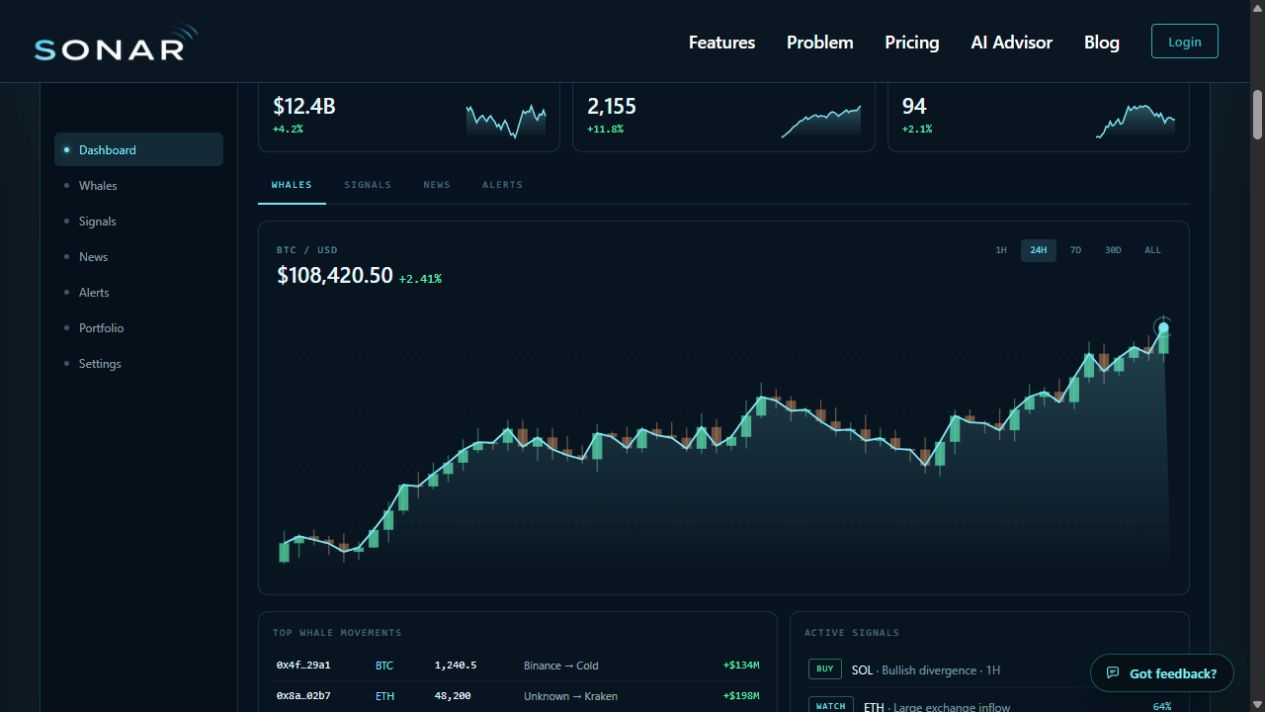
The dashboard above illustrates the input-and-output distinction. Price charts and whale transfers are observations; an active signal is the platform’s interpretation of those observations. A reader should not assume that one large transfer caused the forecast unless the signal rationale, timing and model rules establish that connection.
What a complete signal card must show
A signal card should preserve the conditions that existed when the alert was issued. The asset and reference venue establish which market was measured, while the publication time shows when the information became available. The setup must name a testable trigger rather than only displaying a bullish, bearish or high-confidence label.
- Entry condition: The price, event or indicator state required before the signal becomes active.
- Validity window: The period in which the alert may still be acted on without retrospectively changing its meaning.
- Invalidation: The observable condition that proves the original thesis no longer holds.
- Evaluation horizon: The deadline used to classify the result instead of leaving the call open indefinitely.
- Confidence definition: The inputs or model agreement represented by the score, including whether it has been calibrated against outcomes.
- Reference benchmark: The market return or simple rule used to test whether the signal added information.
An alert that expires without meeting its entry condition should remain in the archive as expired. A failed thesis should remain visible after invalidation, and a corrected signal should retain its earlier version. Kraken’s explanation of crypto signals also separates entry, take-profit and stop-loss information, illustrating why a directional label alone is not enough to evaluate a service.
Position size remains outside the signal. A user still has to decide whether the setup fits existing exposure, available liquidity and an acceptable loss limit. AiCryptoCore’s Trading Mock Pro can be used to record those decisions before any signal is connected to live execution.
Timing decides whether a signal is tradable
Four timestamps reveal whether the product saw the move early enough: the time of the latest source data, the time the model ran, the time the alert was published and the earliest realistic execution time. A service that shows only the alert timestamp can hide stale inputs or processing delays. For a five-minute signal, a two-minute delay may consume most of the opportunity; for a weekly setup, the same delay may be irrelevant.
Liquidity changes the result as well. A deep spot market may remain near the quoted entry, while a thin newly listed token can move through the entire range before a subscriber receives the notification. An alert about an unlaunched or newly traded AI token should therefore be checked against the product and token evidence in the AI-agent coin comparison, not treated like a mature large-cap signal.
A community discussion about AI crypto insights captured this problem from the user side: one participant said the output felt behind current conditions, while another argued that AI without live market or onchain context becomes stale. That freshness discussion is not a named-provider latency benchmark. It supports a narrower test: compare the source timestamp and market state with the moment the alert was actually available.
Accuracy is not the same as profitability
- Accuracy: Measures how often a defined prediction is correct, but does not account for the size of wins and losses.
- Precision: Measures what share of issued bullish or bearish alerts reached the provider’s predefined target.
- Recall: Measures how many qualifying market moves the model detected instead of how many issued signals succeeded.
- Calibration: Tests whether signals labeled with a stated confidence level produce comparable outcomes across a large, consistently defined sample. A confidence score is not a win rate until this relationship has been demonstrated.
- Expectancy: Combines the observed win rate, average valid gain, average valid loss, fees and realistic execution costs. It must be calculated from the provider’s complete dated archive rather than a selected group of successful calls.
- Archive integrity: Every issued, expired, edited and invalidated signal must be classified under rules fixed before the outcome is known. Excluding failed calls, changing targets or selecting favorable assets makes the headline accuracy irreproducible.
- Market-regime coverage: Testing only a bull market rewards models that repeatedly predict upside. A study comparing 41 machine-learning models for Bitcoin trading found that robustness must be examined across different market conditions rather than inferred from one accuracy number.
- Live execution gap: Historical results do not fully reproduce notification delay, spread, partial fills, liquidity changes or subscriber behavior. Profitable backtest results therefore remain separate from realized live performance.
How to audit a crypto AI signal service
Start with the complete dated archive. Each signal should preserve its publication time, asset, market, trigger, horizon and invalidation rule; deleted losses, edited entries or open-ended calls make the provider’s accuracy impossible to reproduce.
Paper-track every valid, expired and rejected signal using prices available after notification. Compare the result with buy-and-hold and a simple non-AI rule so a favorable market is not mistaken for model skill.
Keep signal access separate from execution authority. If automation is enabled, use capped trade-only access without withdrawal permission and apply the controls described in the wallet separation and DeFAI policy guides.
Reject guaranteed returns, accuracy claims without a defined sample, screenshots without an archive and pressure to deposit on an unknown platform. The CFTC warns that AI cannot predict sudden market changes, making unusually certain profit claims a clear risk signal.
Conclusion: useful signals preserve the path from data to outcome
A crypto AI signal works by converting dated inputs into features, model output, a filtered alert and a testable signal card. The model matters, but the timestamps, trigger, invalidation and complete history determine whether a reader can evaluate it. A fluent explanation or high confidence score cannot replace those records.
The strongest service is not necessarily the one publishing the most calls. It is the one that preserves failed and expired signals, explains where its data came from and lets subscribers compare realistic post-notification results with a benchmark. Until that evidence exists, treat the signal as a research input rather than permission to trade.
Frequently asked questions
Are crypto AI signals trading advice?
They are analytical outputs that may inform a decision, but they do not know a reader’s portfolio, loss tolerance or legal circumstances. Position sizing and execution remain separate decisions.
Does 80% confidence mean an 80% win rate?
Not unless the provider demonstrates that relationship through calibration testing. Confidence may represent model agreement or signal strength rather than a statistically validated probability.
How long should a signal remain valid?
The provider should define the horizon before publishing the result. A short-term alert may expire within minutes, while a swing setup may remain valid for days. An open-ended signal cannot be scored consistently.
Can beginners test signals without trading real money?
Yes. Record every alert in a paper account, use the price available after notification, include fees and expired signals, and compare the result with a simple benchmark before considering live execution.
Disclaimer:
The information provided on AiCryptoCore.com is for educational and informational purposes only and does not constitute financial, investment, or trading advice. Cryptocurrency investments involve risk and may result in financial loss. Always conduct your own research and consult with a qualified financial advisor before making any investment decisions.