AI Agents vs AI Infrastructure Crypto: Which to Buy Before 2027
NewsAI agent tokens vs AI infrastructure crypto compared by token utility, risk profile, and 2027 positioning. Which category is worth owning before year-end and why.


AI agents and AI infrastructure are not the same trade. They sit on different layers of the stack, respond to different demand signals, and fail in different ways. Treating them as interchangeable because they both carry the AI label is one of the more reliable ways to get burned by this category.
This article is a direct comparison framework for investors deciding where to allocate in Q4 2026 with a hold horizon into 2027. It does not rehash every project in both categories. For those, see best AI agent crypto coins, AI infrastructure crypto coins, and best AI crypto coins Q4 2026.
The short answer: infrastructure is the more defensible structural trade. Agents are the higher-upside, higher-volatility trade. Which deserves more weight depends on your time horizon, risk tolerance, and view on whether the next six months will be driven by fundamentals or narrative.
How the two layers differ
The AI-crypto stack has three layers. Infrastructure sits at the bottom. Agents sit at the top. Most of the confusion in this category comes from conflating them.
- Infrastructure layer provides the physical and data inputs that AI systems consume: GPU compute (Render, Akash, io.net), data networks (Grass, OriginTrail), and coordination rails (Chainlink). These projects have revenue models that can be analyzed like commodities businesses. Demand comes from AI workloads. Supply comes from hardware operators. The margin sits between them.
- Agent layer provides the applications and economies built on top of infrastructure: autonomous agents that execute tasks (Bittensor subnets, Virtuals Protocol agents, Wayfinder), multi-agent coordination protocols (ASI Alliance, Autonolas), and DeFAI execution tools (Griffain, Giza). These projects have revenue models closer to platforms and marketplaces. Demand comes from users who want AI to do something. Value accrues to the protocols that coordinate and settle that activity.
- The key structural difference: Infrastructure demand is pulled by external AI spending (big tech, enterprise AI labs, developer tools). It does not require the crypto ecosystem to grow for the underlying business to be real. Agent demand is pulled primarily from within the crypto ecosystem — it requires crypto-native users to adopt AI-powered workflows. That is a meaningful distinction for evaluating durability.
Head-to-head comparison
| Dimension | AI Infrastructure | AI Agents |
|---|---|---|
| Token utility | Access fees, provider payments, settlement | Agent access, co-ownership, fee sharing |
| Demand driver | External AI workload growth | Crypto-native adoption |
| Competitive moat | Supply-side network effects, hardware lock-in | Developer ecosystem, agent quality |
| Narrative dependency | Low to medium | High |
| Volatility pattern | Lower beta to AI narrative cycles | Higher beta to AI narrative cycles |
| Failure mode | Commodity price compression | Ecosystem attention collapse |
| Best cycle phase | Accumulation and consolidation | Expansion and narrative peaks |
| Representative tokens | RNDR, AKT, IO, LINK | TAO, VIRTUAL, FET/ASI, PROMPT |
The infrastructure case for 2027
The infrastructure case rests on three durable observations.
First, big-tech AI capex is structurally large and growing. Global AI infrastructure spending exceeded $200 billion in 2025. Forecasts for 2026–2027 are higher. That spending validates demand for GPU compute, data, and coordination infrastructure at a scale that decentralized networks can partially serve. Even capturing a small share of that demand creates a real revenue base.
Second, infrastructure tokens have supply-side defensibility that agent tokens lack. A GPU marketplace with 10,000 verified nodes has a meaningful supply-side network effect. A new entrant cannot replicate that overnight. An agent protocol, by contrast, is primarily software — it can be forked, re-themed, and relaunched with a different narrative without requiring hardware.
Third, infrastructure revenue is more legible. Render’s GPU utilization rate, Akash’s active deployment count, io.net’s cluster hours — these are measurable signals that institutional research desks can model. That legibility reduces the valuation multiple compression risk that hits narrative-dependent tokens when attention cycles end.
The infrastructure risk: Commodity price compression is real. AWS, GCP, and Azure are pricing aggressively, and the centralized alternatives have better SLAs for enterprise buyers. The distributed compute value proposition is clearest for specialized workloads and sovereign compute applications. For general-purpose compute, centralized providers are formidable competitors.
The agent case for 2027
The agent case rests on a different set of observations.
First, agent adoption is early enough that the narrative premium is partly justified. The question is not whether AI agents will be economically significant — they clearly will be. The question is whether crypto-native agent protocols capture enough of that value to justify current valuations. In 2026, the honest answer is: not yet, but the trajectory is credible.
Second, Solana Breakpoint 2026 established “Token Supercycle” as the dominant Solana-ecosystem framing. That framing explicitly includes tokenized agent economies. Breakpoint narrative cycles historically generate 6–12 months of sustained developer attention for the highlighted themes. The agent economy is the central theme of Breakpoint 2026, which means developer and user inflows into agent protocols are likely to accelerate through H1 2027.
Third, agent tokens have asymmetric upside that infrastructure tokens do not. A GPU compute token that 5x-es would be remarkable. An agent protocol token that captures a meaningful share of an economy where autonomous agents transact on behalf of billions of users would be worth far more than any compute marketplace. The upside is speculative, but the ceiling is higher.
The agent risk: Attention collapse is fast. Agent protocol tokens fell 60–80% from their Q1 2026 peak within three months as the narrative shifted. Infrastructure tokens fell less and recovered faster. If you are holding agent tokens through a narrative trough, the recovery path depends on demonstrated adoption that most agent protocols have not yet proven.
Crossover projects: both layers at once
Three projects meaningfully span both categories, which changes the comparison for them.
Bittensor (TAO) operates as both infrastructure (the decentralized AI coordination network) and agent economy (the subnet ecosystem that runs AI services). TAO’s dual-layer nature makes it the most interesting position in the comparison: less volatile than pure agent plays, more upside than pure compute infrastructure.
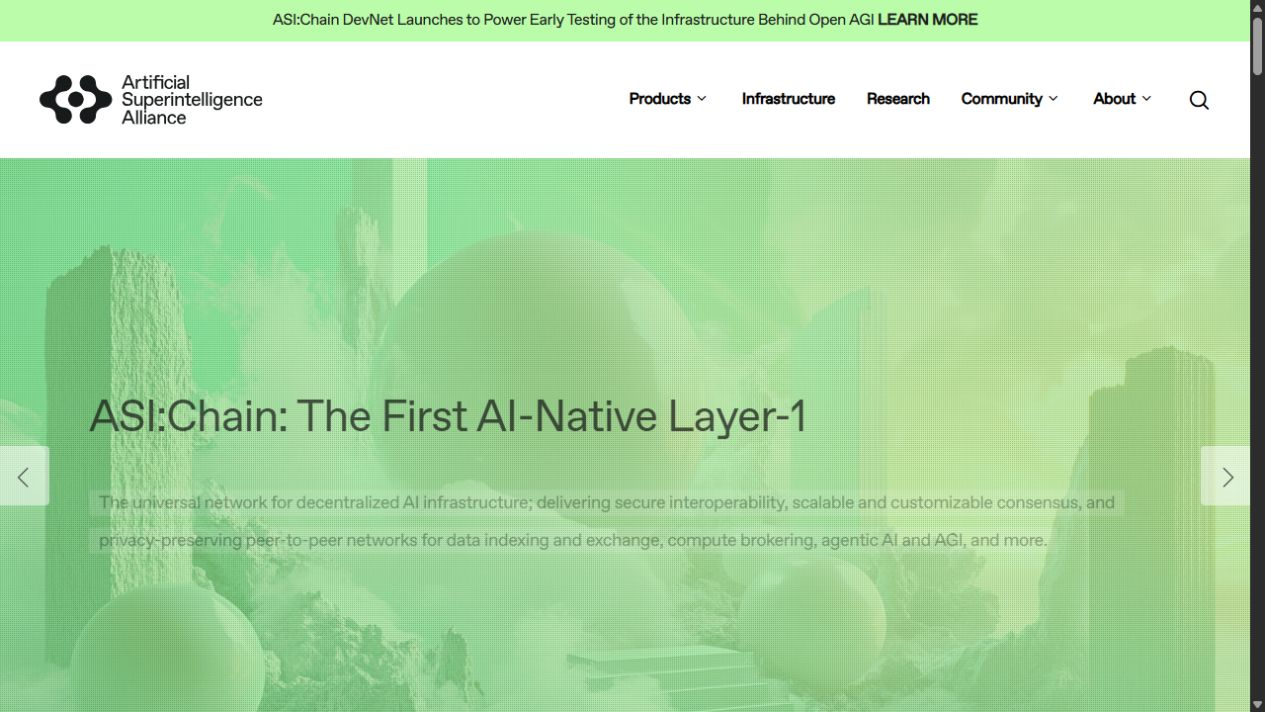
ASI Alliance (ASI) spans data infrastructure (Ocean Protocol heritage), agent coordination (Fetch.ai heritage), and AI service marketplace (SingularityNET heritage). The merger created integration overhead but also created the most cross-layer coverage of any single token in this category.
Chainlink (LINK) is primarily infrastructure (oracle and data layer) but increasingly functions as agent coordination infrastructure as the CCIP and Functions products expand into AI-agent use cases. LINK’s institutional adoption base and regulatory durability make it the lowest-risk infrastructure play, though upside is constrained by the same factors.
Allocation framework
This is not a portfolio recommendation. It is a framework for thinking about relative weight.
| Scenario | Infrastructure weight | Agent weight |
|---|---|---|
| You have a 6-month horizon and high risk tolerance | 30% | 70% |
| You have a 12-month horizon and medium risk tolerance | 50% | 50% |
| You have a 24-month horizon and lower risk tolerance | 70% | 30% |
| You believe 2027 will be narrative-driven | 30% | 70% |
| You believe 2027 will be fundamentals-driven | 70% | 30% |
| You want the lowest volatility AI crypto exposure | 90% (RNDR, LINK, AKT) | 10% |
The crossover projects (TAO, ASI) sit between the two buckets and can substitute for either depending on conviction.
FAQ
Are AI agent tokens or AI infrastructure tokens safer?
Infrastructure tokens have lower narrative dependency and more legible revenue signals, which generally means lower volatility and more durable floors. Agent tokens have higher upside but also higher drawdown risk. Neither is “safe” by conventional standards — both are high-risk crypto assets.
Which AI crypto category performed better in 2026?
Infrastructure tokens outperformed in H1 2026 when big-tech AI capex news drove positive sentiment. Agent tokens briefly outperformed in Q1 2026 at the narrative peak before a significant correction. As of Q3 2026, infrastructure tokens have lower drawdowns from peak than agent tokens across the category.
What is the difference between AI agent tokens and DeFAI tokens?
DeFAI tokens are a subset of agent tokens specifically focused on DeFi use cases — autonomous yield management, position rebalancing, liquidity provision. General AI agent tokens (Virtuals, Bittensor subnets) cover a wider range of applications. See best DeFAI projects 2026 for the DeFAI-specific breakdown.
When should I buy AI agent tokens vs infrastructure tokens?
Infrastructure tokens are more suitable for accumulation during market consolidation because their floor support comes from actual workload demand rather than narrative momentum. Agent tokens are more suitable for entry ahead of specific narrative catalysts (Solana Breakpoint, Devcon, major agent product launches) because their price action is more directly driven by attention cycles.
Is Bittensor an agent token or infrastructure token?
Bittensor spans both categories. The network itself is infrastructure — a decentralized coordination layer for AI systems. The subnets running on Bittensor are agents and applications. TAO’s dual-layer nature is part of why it tends to be less volatile than pure agent protocol tokens while retaining meaningful upside compared to pure compute infrastructure tokens.
Disclaimer: This article is for informational purposes only and does not constitute financial or investment advice. Cryptocurrency and digital asset markets carry significant risk. Always do your own research before making decisions.