Lombard Review 2026: Complete Beginner’s Guide to LBTC, BTC.b, Bitcoin Earn and Borrowing Against Bitcoin
ReviewLast updated: November 17, 2026. Independent editorial review. We have no commercial relationship with Lombard.


Last updated: November 17, 2026. Independent editorial review. We have no commercial relationship with Lombard.
Who This Guide Is For
This guide is for people who own Bitcoin and keep seeing the same pitch: "your Bitcoin is sitting idle, put it to work". You do not need to know what a wrapped token, a bridge, a covered call or a vault is. We explain each term the first time it appears, with an everyday comparison.
It is also for readers who already know the name Lombard from earlier years, and want to know what the product is in late 2026. The docs now say the yield on its main token comes from selling options on Bitcoin, run by an outside asset manager. It also has a second token with no yield, a managed vault, a credit product and an institutional product for people who hold Bitcoin with a custodian.
We did not only read the marketing. We opened the live site and the live app on a desktop, a tablet and a phone, clicked through every screen we could reach, and compared the numbers against independent sources. We also hit a wall that most guides skip, and we describe it in full: the app asked us to certify our legal status, and showed "Product unavailable" on some pages. Where we could not test something, we say so.
How We Tested Lombard
| Device | Viewport | What we did |
|---|---|---|
| Desktop | 1440 x 900 | Homepage, five product pages, docs, and every app screen we could open |
| Tablet | 1024 px wide | Homepage, Earn product page, app Portfolio screen, wallet connection screen |
| Phone | about 430 px wide | Homepage, LBTC product page, app Portfolio screen, wallet connection screen |
The Wallet We Used, and Where We Stopped
We prepared a brand new, throwaway MetaMask profile with no funds. The Lombard connection screen listed MetaMask as "Detected", so the technical side was ready.
We did not finish connecting, and we want to be clear about why. Before you can pick a wallet, the screen asks you to tick three boxes. Two confirm that you accept the Terms of Service and the LBTC product terms. The third says you are not living in a restricted jurisdiction and are not a US or UK person. These are legal statements. We did not want to make them as part of a test, so we left them unticked and stopped at that gate. Everything in this article about balances, deposit forms and minting therefore comes from the docs or from public pages. We did not see a connected dashboard.
We did not deposit anything, sign anything or approve any spending permission. The full list of what we did not test is in the FAQ at the end.
Quick Verdict
Lombard is one of the better documented Bitcoin products we have reviewed. It names its custodians, its strategy manager, its 14 signing institutions and its auditors, and the docs carry a full risk page with a rating for each risk. The weak points are commercial and presentational. The yield on its main token is far below its own target, the sites disagree with each other on basic numbers (yield, consortium size, value locked), the amount of Bitcoin locked is about 80 percent below its peak, the governance token is about 94 percent below its high, and the product is closed to people in the US and UK and to anyone in a restricted jurisdiction. It is best seen as a serious but unfinished product for non-US holders who accept a trust model built on institutions, not on code alone.
| Item | Detail |
|---|---|
| Project | Lombard (Lombard Finance) |
| Website | lombard.finance (marketing), lombard.finance/app (the app), docs.lombard.finance |
| Products | LBTC, BTC.b, Bitcoin Earn, Bitcoin Onchain Credit Strategy, Bitcoin Smart Accounts, SDK |
| Chains | Ethereum, Base, BNB Chain, Avalanche, Solana, Sui and others (10 per the docs) |
| Tokens | LBTC (yield-bearing Bitcoin), BTC.b (plain 1:1 Bitcoin), BARD (governance) |
| Our editorial score | 3.5 out of 5 |
| Wallet needed to browse | No for the marketing pages and most app screens |
| Money at risk in our test | None |
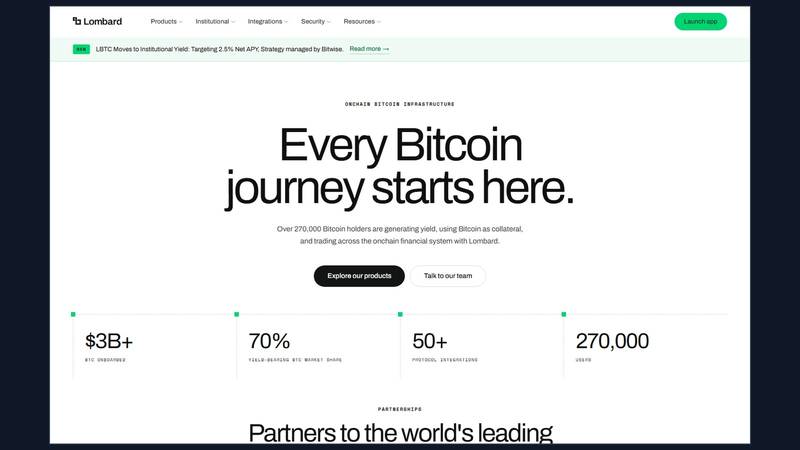
Lombard homepage on desktop showing the headline Every Bitcoin journey starts here and four headline statistics.
What Is Lombard (Plain English)
Bitcoin lives on its own network. It cannot be used directly in most of the apps people use to lend, borrow or trade, because those apps run on other networks such as Ethereum or Solana. The usual fix is a "wrapped" token. You hand over real Bitcoin, someone holds it, and you receive a token on the other network that is meant to be worth the same.
Think of a coat check. You hand over your coat and get a numbered ticket. You can trade the ticket, use it as security for a loan, or hand it back later to get the coat. The ticket is only worth something if the coat is really there and the person at the desk is honest.
Lombard runs the coat check for Bitcoin. Its two tickets are:
- BTC.b: a plain ticket. One BTC.b equals one Bitcoin. No yield.
- LBTC: a ticket that grows in value. Part of the stored Bitcoin is used to earn income, and the ticket's price against Bitcoin rises slowly as income arrives.
In Plain Terms
- You send real Bitcoin to an address Lombard gives you, and you receive LBTC or BTC.b on another network.
- Lombard says the Bitcoin is held by named institutions, and that 10 of 14 independent institutions must sign off on every critical action.
- With LBTC you earn a variable yield, which the Lombard docs say comes from selling "covered calls" on Bitcoin (we explain this below).
- You can use LBTC as collateral to borrow dollar-pegged coins, or put it into other apps.
- To get your Bitcoin back, you burn the token and Lombard sends native Bitcoin to your address. For LBTC this can take up to 10 days.
The Four Roles
| Role | What you do | What you get | Main risk |
|---|---|---|---|
| Plain holder | Mint BTC.b | Bitcoin you can use on other networks, with no yield | Trust in the custody and signer system |
| Yield seeker | Mint LBTC and hold it | A variable yield paid in Bitcoin terms | Strategy risk and a long exit window |
| Borrower | Use LBTC as collateral in Aave, Spark, Morpho or Jupiter | Stablecoin loans | Liquidation if prices fall |
| Vault depositor | Put Bitcoin into Bitcoin Earn or the credit strategy | A managed yield | Strategy and counterparty risk, 14-day withdrawal window (docs) |
Key Facts
| Item | Figure | Source and date |
|---|---|---|
| Total value locked (app Earn page) | $548.0m | Lombard app, Nov 17, 2026 |
| LBTC value locked (app) | $409.5m | Lombard app, Nov 17, 2026 |
| LBTC value locked (tracker) | $429.1M | DefiLlama, Nov 17, 2026 |
| BTC.b value locked | $140.5M | DefiLlama, Nov 17, 2026 |
| Lombard Vaults value locked | $59.2M | DefiLlama, Nov 17, 2026 |
| LBTC peak value locked | $2.107B on May 12, 2025 | DefiLlama history |
| "BTC onboarded" (homepage and docs) | $3B+ | Lombard homepage, Nov 17, 2026 |
| Users (homepage) | 270,000 | Lombard homepage, Nov 17, 2026 |
| Yield-bearing BTC market share (homepage) | 70% | Lombard homepage, Nov 17, 2026 |
| Hack history | None in the DefiLlama hacks database | DefiLlama, Nov 17, 2026 |
| Audits | 10 reports from 6 firms (docs), 2 counted by DefiLlama | Docs and DefiLlama |
Why the Numbers Differ
We found four different value-locked figures, and we cannot tell you which is "right".
- The app says $548.0m in total, made up of LBTC at $409.5m, Bitcoin Earn at $59.5m and the credit strategy at $38.0m. Those three add up to $507.0m (our calculation), not $548.0m, so there is about $41M that the page does not explain.
- DefiLlama lists LBTC at $429.1M, BTC.b at $140.5M and Lombard Vaults at $59.2M. Added together that is $628.8M (our calculation), and part of it may overlap, because vault deposits can themselves hold LBTC.
- CoinGecko prices the circulating LBTC at $389.6M. That is 6,033 LBTC at $64,576 each (our calculation agrees with the page).
- The homepage and docs say "$3B+ BTC onboarded". That is about five times any current figure above. It may be a cumulative number of deposits over time, but the site does not say. We treat it as a marketing figure, not a balance.
When you compare Lombard with other projects, use one source for all of them.
The Big Drop
DefiLlama shows LBTC's locked value at $2.107B on May 12, 2025, and $429.1M now. That is about 80 percent lower (our calculation). LBTC's own price also fell, from a high of $125,812 on Oct 6, 2025 to $64,576 now (CoinGecko), so part of the drop is price and part may be people leaving. The data we saw cannot split the two.
Related Entries
DefiLlama keeps Lombard in three entries, LBTC, BTC.b and Vaults, and it files LBTC under "Restaked BTC" and BTC.b under "Bridge". The wide gap between product labels is a reminder that the same company runs very different kinds of risk.
How Lombard Looks on Your Device
Desktop
The homepage is clean and light, with a green accent and a large headline, "Every Bitcoin journey starts here." Four statistics sit under it: $3B+ BTC onboarded, 70% yield-bearing BTC market share, 50+ protocol integrations and 270,000 users. A green banner above the page says LBTC "moves to institutional yield: targeting 2.5% net APY, strategy managed by Bitwise". Below, a row of logos shows Bitwise, Anchorage Digital, Aave, Morpho, Binance, Bybit, Ledger and Chainlink.
The app is a separate part of the site at lombard.finance/app. A left sidebar has Portfolio, LBTC, Earn, Borrow, Bridge and Swap. A green "Connect" button and a "Deposit" button sit in the top right.
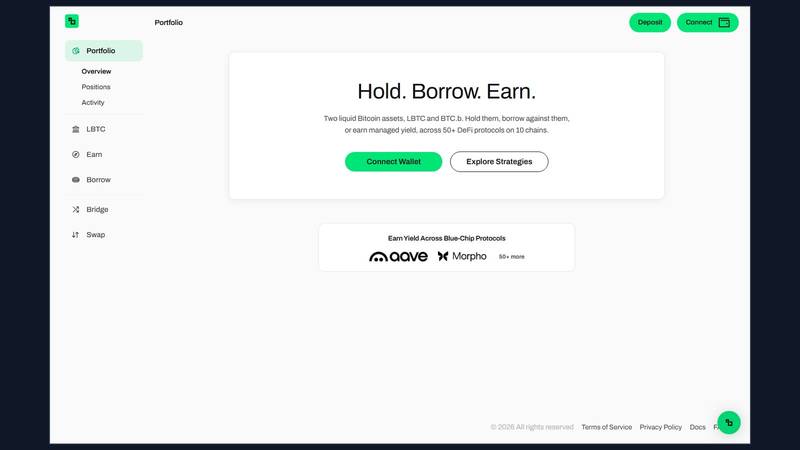
Lombard app Portfolio screen on desktop with a sidebar and the Hold, Borrow, Earn headline.
Tablet
On a tablet the marketing site keeps its layout, with a menu icon in place of the full navigation. The app handles the smaller width well: the sidebar shrinks to a column of icons with no text labels, and the main card stays centered. The icons are not labelled, so a first-time visitor has to guess what each one does.
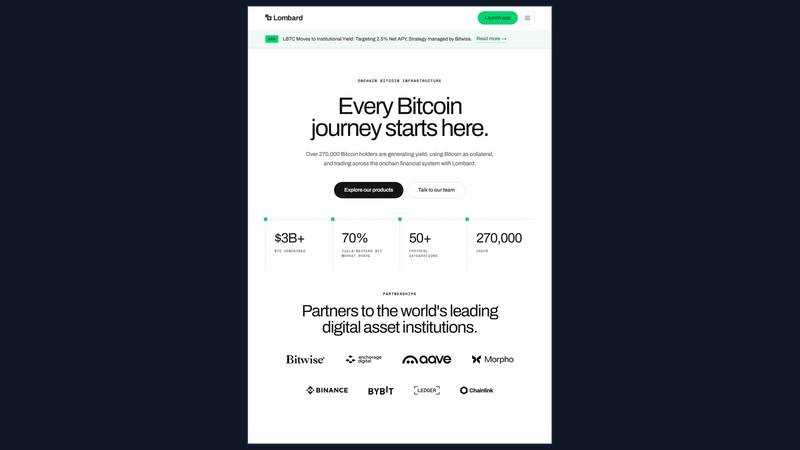
Lombard homepage on a tablet.
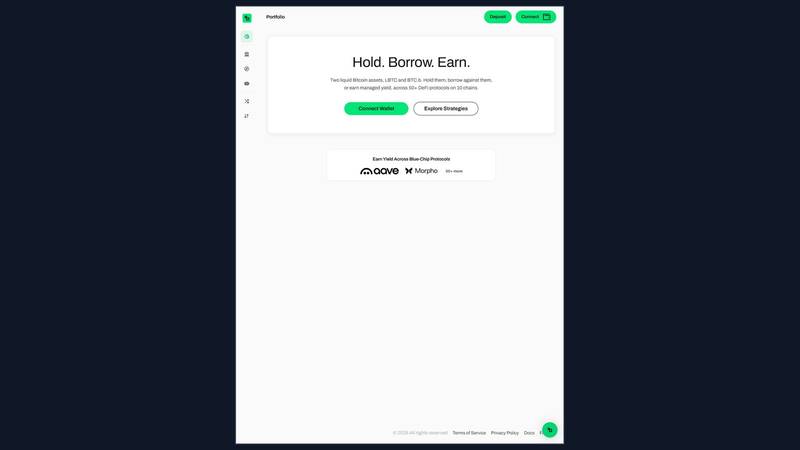
Lombard app Portfolio screen on a tablet with the sidebar reduced to icons.
Phone
On a phone the homepage stacks into one column, and the four statistics become a two-by-two grid. The app swaps the sidebar for a round menu button next to the Connect button, and the wallet screen fits the narrow width. We found no clipped text on the pages we opened.
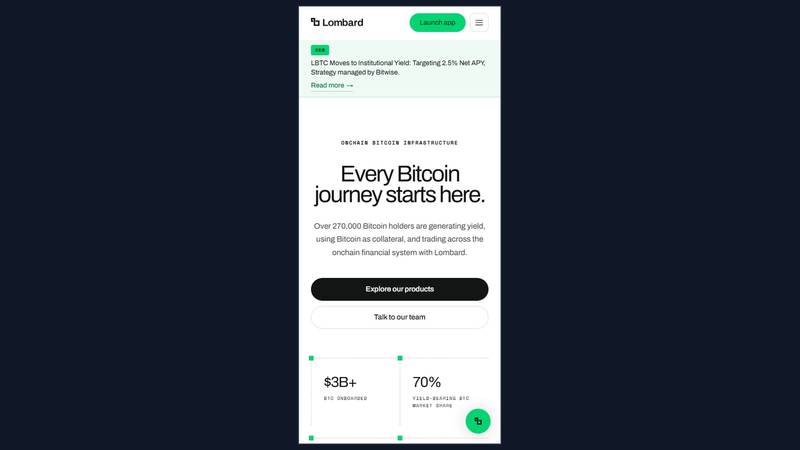
Lombard homepage on a phone.
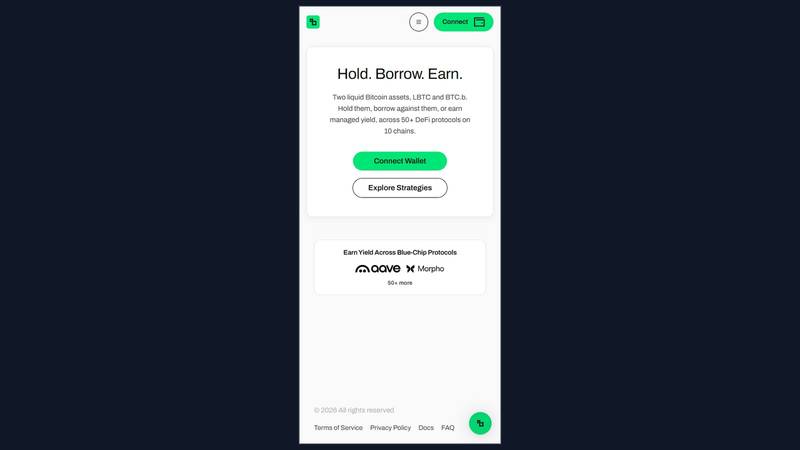
Lombard app Portfolio screen on a phone with a menu button.
Bugs and Rough Edges We Found
- Several app pages, including the LBTC page and a staking page, showed "Product unavailable. This product is unavailable to you based on the Lombard Terms of Service" when we opened them. The message appeared before any wallet was connected, so the site must decide from where we connected. We discuss this restriction in the next section.
- The BTC.b product page lists Katana among the chains where BTC.b is available, but the docs say native minting and redemption on Katana were deprecated from September 16, 2026. The page looks out of date on this point.
- The tablet app shows icon-only navigation with no labels.
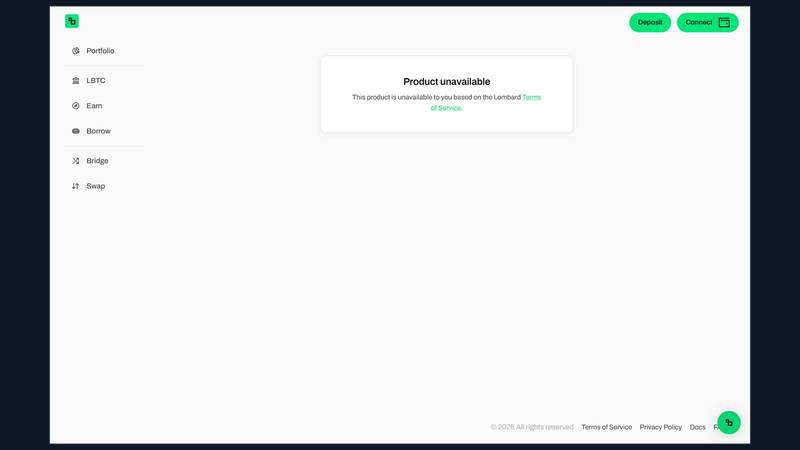
Lombard app showing Product unavailable on desktop.
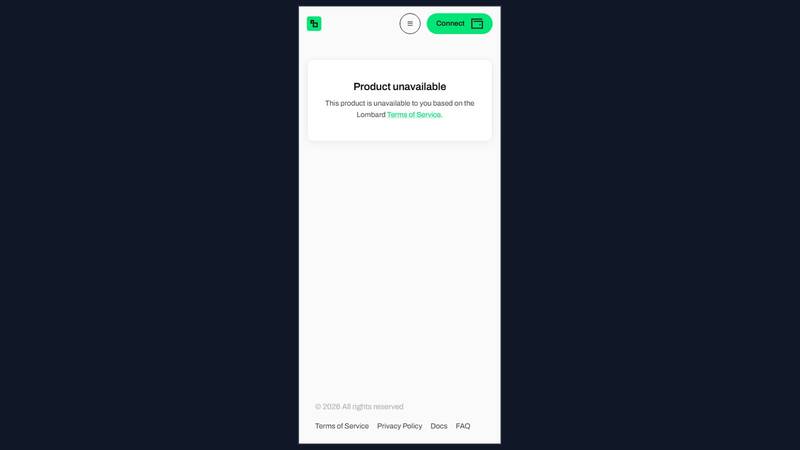
Lombard app showing Product unavailable on a phone.
Connecting Your Wallet (and the Gate in Front of It)
- Open the app at lombard.finance/app and press Connect or Connect Wallet.
- A box titled "Connect Wallet" opens. At the top are three tick boxes:
- I have read and accept the Terms of Service and understand the associated risks.
- I have read and accept the LBTC Product Terms and understand the risks specific to LBTC.
- I attest that I am not domiciled in a Restricted Jurisdiction and am not a US or UK person.
- Below the boxes are four tabs for different kinds of wallet: EVM, Sui, Solana and Starknet. The EVM tab listed MetaMask, Binance Wallet, WalletConnect, Trust Wallet, OKX Wallet, Coinbase Wallet, Phantom, Bitget, Uniswap, Backpack, Rainbow, Core and Rabby, among others.
- Pick a wallet, approve in the wallet's own popup, and the page loads your balances.
We stopped at step 2 for the reasons given earlier. The screen is clear and the same on all three devices, which is a good sign for a product that asks for legal confirmations. It is also a real barrier. If you live in the US or the UK, the docs say the LBTC yield strategy and direct mint and redeem are not available to you at all. The docs point to a Terms of Service page for the full list of restricted places, and we did not read that list. Check it before you plan anything.
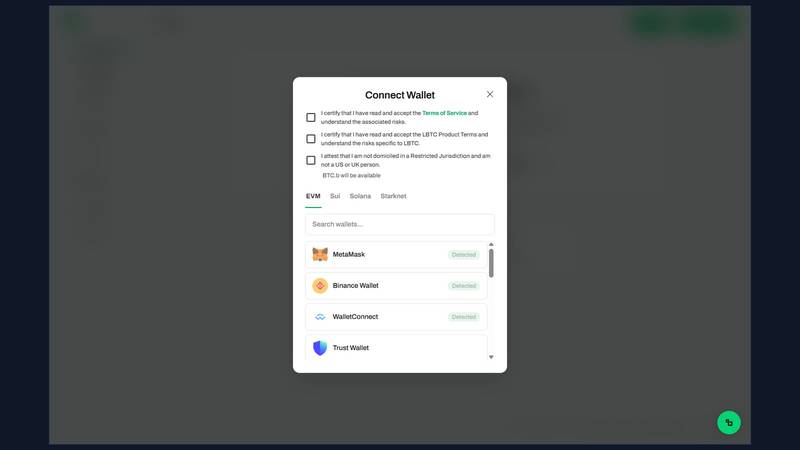
Connect Wallet screen on desktop with three tick boxes above the wallet list.
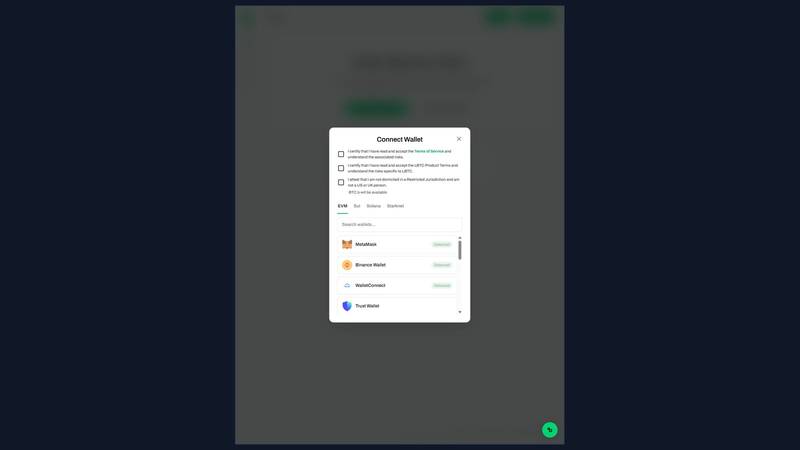
Connect Wallet screen on a tablet.
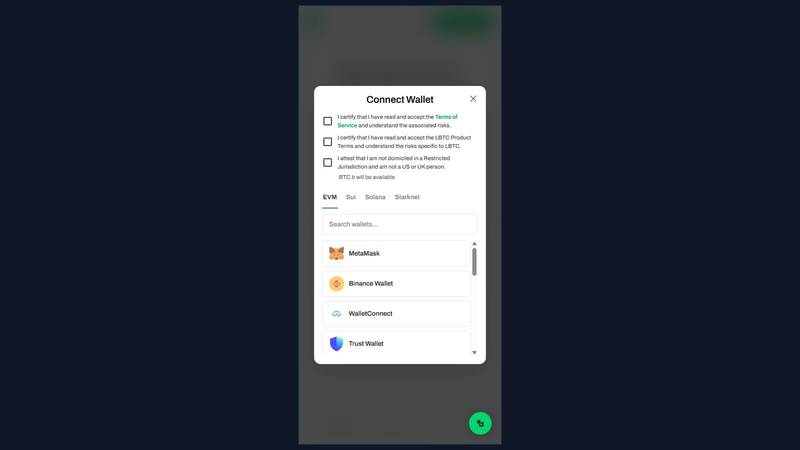
Connect Wallet screen on a phone.
Beginner safety tip: connecting a wallet only shares your address, but "Approve" lets a contract move a token. In a Bitcoin product the amounts are large, so check every popup, and double check the deposit address before you send real Bitcoin. The BTC.b docs warn that a mint cannot be cancelled once you send Bitcoin to the deposit address.
Core Features at a Glance
| Feature | What it does | Tested by us |
|---|---|---|
| LBTC | Yield-bearing Bitcoin token | Read product page and docs. App page said Product unavailable |
| BTC.b | Plain 1:1 Bitcoin token | Read product page and docs |
| Earn dashboard | Lists LBTC, Bitcoin Earn and the credit strategy | Viewed logged out |
| Bitcoin Earn | Managed vault with a BTCe receipt token | Viewed dashboard card and product page |
| Bitcoin Onchain Credit Strategy | Fixed premium from a trading firm | Viewed product page and dashboard card |
| Borrow | Table of lending markets that accept LBTC | Viewed logged out |
| Bridge | Move BTC.b or LBTC between chains | Viewed form, did not connect |
| Swap | Swap ETH and other assets for LBTC | Viewed form, did not connect |
| Bitcoin Smart Accounts | Institutional borrowing against custodied Bitcoin | Read product page and docs only |
| SDK | Tool for apps and exchanges | Read docs only |
Feature 1: LBTC (Yield-Bearing Bitcoin)
LBTC is Lombard's main product. The docs call it a "non-rebasing" token. In plain words, your number of tokens stays the same, and each token becomes worth slightly more Bitcoin over time. It is like a savings certificate that stays at 100 units while the value printed on it rises.
Where the Yield Comes From (Docs)
The docs say the yield comes from a covered-call strategy run by Bitwise Investment Manager, LLC, a subsidiary of Bitwise Asset Management. A covered call works like this. You own Bitcoin. You sell someone the right to buy it from you at a higher price by a set date. They pay you a fee up front, called a premium. If the price does not reach that higher level, you keep both the Bitcoin and the fee. If it does, you give up some of the upside.
The docs add several limits:
- Calls are set roughly 1.5 to 2 standard deviations above the market price, so most are expected to expire unused.
- Positions are rolled over every six to eight weeks, mostly, and never longer than six months.
- The strategy uses no leverage, no put options, no physical delivery (all settled in cash) and no lending of the underlying Bitcoin.
- Only part of the Bitcoin is used. The docs set the "active" share at 50 to 60 percent of the backing. The other 40 to 50 percent stays "passive" in the Security Consortium's custody, earns nothing and funds redemptions first.
- The active share is held at Anchorage Digital Bank and Kraken Institutional in segregated accounts. Bitwise can open and close option positions, and the docs say it cannot withdraw or move the Bitcoin.
The Number to Watch: 0.90 Percent vs 2.5 Percent
The LBTC product page showed a large "Current APY" of 0.90%, with smaller text saying it was "from 0.90% and building" and "Targeting 2.5%". The banner on every page says "Targeting 2.5% Net APY". The docs say the 2.5 percent is a target, variable, not guaranteed, and that losses are possible.
So the live yield was about 36 percent of the target on the day we looked (0.90 divided by 2.5, our calculation). On one Bitcoin worth $64,576, the target means about 0.025 BTC a year and the live figure about 0.009 BTC a year (our calculation). That is not a scam, and the page says it plainly. It does mean that anyone who read only the banner would expect nearly three times the yield shown.
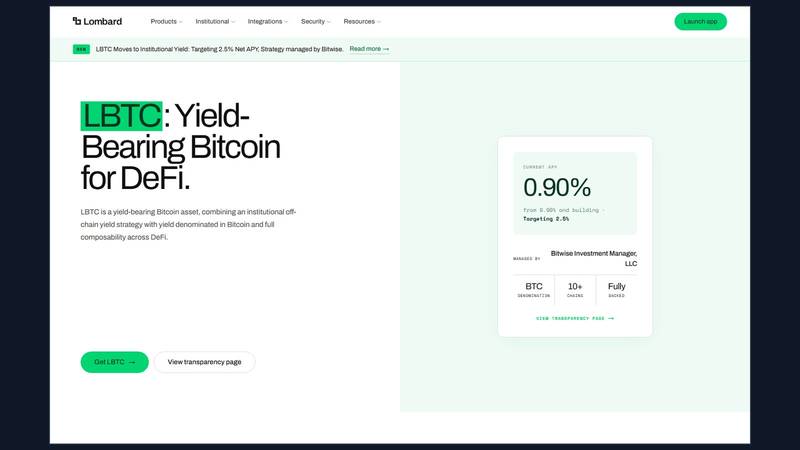
LBTC product page on desktop showing a current APY of 0.90 percent and a target of 2.5 percent.
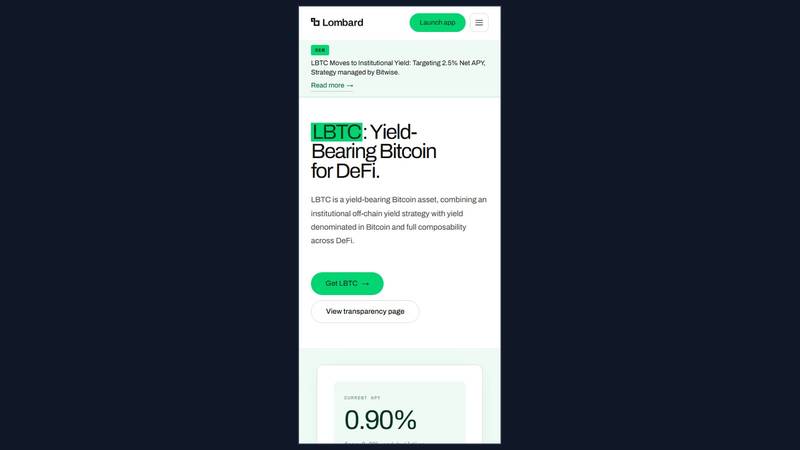
LBTC product page on a phone.
The LBTC screen inside the app, where you would mint and redeem, showed a Product unavailable message for us.
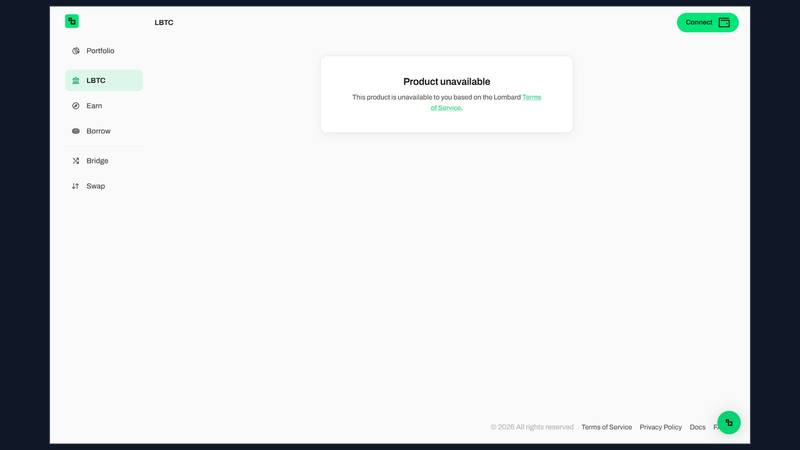
Lombard app LBTC screen showing Product unavailable.
Minting and Redeeming (Docs)
To mint, you send native Bitcoin to a deposit address generated for you. The deposit is verified by the Security Consortium and by an independent checker called Bascule, and LBTC arrives at your chosen address. The minimum deposit is 0.0002 BTC. To redeem, you request a withdrawal in the app, the LBTC is burned, and native Bitcoin is sent to your address "within a window of up to 10 days". The docs say there is no gate or pause on redemption, but it is not instant.
A ten-day wait matters. During a market panic, LBTC can trade below its fair value on exchanges while you wait for redemption (the docs name this "depeg risk").
Feature 2: BTC.b (Plain Bitcoin)
BTC.b is the simple ticket. It is always 1:1 with Bitcoin and pays no yield. The docs say it was originally launched by Ava Labs and was acquired by Lombard in October 2025. The product page says "Bitcoin for DeFi. Zero fees." and lists Ethereum, Avalanche, MegaETH, Katana, Stable and Monad.
What the docs add:
| Item | BTC.b | LBTC |
|---|---|---|
| Yield | None | 2.5% net APY target, variable |
| Price against Bitcoin | Always 1:1 | Rises over time |
| Minting fee | 0% | 0% (Ethereum mints deduct a small network fee) |
| Redemption fee | 0.0001 BTC | 0.0001 LBTC |
| Redemption time | 2 hours (docs) | Up to 10 days (docs) |
| Minimum deposit | 0.0002 BTC | 0.0002 BTC |
Our calculation: at $64,576, the 0.0001 fee is about $6.46, and the 0.0002 minimum is about $12.92. The docs also say a Bitcoin network fee of roughly $2 to $20 applies when you mint, and that gas on the destination chain varies.
There is one small inconsistency worth knowing about. The product page card shows "0 fees, instant", while the docs say a mint waits for 3 to 6 Bitcoin confirmations and a redemption takes 2 hours. Bitcoin blocks arrive about every ten minutes, so "instant" cannot literally apply to the Bitcoin leg. We read "instant" as describing the fee-free swap screen, not the whole process, but the page does not explain it.
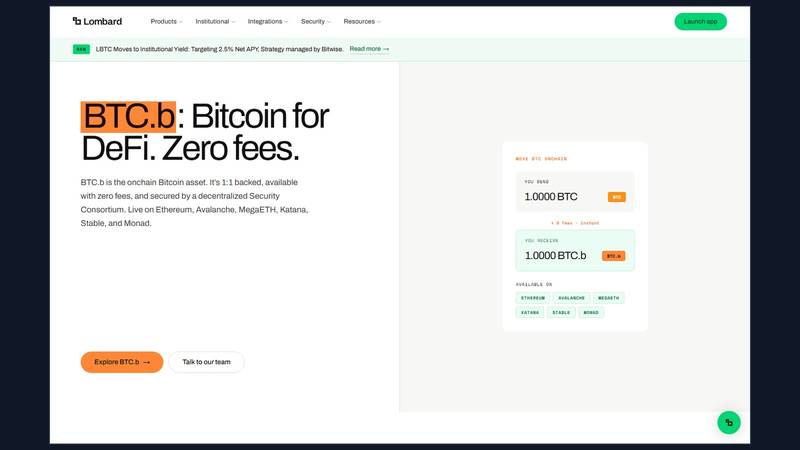
BTC.b product page on desktop showing zero fees and the list of chains.
Feature 3: Bitcoin Earn (Managed Vault)
Bitcoin Earn is described as a "meta-vault". You deposit LBTC, BTC.b or native Bitcoin. The vault spreads your money across several strategies and gives you a receipt token called BTCe. Rewards compound, so the BTCe price rises over time. The docs say withdrawals go through a 14-day processing window.
The numbers disagree across three places:
| Where | Figure shown |
|---|---|
| Homepage | "Up to 4% APY" |
| Earn product page | 2.65% current APY, denominated in BTC |
| App Earn dashboard | 4.5% target APY, TVL $59.5m |
Those can all be true at once, because "up to", "current" and "target" are three different things. But a beginner will not know that. The product page also shows the vault split: 60 percent in a Bitcoin money market (named Sentora) and 40 percent in the Bitcoin Onchain Credit Strategy (borrower: Flow Traders). The docs also say holders on Ethereum can earn BARD token incentives through a service called Merkl while a campaign is running.
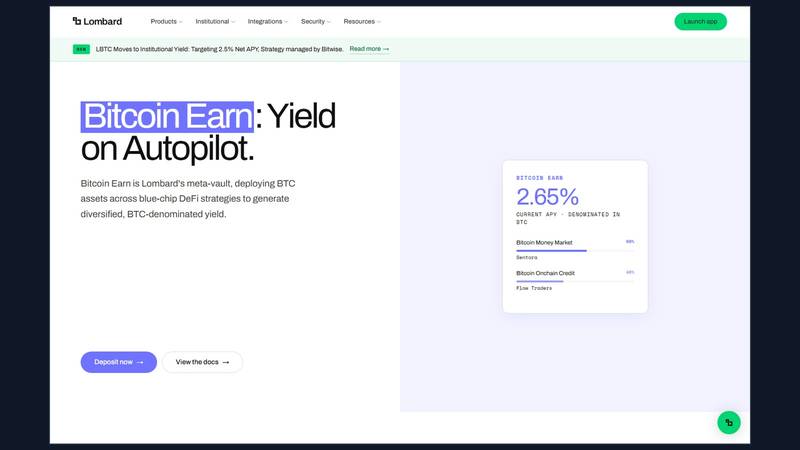
Bitcoin Earn product page on desktop showing a current APY of 2.65 percent.
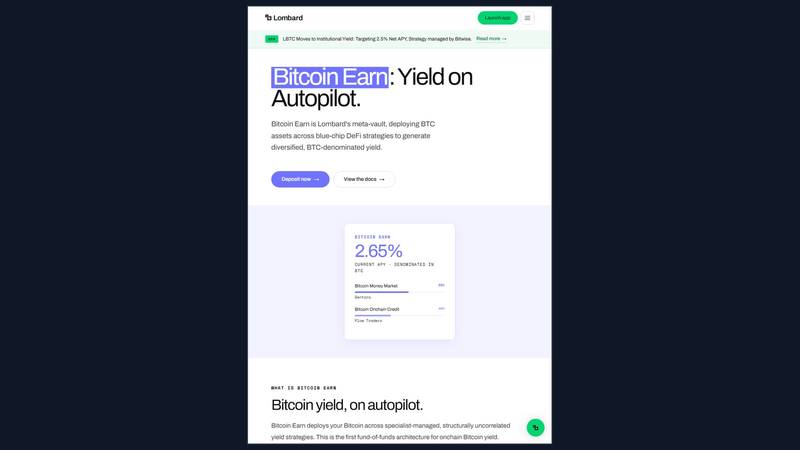
Bitcoin Earn product page on a tablet.
Feature 4: Bitcoin Onchain Credit Strategy
This is the most unusual product. The page says your Bitcoin backs stablecoin borrowing by "regulated trading firms", and they pay you a fixed premium for it. The borrower on the page is Flow Traders. The docs say the loan is made through a protocol called Cap, the rate is agreed directly rather than set by market demand, and the premium is paid in Bitcoin terms. The page shows TVL of $38.0M, live since July 2026, and accepts BTC, LBTC or BTC.b. The app card shows a 4 percent target.
Our reading: you are lending to a company, even if the structure is onchain. If the borrower failed to pay, you could lose money, and a fixed premium does not remove that risk. We have not read the credit terms or the legal agreements, and we cannot say how losses would be shared. Treat this as a product for people who understand credit risk.
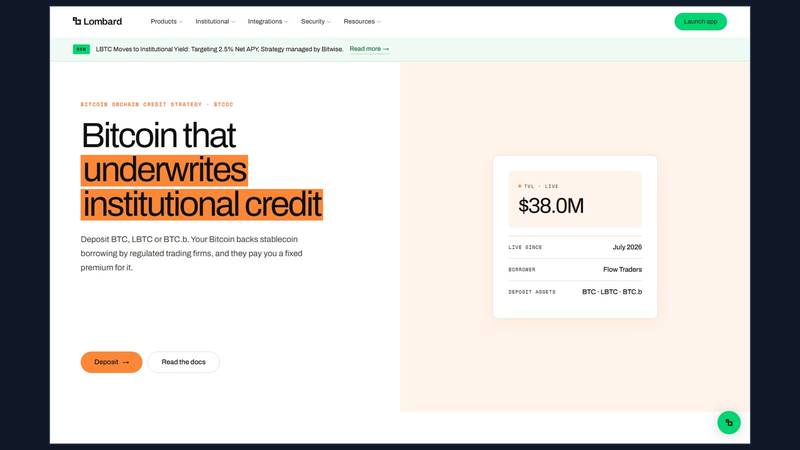
Bitcoin Onchain Credit Strategy page on desktop with TVL of 38 million dollars.
Feature 5: Earn Dashboard
The dashboard in the app (lombard.finance/app/earn) opens without a wallet. It shows "Total TVL $548.0m", "50+ protocols" (Aave, Morpho, Jupiter, Spark) and "10 chains". Under "Automated Strategies" are three cards, LBTC (2.5% target, $409.5m), Bitcoin Earn (4.5% target, $59.5m) and the credit strategy (4% target, $38.0m). Below them is a "Bitcoin in DeFi" area with ideas such as looping LBTC (up to 94.5 percent loan-to-value across 6 markets), providing liquidity on exchanges (5 pools) and "other incentivized activities".
Looping means borrowing against your deposit to buy more of it, over and over. It raises both gains and losses. A 94.5 percent loan-to-value means a small fall in price can wipe out the position. The page lists it without warnings on this screen. Do not read it as a recommendation.
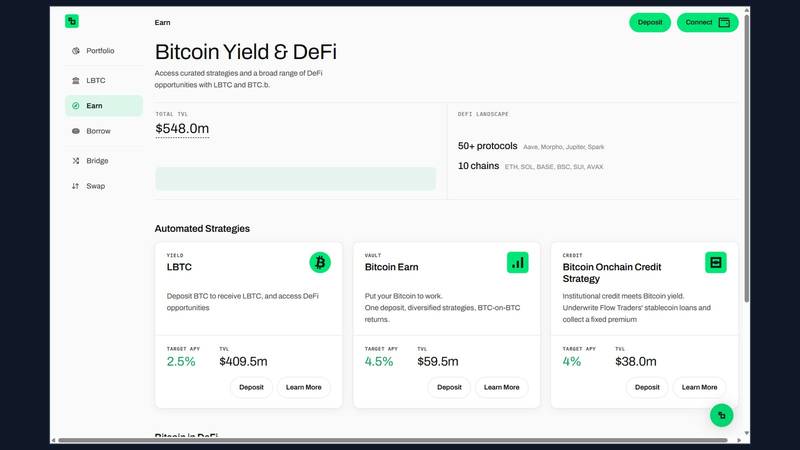
Lombard app Earn dashboard with three strategy cards.
Feature 6: Borrow
The Borrow page is the most useful screen we opened. Without any wallet, it shows a live table of lending markets that accept LBTC as collateral. The header says 12 markets across 4 protocols (Aave, Spark, Morpho and Jupiter) with a maximum loan-to-value of 86 percent.
| Debt | Protocol and chain | Max LTV | Borrow APY | Available liquidity | Utilization |
|---|---|---|---|---|---|
| USDC | Morpho, Ethereum | 86% | 5.71% | $256K | 87.4% |
| USDC | Morpho, Base | 86% | 17.39% | $3K | 93.1% |
| USDC | Jupiter, Solana | 75% | 5.06% | $61M | 87.1% |
| USDS | Spark, Ethereum | 74% | 5.00% | $210M | 78.4% |
| USDT | Spark, Ethereum | 74% | 4.52% | $17M | 95.2% |
| USDT | Aave, Ethereum | 70% | 4.14% | $440M | 84.8% |
| USDC | Aave, Ethereum | 70% | 4.88% | $162M | 94.2% |
All figures are from the Lombard app on Nov 17, 2026, and they change constantly. We left out several small rows.
How to read it:
- "LTV" is the share of your collateral's value you can borrow. At 70 to 86 percent, a fall of 15 to 30 percent in LBTC's value could trigger a forced sale (our rough reading, which depends on each protocol's liquidation rules).
- "Utilization" is how much of the money supplied is already borrowed. Above 90 percent, little is left for others to borrow, and rates can jump. The Base market shows 17.39 percent APY with only $3K available, a good example of a small, stressed market.
- Because LBTC tracks Bitcoin, it fell about 21 percent in 30 days (CoinGecko). A borrower at 86 percent LTV would be close to the edge after a move like that. Keep a wide safety margin.
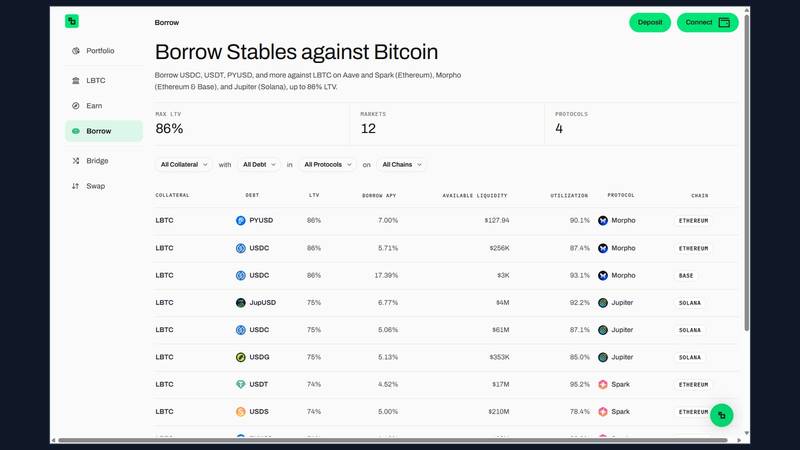
Lombard app Borrow page with a table of lending markets.
Feature 7: Bridge and Swap
The Bridge page is a simple box: From (Ethereum), To (Monad), an Amount field with BTC.b, a switch to send to another address, and a note that all bridging is "fully traceable". The docs say bridging uses Chainlink's CCIP system plus approval from the Security Consortium, a "dual-verification" design, and that all routes go through Ethereum since September 2026.
The Swap page is a plain two-box swap, defaulting to ETH in and LBTC out, with a Connect Wallet button. Both work only after you connect, and we did not connect. For a separate walkthrough of token swaps, see our 1inch review.
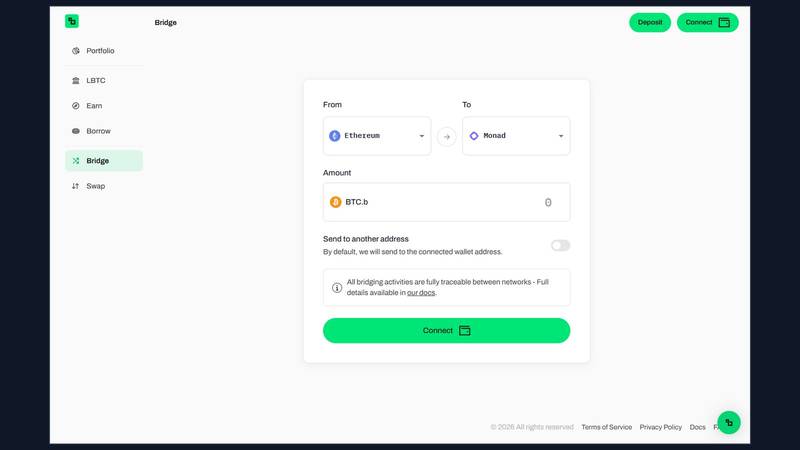
Lombard app Bridge page.
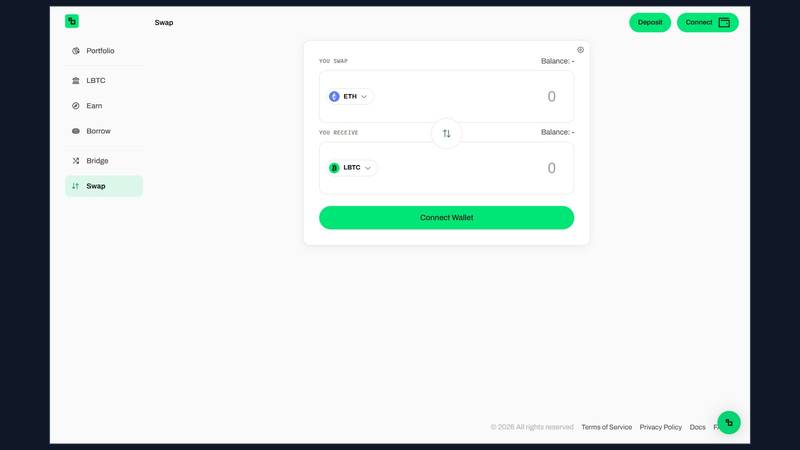
Lombard app Swap page.
The September 2026 Chain Update (Docs)
On September 16, 2026, Lombard deprecated native minting and redemption of LBTC and BTC.b on five chains: TAC, Sonic, Katana, Berachain and Starknet. Holders on the first four must bridge to Ethereum by December 10, 2026, which is 23 days after our review date (our calculation). The Starknet bridge to Ethereum stays in place. If you hold LBTC or BTC.b on one of those chains, act before the deadline.
Feature 8: Bitcoin Smart Accounts
Bitcoin Smart Accounts are for institutions that keep Bitcoin with a regulated custodian. The page promises "no custody, control, or title transfer". The docs say your custodian applies a designation to an account, Lombard issues a BTC.b receipt token on-chain, and you use it as collateral on protocols such as Morpho while the real Bitcoin stays in custody. The design uses partially signed Bitcoin transactions and time locks to emulate covenants. The only call to action on the page is "Talk to our team", so we did not test anything.
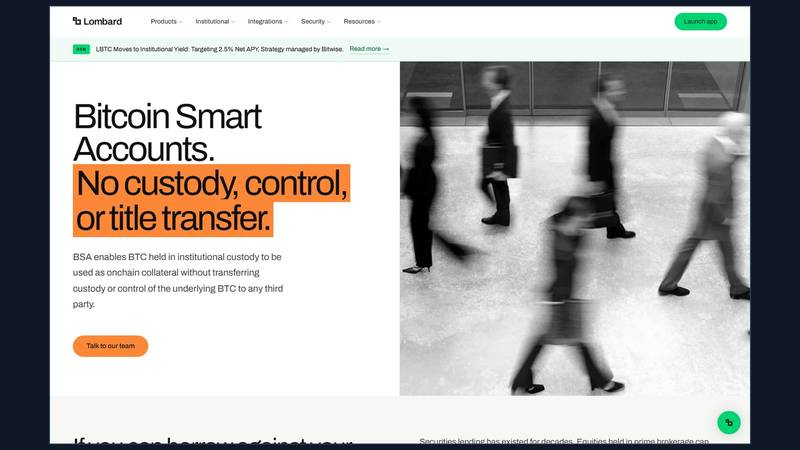
Bitcoin Smart Accounts product page on desktop.
Feature 9: SDK, Integrations and Docs
The Lombard SDK is a TypeScript toolkit for wallets, exchanges and apps. The site says it is used by Ledger, Binance and Bybit, and the integrations page says "trusted by leading digital asset platforms". We did not test the SDK. The docs site is well organized, with sections on products, architecture, security, transparency, token economics and a long Build area. The pages we fetched were marked "Last updated on November 9, 2026", only eight days before our review, which is a good sign.
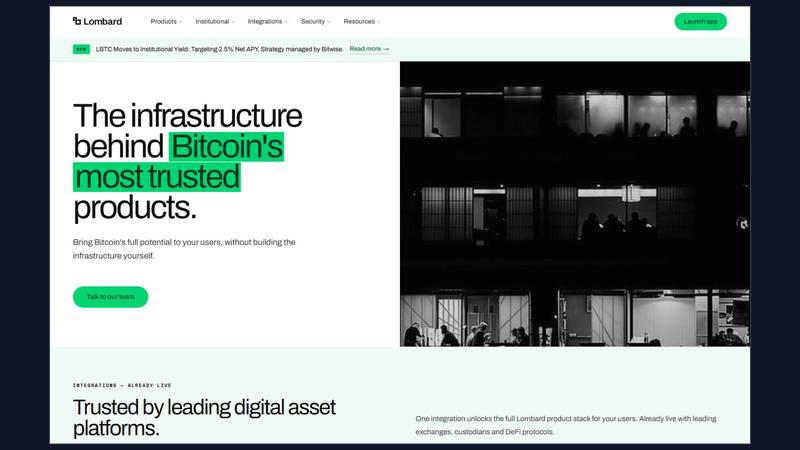
Lombard integrations page on desktop.
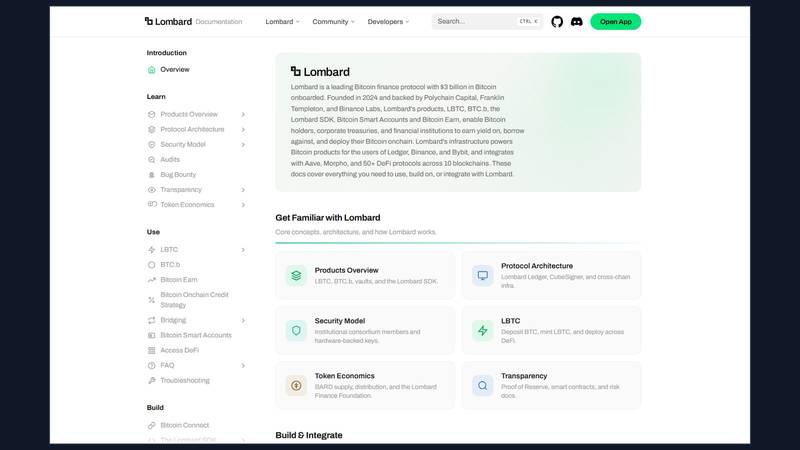
Lombard documentation home page.
The LBTC and BARD Tokens
LBTC Market Data
| Item | LBTC | Source and date |
|---|---|---|
| Price | $64,576 | CoinGecko, Nov 17, 2026 |
| Market cap | $389.6M | CoinGecko, Nov 17, 2026 |
| 24-hour volume | $326k | CoinGecko, Nov 17, 2026 |
| Circulating supply | 6,033 LBTC | CoinGecko, Nov 17, 2026 |
| All-time high | $125,812 on Oct 6, 2025 (down 48.7%) | CoinGecko |
| 7-day change | down 13.7% | CoinGecko, Nov 17, 2026 |
| 30-day change | down 21.1% | CoinGecko, Nov 17, 2026 |
BARD Market Data
| Item | BARD | Source and date |
|---|---|---|
| Price | $0.0987 | CoinGecko, Nov 17, 2026 |
| Market cap | $39.16M | CoinGecko, Nov 17, 2026 |
| Fully diluted value | $98.75M | CoinGecko, Nov 17, 2026 |
| 24-hour volume | $6.37M | CoinGecko, Nov 17, 2026 |
| Circulating supply | 396.56M | CoinGecko, Nov 17, 2026 |
| Total and max supply | 1,000,000,000 | CoinGecko and docs |
| All-time high | $1.70 on Mar 5, 2026 (down 94.2%) | CoinGecko |
| All-time low | $0.0804 | CoinGecko |
| 7-day change | down 2.7% | CoinGecko, Nov 17, 2026 |
| 30-day change | down 9.4% | CoinGecko, Nov 17, 2026 |
| Rank | 473 | CoinGecko, Nov 17, 2026 |
Why the Numbers Differ
LBTC's daily trading volume is only $326k against a market cap of $389.6M, which is about 0.08 percent (our calculation). Most LBTC does not trade at all. It sits in wallets, vaults and lending markets. Low volume matters if you plan to sell on an exchange. The way out for large holders is the redemption route (up to 10 days) or a deep lending market, not the open market.
BARD is the opposite. Its volume is $6.37M against a $39.16M market cap, or about 16 percent (our calculation), which is active. Its fully diluted value ($98.75M) is two and a half times its market cap, because only 39.7 percent of the supply is circulating (our calculation: 396.56M divided by 1,000M).
How to Read This
- LBTC is priced like Bitcoin. Its falls and rises are mostly Bitcoin's, not Lombard's.
- BARD is a different kind of bet. It is down about 94 percent from its March 2026 high, and CoinGecko's circulating figure implies that about 60.3 percent of the supply is not yet in circulation (our calculation from the figures above).
- A community sale in the docs raised $6.75 million at a $450M fully diluted value. BARD's value now is $98.75M, about 78 percent below that sale value (our calculation). Buyers in that sale are the ones most underwater, and we do not know how many still hold.
BARD Token Distribution (Docs)
| Share | Group | Unlock terms in the docs |
|---|---|---|
| 35% | Ecosystem (several pools) | Mixed. Some unlocked at launch, some linear over 24 months |
| 25% | Core contributors | 48-month lock, linear from 12 months after launch |
| 20% | Foundation | 4.25% at launch, the rest linear over 3 years |
| 20% | Early investors | 48-month lock, linear from 12 months after launch |
At launch, 22.5 percent of the supply was circulating, and the rest unlocks over 48 months, according to the docs. The lead investor was Polychain Capital, and the list includes Franklin Templeton, YZi Labs (formerly Binance Labs), OKX Ventures and HTX Ventures, among others. The docs also list "strategic exchange partners" (Binance, Bybit, OKX, HTX and Bitget).
Our calculation: team and investors together hold 45 percent of supply, locked for 48 months with linear release starting at month 12. That means they are still receiving new tokens on a schedule, which adds supply over time. We do not know the exact launch date from the docs we read, so we cannot say how much of that release has already happened.
The docs say BARD's "utility will evolve in line with the product development roadmap". In plain terms, BARD does not currently have a firm set of rights attached that we could verify, such as a share of fees. The docs do say the protocol collects fees (vault operating fees and the 20 percent LBTC rewards fee), but we found no statement that BARD holders receive them.
Governance
The docs describe an independent Lombard Finance Foundation, incorporated in the Cayman Islands, as steward of the ecosystem. It holds 20 percent of BARD. We did not find a live voting page in the app or on the marketing site, and the docs call BARD's utility a work in progress. So, today, a BARD holder does not appear to run the protocol. The real control sits with the Security Consortium (for custody) and the Lombard team (for upgrades, behind a 24-hour timelock, per the docs).
Fees and Costs
The fee figures below come from Lombard's published fees page; check it again before transacting.
| Cost | What the docs say |
|---|---|
| LBTC minting fee | 0%. Ethereum mints deduct about 0.0001 LBTC for network gas |
| LBTC protocol rewards fee | 20% of strategy gains, with a high-water mark |
| LBTC protocol operating fee | None |
| LBTC redemption fee | 0.0001 LBTC (about $6.46 at today's price, our calculation) |
| BTC.b minting fee | 0% |
| BTC.b redemption fee | 0.0001 BTC |
| Minimum deposit | 0.0002 BTC |
| Bitcoin network fee when minting | About $2 to $20 (docs) |
| Vault withdrawals | 14-day window (docs) |
A "high-water mark" means Lombard only takes its 20 percent on new gains above the strategy's previous peak. If the strategy loses money, it takes nothing until it earns back the loss. The docs give an example: on 1.00 BTC of gains, 0.20 BTC is the fee and 0.80 BTC goes to holders.
The docs say the 2.5 percent target is already after this fee, and that the fee applies only to the active share (50 to 60 percent), not to the passive share. We find the fee structure fair and easy to read. The real cost to most users is not a fee. It is the gap between 0.90 percent and 2.5 percent, and the wait to exit.
Security
How Lombard Protects the Bitcoin (Docs)
| Layer | What the docs say | Our note |
|---|---|---|
| Security Consortium | 14 independent institutions. 10 of 14 must sign every critical action | Needs trust in the group. See the discrepancy below |
| Key storage | Keys are generated inside hardware security modules (CubeSigner, built by Cubist) and never leave the hardware | Docs claim, we did not test |
| Bascule Drawbridge | An independent check that a Bitcoin deposit really exists, with 6 confirmations, before LBTC is minted. A reverse check confirms LBTC was burned before Bitcoin is paid out | A good second lock, per the docs |
| Pausable contracts | Critical functions can be paused | A pause protects against attacks, but also gives control to the admins |
| Upgrades | Two steps, behind a 24-hour on-chain timelock | 24 hours is short compared with some protocols |
| Monitoring | Hypernative real-time monitoring, rate limits | Docs claim |
| Oracles | Chainlink and RedStone, updated about every 10 minutes | Docs claim |
The Consortium
The docs name 14 members in five groups:
| Group | Members |
|---|---|
| Crypto institutions | Galaxy, OKX, Kraken, DCG |
| Market makers | Amber, Wintermute |
| Mining pools | Antpool, F2Pool |
| Institutional validators | Bitwise Onchain Solutions, Figment, Kiln, P2P |
| Security and research | Cubist, Nansen |
Ten of the fourteen must sign. The docs say that even four compromised members could not authorize a bad action on their own.
Three counts that do not match. The consortium page lists 14 members and says 10 of 14 must sign. The security overview page includes a box that says "15 independent institutions". The homepage says "12-member Security Consortium" and shows "12 Consortium Members" as a statistic, while also saying "10 of 14 validators". At least two of these are wrong or out of date. We believe 14 is correct because we counted 14 names on the members page, but a reader should not have to guess on a point this central.
Overlaps worth knowing about (our observations). Bitwise Onchain Solutions is a consortium member, and Bitwise Investment Manager runs the yield strategy. Kraken is a consortium member and also holds part of the active Bitcoin through Kraken Institutional. OKX is a member and its venture arm is also an investor, and the docs list OKX, Binance and others as strategic exchange partners. These are all real institutions, and overlap is not wrongdoing. But "14 independent institutions" is a simpler story than the web of relationships we can see.
Where the Bitcoin Is Held (Docs)
The Bitcoin is split in two. The active 50 to 60 percent sits with Anchorage Digital Bank and Kraken Institutional under accounts the docs call segregated, Lombard-owned and bankruptcy-remote. The passive 40 to 50 percent sits in the Security Consortium's custody. This means a mix of regulated custodians and a multi-party signing group, not a single smart contract.
Audits
The docs list ten reports from six firms:
| Date | Firm | Scope |
|---|---|---|
| Oct 24, 2025 | OpenZeppelin | BTC.b and BridgeV2 |
| Sep 22, 2025 | ABDK | StakeAndBake |
| Jul 25, 2025 | Sherlock | Yield bearing |
| Jul 25, 2025 | OpenZeppelin | Yield bearing |
| Dec 17, 2024 | Veridise | V2 release |
| Dec 13, 2024 | OpenZeppelin | V2 release |
| Dec 9, 2024 | Halborn | FBTC integration |
| Oct 10, 2024 | Halborn | BTC.b PMM |
| Aug 21, 2024 | Veridise | V1 release |
| Aug 5, 2024 | Halborn | V1 release |
Cantina is named as a sixth partner in the docs but has no dated report in the list we read. The newest report in the list is from October 2025, which is more than a year old. DefiLlama counts two audits for LBTC. We did not read the reports. Note that the covered-call yield strategy and the latest chain changes are newer than that list, and we could not confirm which audit covers them.
Bug Bounty
Lombard runs a public bounty on Immunefi, live since September 2024.
| Severity | Smart contracts | Websites and apps |
|---|---|---|
| Critical | $50,000 to $500,000 (10% of funds affected) | $15,000 to $30,000 |
| High | $10,000 to $50,000 | $10,000 |
| Medium | $2,500 | $2,000 |
| Low | $1,000 | Not listed |
Payments are in USDC on Ethereum and require identity checks (KYC). Testing must be done on local forks. Issues already known, third-party contracts and phishing are excluded. A $500,000 maximum for a product with hundreds of millions locked is typical for the industry, though on the low side.
Track Record
DefiLlama's hacks database has no entry for Lombard, and the docs say there have been no incidents causing loss of user funds and that full backing has been kept since launch. We could not independently confirm the second statement. An empty hacks list is good news, but it is also a short history, because the product is only about two years old.
Risk Table
The docs rate many risks "medium", including smart contract, bridge, depeg, liquidity, regulatory, strategy and consortium risk. We agree with most of them and add our own view:
| Risk | Level in our view | Why |
|---|---|---|
| Trust in the signer group | Medium to high | The system relies on institutions acting honestly and staying online |
| Smart contract bug | Medium | Several audits, but the newest is more than a year old |
| Strategy loss | Medium | Option positions can lose money in sharp rallies, per the docs |
| Long exit window | Medium | Up to 10 days for LBTC, 14 days for vaults |
| Depeg on exchanges | Medium | Low trading volume, stress could widen the gap |
| Bridge | Medium | Cross-chain transfers use outside systems (Chainlink CCIP) |
| Regulatory | High for US and UK users | The product is closed to them |
| Credit counterparty | Medium | Applies to the credit strategy and Bitcoin Earn |
| Governance token | High | BARD is down 94% from its high |
Lombard vs Competitors
We compare Lombard with the other large Bitcoin tokens that DefiLlama tracks, using figures from Nov 17, 2026.
| Protocol | TVL (DefiLlama) | Note |
|---|---|---|
| WBTC | $7.52B | The oldest wrapped Bitcoin |
| Coinbase Bridge (cbBTC) | $7.02B | Exchange-issued |
| Binance Bitcoin | $4.40B | Exchange-issued |
| Babylon Protocol | $2.69B | Bitcoin staking and restaking |
| Kraken Bitcoin | $613.7M | Exchange-issued |
| Function FBTC | $540.1M | Multi-issuer wrapped Bitcoin |
| Lombard LBTC | $429.1M | Yield-bearing wrapper |
| Lorenzo enzoBTC | $390.1M | Wrapped Bitcoin |
| SolvBTC | $376.4M | Wrapped Bitcoin |
| Lombard BTC.b | $140.5M | Plain wrapper |
Lombard's LBTC ranks seventh in this list (our reading). The first three names are issued by or tied to very large exchanges and sit far above the rest. The homepage claim of "70% yield-bearing BTC market share" may be true under a narrow definition of "yield-bearing", but we could not reproduce it from DefiLlama's lists, and the site does not state its method.
What sets Lombard apart is the design around yield and institutions, the Bitwise relationship and the unusually detailed docs. What holds it back is size, a smaller user base than the exchange-issued tokens, and a sign-up gate that excludes US and UK persons.
Pros and Cons
What We Liked
- Detailed docs. Fees, custody, strategy limits, risks and incident history are all written down, and the pages we read were updated on November 9, 2026.
- Named people and firms. Custodians, manager, signers and auditors are all named.
- Ten audits from six firms between August 2024 and October 2025, and a public bounty of up to $500,000.
- No entry in the hacks database.
- Fair fee design. A rewards-only fee with a high-water mark, no operating fee and a 0% minting fee.
- A free-to-browse Borrow table. It shows live rates, limits and liquidity without a wallet.
- Clear honesty on the main yield. The LBTC page shows 0.90% current next to the 2.5% target.
- Good responsive layout on tablet and phone.
What We Did Not Like
- Yield gap. 0.90 percent live against a 2.5 percent target, and a banner that shows only the target.
- Numbers that disagree. The consortium is 12, 14 or 15 members depending on the page. Bitcoin Earn is 2.65, 4 or 4.5 percent. Value locked is $548.0m, $507.0m or $628.8M depending on how you add it up.
- Region gate. US and UK persons and restricted places are excluded, and the app shows "Product unavailable" on several pages.
- Value locked is about 80 percent below its peak (DefiLlama).
- BARD is down about 94 percent from its high, with the docs saying its utility is still to come.
- Long exits. Up to 10 days for LBTC and 14 days for vaults.
- Trust model. Safety rests on institutions and custodians, not on code alone.
- Newest audit is more than a year old.
- Stale detail. The BTC.b page still lists Katana after the September 2026 chain cut.
Who Should Use Lombard
- Non-US, non-UK Bitcoin holders who want simple on-chain Bitcoin. BTC.b, with its 0% minting fee and 2-hour redemption (docs), fits this best.
- Holders who accept a modest, variable yield and can wait up to 10 days to exit LBTC.
- Borrowers who understand liquidation. The Borrow page is a useful comparison tool, even if you never use Lombard itself.
- Institutions with a custodian, for whom Bitcoin Smart Accounts may be worth a conversation.
Who should probably skip it: anyone in the US or UK, anyone who may need their Bitcoin back within days, complete beginners who have never used a wallet, and anyone who wants the full 2.5 percent now rather than later.
Verdict
Our editorial score is 3.5 out of 5.
Lombard is open about how it works, and that is rare. The docs read like a real risk document rather than a brochure, the fee design is fair, the audit and bounty trail is solid and there is no hack on record. The score is held down by things you will feel as a user: a headline yield far below its target, sites that contradict each other on basic numbers, a legal gate that shuts out two of the largest crypto markets, a shrinking base of deposits and a governance token that has lost almost all of its peak value. We would not call it unsafe. We would call it a serious institutional-style product that is still finding its footing, best used in small amounts by people who read the fine print.
FAQ
Is Lombard safe?
It has ten audit reports from six firms, a public bounty, named custodians and no entry in the DefiLlama hacks database. It is not risk-free. Your Bitcoin depends on a group of institutions, several custodians and an options strategy, and the newest audit we found is from October 2025.
Is Lombard legit?
It is a real, operating protocol that appears on the main trackers with hundreds of millions of dollars locked, and its partners (Bitwise, Anchorage, Chainlink and others) are real firms. Legitimate does not mean risk-free.
What does Lombard do in simple terms?
It issues tokens on other blockchains that are backed by real Bitcoin, and it offers ways to earn on, borrow against or move that Bitcoin.
What is the difference between LBTC and BTC.b?
BTC.b is always worth one Bitcoin and pays no yield. LBTC rises slowly in value against Bitcoin because part of the backing earns income. LBTC takes up to 10 days to redeem, while BTC.b takes about 2 hours, according to the docs.
What yield does LBTC pay?
The product page showed 0.90 percent current APY on Nov 17, 2026, against a 2.5 percent net target. The docs say the target is variable and not guaranteed.
Can I use Lombard in the US or UK?
According to the docs, the LBTC yield strategy and direct mint and redeem are not available to US or UK persons or to people in restricted jurisdictions. The app also asks you to attest you are not one of these. Check the Terms of Service for the full list.
Is BARD a good investment?
We do not give investment advice. We can say it trades about 94 percent below its March 2026 high, that about 60 percent of supply is not yet in circulation, and that the docs say its utility is still evolving.
How long does it take to get my Bitcoin back?
Up to 10 days for LBTC, about 2 hours for BTC.b and a 14-day window for Bitcoin Earn, according to the docs. We did not test any withdrawal.
Why does Lombard show different numbers on different pages?
We do not know. Some differences are definitions (current, target and "up to" yields). Others, such as the size of the consortium, look like out-of-date text.
Can I lose money on Lombard?
Yes. Bitcoin can fall, the option strategy can lose money in a sharp rally, contracts can have bugs, the signer group could fail, borrowers can be liquidated, and LBTC can trade below its fair value for a time.
Do I need a wallet to look around?
No for the marketing site, the docs, the Earn dashboard, the Borrow table, the Bridge page and the Swap page. You need one, plus three tick-box confirmations, to go further.
What did you not test?
We did not connect a wallet, because the connection screen requires legal attestations that we did not want to make. We did not mint, redeem, deposit, borrow, bridge, swap or sign anything. We did not see a connected dashboard, any personal balance, or the LBTC page inside the app, which showed "Product unavailable" for us. We did not test Bitcoin Smart Accounts or the SDK, and we did not read the audit reports or the credit agreements. Anything about those actions comes from the docs.
Quick Links
- Lombard homepage
- Lombard app
- Lombard documentation
- Lombard fees page
- Lombard audits page
- Lombard risks page
- Lombard LBTC on DefiLlama
- LBTC on CoinGecko
- BARD on CoinGecko
Disclaimer
This article is an independent editorial review for information only. It is not financial, legal or tax advice. Crypto assets are volatile and you can lose some or all of your money. We tested without connecting a wallet, and we did not sign any transaction. Lombard's products are not available to everyone, so check your local rules and the Terms of Service before you act. Figures are from the sources and dates named in each table and may have changed since. Do your own research before you mint, deposit or borrow.
Editorial credits
Checked by AiCryptoCore QC Team before publishing on November 18, 2026 for headline accuracy, original value, factual consistency, metadata, commercial disclosure, authorship claims, review evidence and risk disclosure: our AI review system checks every article before it goes live, and our duty editor monitors it after publication.
AiCryptoCore uses AI for research, drafting and review. Our editorial team is responsible for every article and corrects or withdraws articles when needed. How we review.