

AI Infrastructure Crypto Coins in 2026: Compute, Data, and Demand
Compare AI infrastructure crypto coins by delivered workload, demand evidence, operating burden, and the risks behind compute token narratives.

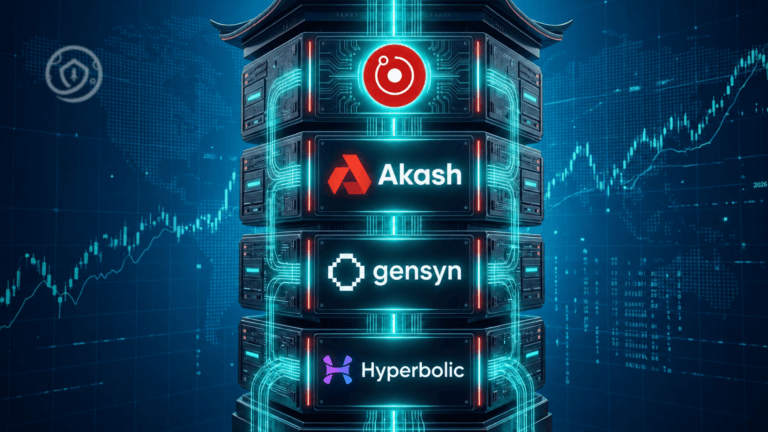
Render is the strongest candidate here for completed creative and GPU workloads, Akash is the clearest open-cloud deployment candidate, Gensyn is the specialized distributed machine-learning candidate, and Hyperbolic is the most direct accessible compute and inference candidate. Each sells a different resource, so a single AI crypto project ranking would hide the buying decision.
Infrastructure demand becomes meaningful only when a customer receives a workload at an acceptable total cost and reliability level. GPU supply, provider counts, network emissions, and token liquidity are supporting signals; completed jobs, repeat usage, output quality, and recovery behavior are the evidence that turns a resource network into a business, a distinction also made in Coinbase Institutional’s AI infrastructure research.
Top AI Infrastructure Crypto Coins in 2026
| Project | Resource delivered | Best-fit use | Evidence that matters |
|---|---|---|---|
| Render | Distributed rendering and GPU compute | Creative jobs and parallel GPU work | Completed workload, delivery quality, provider availability |
| Akash | Open cloud deployment capacity | Persistent apps and configurable environments | Deployment, uptime, storage, networking, total cost |
| Gensyn | Distributed machine-learning coordination | Verifiable training or specialized ML work | Reproducibility, contribution quality, completed task |
| Hyperbolic | AI compute and inference marketplace | Model serving and accessible GPU capacity | Model compatibility, cold start, output quality, failure recovery |
The shortlist is organized by the resource a buyer consumes. Render and Akash should not be judged through the same workload, and Gensyn should not be judged by a simple hourly GPU quote. The profile section keeps those operating differences visible, while Top Projects provides the broader site-level market screen.
Best AI Infrastructure Crypto Coins To Buy
Render
Render has the clearest completed-workload frame in this group. A creator or application submits a job through the Render Network, providers contribute capacity, and the useful result is a delivered render or compute output. That gives the review a concrete unit to inspect instead of relying on a headline capacity number.

The useful comparison fixes the same scene, asset, resolution, completion target, and delivery requirement. A network can look cheap at the quote stage while becoming expensive through retries, queue time, output issues, or provider availability. The buyer’s result matters more than the size of the available provider pool.
Render’s main risk is demand cyclicality. A functioning marketplace can still face weaker utilization when creative or AI workloads fall, or when comparable capacity becomes easier to buy elsewhere. The decentralized GPU comparison narrows this workload-level analysis.
Key features
- Routes rendering and GPU-compute jobs through a distributed provider network.
- Fits visual-render pipelines where a finished asset is the unit of delivery.
- Lets buyers compare job completion, queue behavior, and output quality on the same brief.
- Keeps provider availability visible as part of the practical delivery constraint.
- Separates a completed workload from a headline claim about aggregate GPU supply.
Akash
Akash is an open cloud marketplace rather than a managed-cloud substitute by default. Its value is deployment flexibility and provider choice, while the buyer takes on more responsibility for configuration, networking, storage, observability, and recovery.
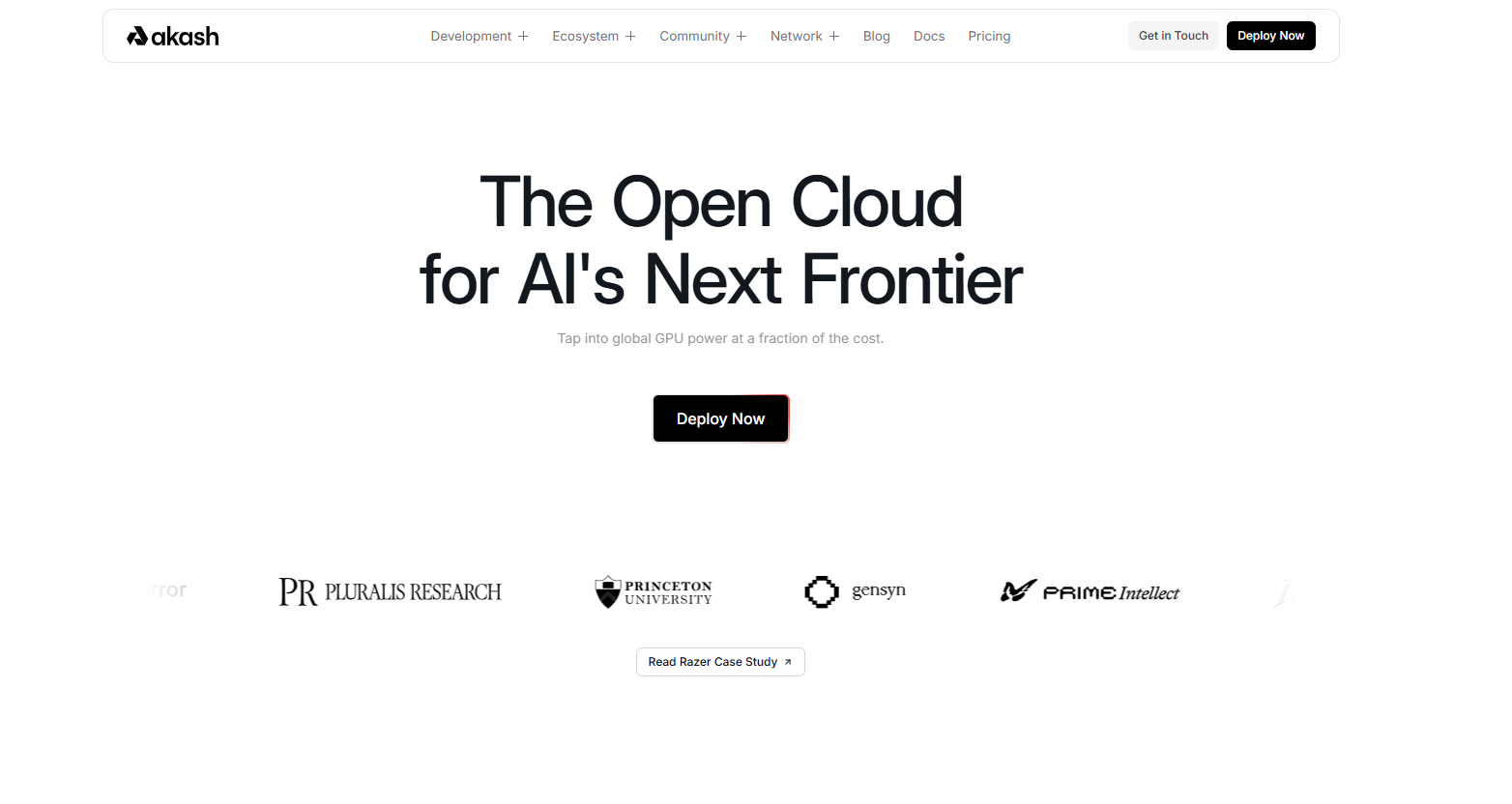
The fair comparison includes the time required to deploy and maintain the same application. A low hourly GPU or CPU rate does not represent total cost when the workload also needs persistent storage, secure networking, monitoring, and a recovery plan. Those operational elements decide whether an application can remain online.
Akash is strongest for readers who value portability and configurable infrastructure. Its main risk is operational complexity: the marketplace can offer attractive supply while the buyer still needs the skills and processes normally supplied by a managed cloud provider. The AI DePIN token guide gives the broader supply-side context without treating deployment flexibility as proof of demand.
Key features
- Provides a marketplace model for deploying applications across independent providers.
- Supports configurable compute environments instead of one fixed managed-cloud workflow.
- Makes infrastructure choices extend beyond compute to storage, networking, and observability.
- Gives technically capable teams more control over placement and operating configuration.
- Exposes deployment and recovery work that a managed cloud usually abstracts away.
Gensyn
Gensyn changes the comparison from generic compute supply to distributed machine-learning coordination. The Gensyn network frames the relevant deliverable as more than a rented GPU: it is a reproducible training or machine-learning result produced across contributors under a defined verification process.

The evidence should identify the task, the model or workload, the contribution boundary, the reproducibility standard, and the completion record. Network participation is not enough when the resulting model work cannot be checked or when the benchmark differs from the work a buyer needs.
Gensyn’s main risk is a gap between network-level coordination and externally valuable output. The project earns its infrastructure role when distributed participation produces work that can be reproduced, evaluated, and used beyond an internal reward system. That is the same distinction used in the AI crypto revenue analysis when it separates network activity from customer value.
Key features
- Coordinates distributed participation around machine-learning tasks rather than generic VM rental.
- Treats reproducibility as a core condition for evaluating a completed workload.
- Makes the contribution method and task boundary part of the delivery record.
- Fits specialized training or ML work that needs a defined evaluation process.
- Shifts the buyer’s focus from raw hardware access to a usable finished result.
Hyperbolic
Hyperbolic belongs in the accessible compute and inference layer. The Hyperbolic platform is useful only when a user can obtain the required model environment, start a request predictably, receive the output at the expected quality, and recover when a provider fails.
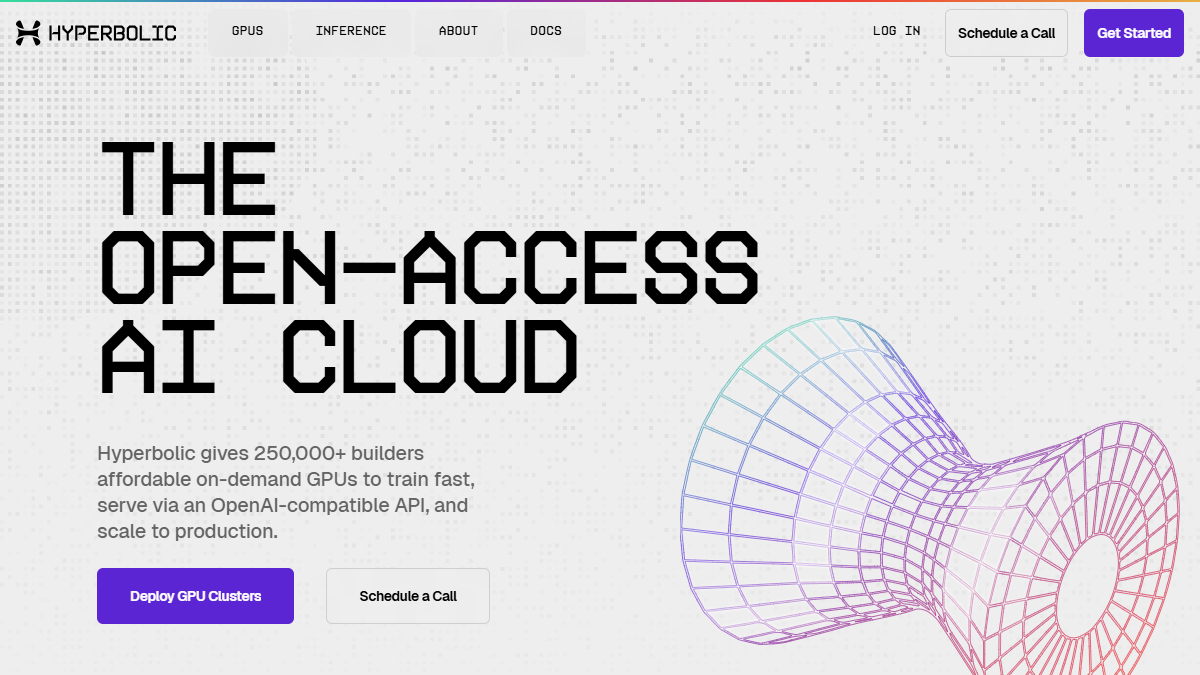
The fair test runs the same model request with the same input, memory requirement, location, and latency target. Cold start, error behavior, response quality, and the full price of serving the request are more revealing than a broad capacity announcement.
Hyperbolic’s main risk is delivery consistency. A marketplace can list compatible hardware while still failing a production workload through cold starts, unavailable providers, or an unclear recovery path. The decentralized inference comparison covers the proof, privacy, and model-quality layer in more detail.
Key features
- Focuses on accessible GPU capacity and model-serving workflows.
- Lets a buyer evaluate inference through a defined model request rather than a capacity headline.
- Keeps cold starts and response behavior inside the service-quality comparison.
- Makes model compatibility and memory requirements part of the selection process.
- Highlights recovery behavior when an available provider cannot complete a request.
What each network must prove before it earns demand
The scorecard follows the profiles so that every category reflects a specific service and buyer constraint. It is editorial triage, not an investment rating.
| Project | Resource clarity | Delivery evidence | Token role | Operational burden | Total |
|---|---|---|---|---|---|
| Render | 9 | 8 | 8 | Demand cyclicality | 25/30 |
| Akash | 8 | 8 | 7 | Buyer-managed operations | 23/30 |
| Gensyn | 8 | 7 | 7 | Reproducibility and task-value gap | 22/30 |
| Hyperbolic | 8 | 7 | 6 | Provider consistency and recovery | 21/30 |
Render leads on workload clarity because its completed-job frame is easy to define. Akash has the clearest deployment flexibility, Gensyn has the clearest distributed ML coordination thesis, and Hyperbolic has the most direct model-serving comparison. The scores describe distinct operating strengths, not a universal best token; the organic demand checker is a useful next step for turning that distinction into a repeat-usage review.
Choose the network by workload and failure mode
| Project | Use it first for | Avoid it when | First practical test |
|---|---|---|---|
| Render | A defined rendering or GPU job with a deliverable asset | The workload needs a persistent, full application environment | Submit one fixed scene and compare delivery time, cost, and output quality |
| Akash | A deployable application that benefits from provider choice | The team cannot operate networking, storage, monitoring, and recovery | Deploy the smallest production-like service and force a restart |
| Gensyn | A machine-learning task that needs a defined contribution process | The only requirement is instantly available GPU rental | Repeat the same task and inspect whether the result can be reproduced |
| Hyperbolic | Model serving where request behavior and accessible capacity matter | The workload cannot tolerate cold starts or uncertain provider recovery | Run a fixed inference request through a start, failure, and retry sequence |
The practical choice starts with the output a team needs to receive. Render is oriented around a completed job, Akash around an operating deployment, Gensyn around a reproducible ML task, and Hyperbolic around a dependable model request. Those units are concrete enough to test before a reader assigns value to an infrastructure token.
Conclusion
Render, Akash, Gensyn, and Hyperbolic represent four different infrastructure exposures: completed GPU work, open deployment, distributed machine-learning coordination, and accessible model compute. The resource and customer define the comparison before token design enters the discussion.
The next step is a matched workload test with recorded completion, quality, total cost, and failure recovery. That record shows whether a network has usable demand or only a broad AI infrastructure narrative.
Frequently asked questions
What are AI infrastructure crypto coins?
They are assets connected to networks that supply compute, data, verification, storage, or coordination for AI workloads. The underlying services and token roles vary materially across projects.
Is decentralized compute automatically cheaper?
No. Total cost includes setup, storage, networking, monitoring, failed jobs, support, and recovery in addition to the listed compute rate.
Which evidence matters most for an infrastructure project?
Completed workloads, repeat customers, output quality, provider economics, and transparent failure handling are stronger evidence than provider counts or token volume.
Disclaimer:
The information provided on AiCryptoCore.com is for educational and informational purposes only and does not constitute financial, investment, or trading advice. Cryptocurrency investments involve risk and may result in financial loss. Always conduct your own research and consult with a qualified financial advisor before making any investment decisions.