
AI Agent Launchpad Review: Virtuals, HoloLaunch, Fetch.ai Agent Launch, and Metaplex Genesis
Review Virtuals, HoloLaunch, Fetch.ai Agent Launch, and Metaplex Genesis by agent setup, token launch, liquidity, ownership, and support.

An AI agent launchpad takes an agent from product setup to public distribution by combining identity, token issuance, fundraising, liquidity and market discovery. It can shorten the path from a working agent to an onchain economy, but it cannot create user demand or make the agent’s output reliable.
This review first explains that launch process, then examines four materially different products. Virtuals combines tokenization with a public capital market, HoloLaunch connects launches with AI characters and creator-owned IP, Agent Launch adds a token economy to a Fetch.ai agent, and Metaplex links a verifiable identity to Solana liquidity.
What is an AI agent launchpad?
An AI agent launchpad packages several steps that builders would otherwise assemble separately: creating an agent identity, configuring its public profile, issuing or connecting a token, raising capital, establishing liquidity and placing the project in front of potential users or buyers. Some platforms also provide a managed runtime, wallet or marketplace where the agent can perform work.
The label does not fit every AI crypto product. An agent framework helps developers run software, while a token launcher issues assets and a marketplace lists agents or services. A launchpad combines enough of these functions to take an agent from setup to public distribution. Many projects in a broad list of AI crypto projects therefore provide useful infrastructure without offering an end-to-end launch.
What an AI agent launchpad actually provides
TThe live platforms show that an AI agent launchpad is not only a token-creation page. It connects four product layers that would otherwise sit across separate agent builders, wallets, fundraising tools and exchanges:
- Agent creation and identity: Virtuals gives a new agent a public profile inside its capital market, Holoworld connects a virtual character with its creator ecosystem, Agent Launch connects to an Agentverse identity, and Metaplex registers an onchain identity with an Asset Signer wallet. The builder still has to supply useful behavior.
- Tokenization and funding: Virtuals uses paid launch classes, HoloLaunch distributes AI-native IP through campaigns and curves, Agent Launch deploys a BSC token for 120 FET, and Metaplex Genesis supports pools, presales, auctions and curves.
- Discovery and liquidity: Virtuals places tokens in a public capital market, HoloLaunch displays curve progress, Agent Launch starts each token on a bonding curve that can graduate to PancakeSwap, and Genesis can move a completed curve into Raydium liquidity.
- Monetization and ownership: Each product connects a different economic layer to the agent. Buyers still need to distinguish token access, creator fees and trading incentives from ownership of the model, brand, data or intellectual property.
The category changes quickly enough that older comparison lists can become misleading. Auto.fun, for example, appears in historical launchpad coverage, while the current Auto website presents a DeFi execution wallet. This review therefore includes only products whose launch interfaces can still be inspected.
Review findings at a glance
| Product reviewed | Primary chain | Current access | Agent and token path | Liquidity path | Main review finding |
|---|---|---|---|---|---|
| Virtuals Protocol | Base and Solana | Live capital market | Create an agent, then select a paid tokenization class | Public pool with built-in trading fees | Complete token-launch and discovery flow, but market activity dominates the interface |
| HoloLaunch | Solana | Live launch market | Launch AI-native IP through a bonding curve or campaign | Curve progress followed by graduation | Clear creator and character focus, with limited evidence of post-launch product use |
| Agent Launch by Fetch.ai | BNB Smart Chain | Live token launchpad | Connect an Agentverse agent, configure its token and approve the deployment | Bonding curve; graduation at 30,000 FET moves liquidity to PancakeSwap | Clear agent-to-token handoff, but it tokenizes an existing agent rather than building the product |
| Metaplex Genesis | Solana | Live app and Agent Stack | Register an identity, launch a token and optionally bind it permanently | Genesis curve or Launch Pool with Raydium graduation | Strong identity and token provenance, while the AI product remains builder-supplied |
The review does not rank these products because they do not provide the same service. Virtuals includes market distribution, HoloLaunch serves a creator market, Agent Launch tokenizes an existing Fetch.ai agent, and Metaplex provides identity and finance primitives without supplying the AI model. Readers should separate these product differences from the broader AI agent coin investment case.
Virtuals Protocol: integrated token launch and discovery
The Virtuals launch mechanics add different controls to each route. Pegasus and Unicorn pass through a review period, while Titan opens directly into public liquidity. Selected launches also use a rapidly declining sniper tax intended to reduce immediate bot capture.
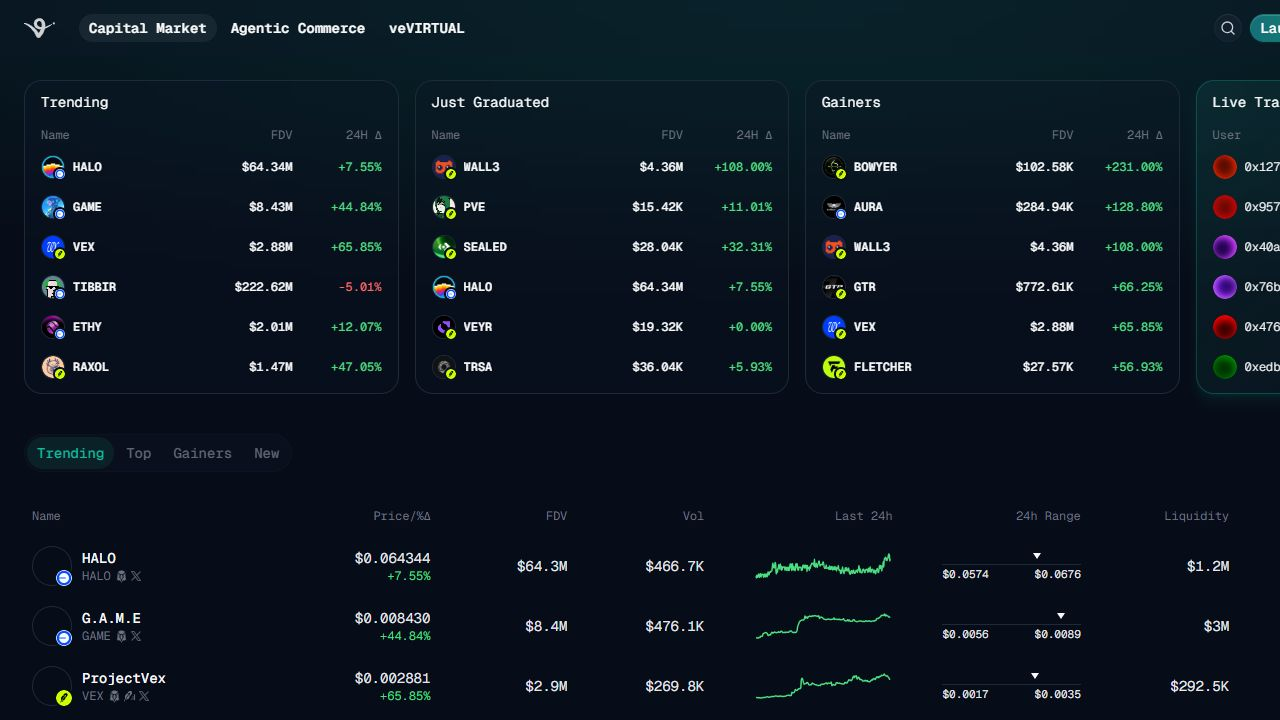
The public market gives a launch immediate distribution, but the reviewer must still open the agent product and identify its task, output and paying user. The same separation applies to AI infrastructure crypto coins: a working market is not evidence of delivered demand.
- Current status: live capital market with agent creation, tokenization and public discovery.
- Launch model: paid Pegasus, Unicorn or Titan tokenization paths; the current creation fee is 1,000 VIRTUAL.
- Agent layer: agents receive a public product profile, while their task, model and service quality remain builder-controlled.
- Token and liquidity: launches enter a public pool with trading fees shared between creators and ecosystem incentives.
- Main limitation: price, graduation and liquidity are more visible than paid agent usage or output quality.
Ownership deserves an explicit pre-launch check. In a first-hand Virtuals ownership report, one user said an imported Sentient Agent could not be claimed because the creator and owner wallets were controlled by the platform, and support could not resolve the legacy setup. One account does not establish a platform-wide defect, and the workflow may have changed. It does show why a creator should confirm which wallet controls the agent, token, upgrade permissions and recovery route before paying the launch fee.
Virtuals works as an integrated launch product for a team that already wants tokenization, immediate market visibility and creator economics. The same integration is a limitation for a builder that wants the agent product to remain separate from price speculation and trading-led discovery.
HoloLaunch: a launchpad for AI-native IP
The product advantage is narrative continuity. Holoworld lets a creator connect an existing character, audience and content loop to a launch. The public market lists projects such as AVA IN THE HOOD alongside smaller character tokens moving through the curve.

Graduation only confirms that buying activity reached the liquidity threshold. A participant still needs the allocation, royalty recipient, unlock terms and a plain-language statement explaining whether the token governs the character or merely trades beside it.
- Current status: live Solana launch market with active and graduated projects.
- Launch model: AI-native IP can enter a campaign or bonding curve through HoloLaunch.
- Agent layer: the surrounding Holoworld product supports virtual characters, content and creator-owned IP.
- Token and liquidity: the public market displays curve progress and marks projects that reach graduation.
- Main limitation: visible market activity does not explain durable IP rights, recurring character use or post-launch revenue.
No sufficiently specific first-hand account was found that traces a HoloLaunch contribution through allocation, claim, graduation and subsequent product access. The public market proves launches exist, but the complete participant journey has not been independently reproduced here. That ownership gap mirrors the control questions used to compare decentralized AI projects.
HoloLaunch has a distinct AI-native IP and character angle rather than a general-purpose agent proposition. Its review remains conditional for utility agents because the visible fundraising and bonding-curve activity does not establish that a campaign supports a working service rather than a collectible narrative.
Agent Launch by Fetch.ai: tokenization for an existing agent
The product boundary is unusually clear. Builders create or host the software in Agentverse, then use Agent Launch to give that agent a token and market. A non-technical creator can complete the dashboard flow, while an existing agent can prepare the launch and hand the final transaction to a human signer.
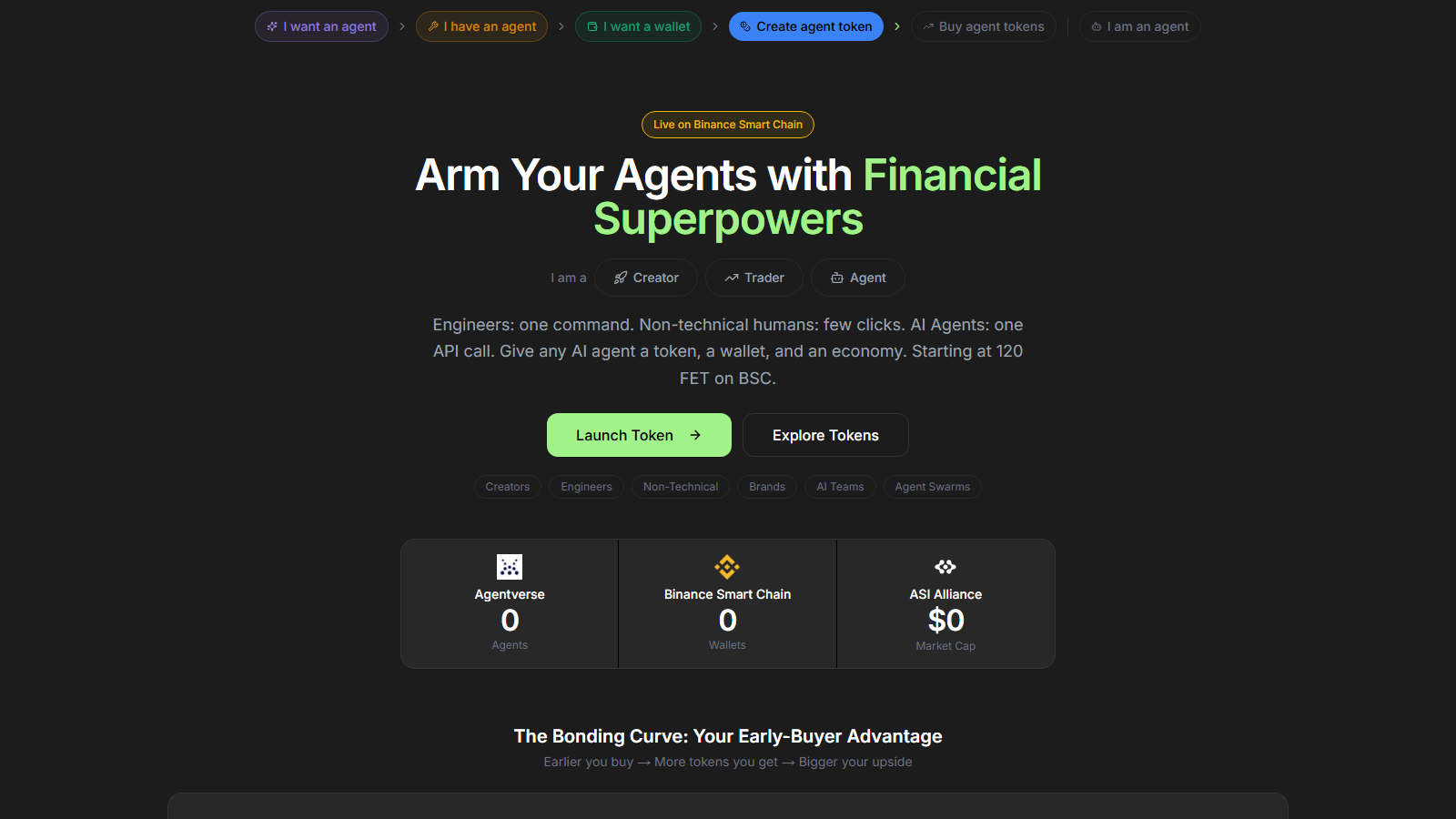
The economics are visible before deployment. The platform shows a 120 FET starting cost, bonding-curve pricing and automatic graduation at 30,000 FET. Its public market also exposes launched tokens, prices and market capitalizations, allowing a buyer to confirm that trading exists without mistaking those figures for evidence that the linked agent performs useful work.
- Current status: live token-launch interface operated by Fetch.ai Foundation on BNB Smart Chain.
- Launch model: connect an Agentverse agent, define its token and complete a human wallet approval for the 120 FET deployment fee.
- Agent layer: Agentverse supplies the agent identity and hosting; Agent Launch adds the wallet, token and public market.
- Token and liquidity: every launch begins on a bonding curve and graduates to PancakeSwap after the curve reaches 30,000 FET.
- Main limitation: the launchpad proves token deployment and trading access, not that the underlying agent has users, revenue or reliable output.
The Agent Launch terms make the ownership boundary important: tokens are associated with agents, while creators remain responsible for the agent and its activity. A buyer should therefore open the linked Agentverse profile, identify a working task and verify who controls the agent before treating the token as an economic claim on that product.
No detailed independent account was found that follows one creator from Agentverse connection through deployment, curve trading and PancakeSwap graduation. That evidence gap does not negate the live interface, but it limits conclusions about wallet friction and support after launch. A first test should use a separate low-value wallet, consistent with AiCryptoCore’s hot-wallet versus cold-wallet guide.
Agent Launch is the most focused tokenization product in this group. It suits a builder who already has a Fetch.ai agent and wants a defined BSC market path; it is not a substitute for building, testing or finding users for the agent itself.
Metaplex Genesis: verifiable identity before token liquidity
The public GENESIS launch page identifies the Launch Pool format, sale allocation, duration, graduation minimum and proceeds assigned to liquidity. It also exposes controls such as disabled mint and freeze authority, allowing a participant to inspect the asset path rather than trust the AI-agent label.
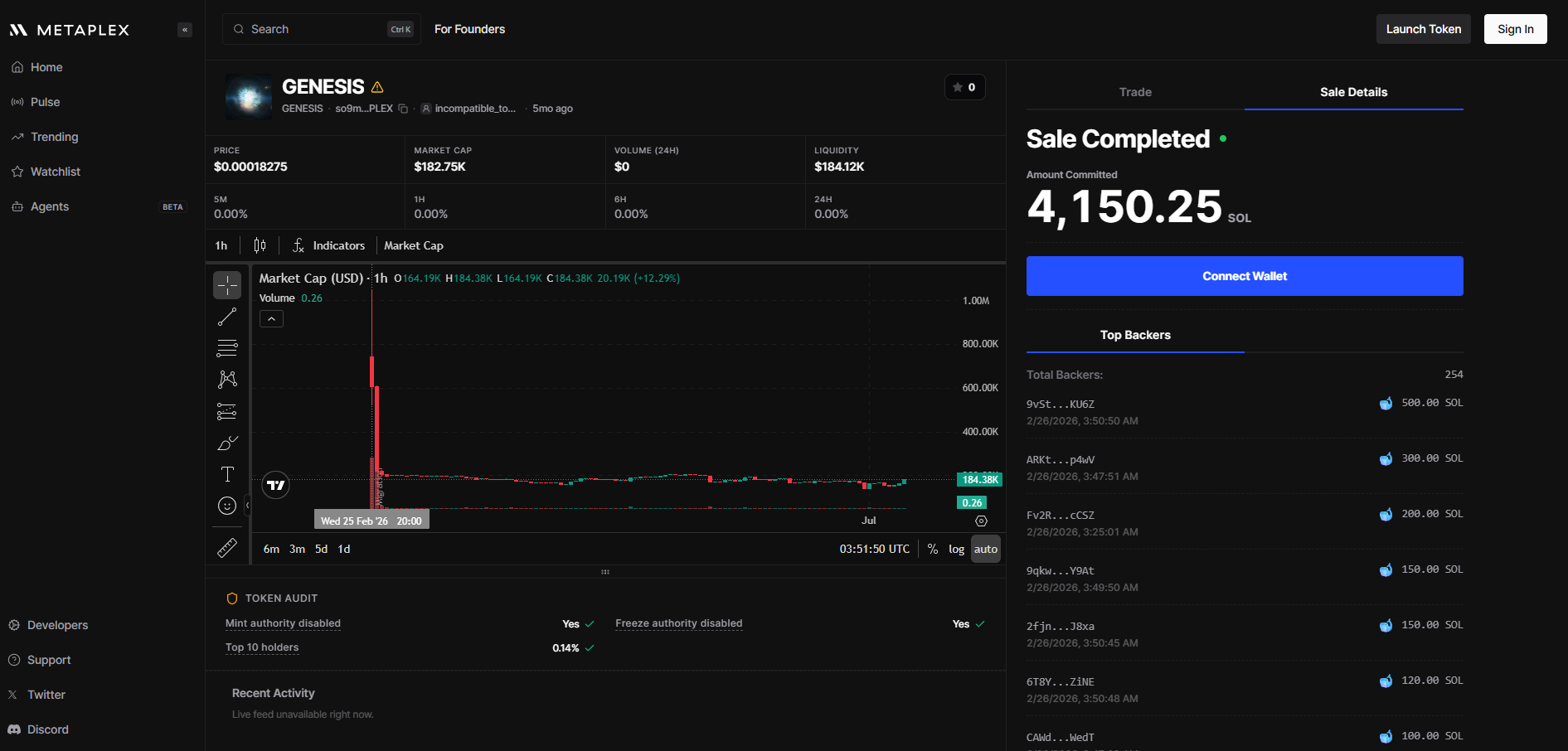
Creator fees can route into the agent’s Asset Signer wallet. Permanent token binding improves provenance but removes the ability to replace a compromised or poorly designed mint, so builders can delay that step until the fee destination and identity are final.
- Current status: live Metaplex app, Genesis launch infrastructure and Agent Stack on Solana.
- Launch model: register an agent identity, launch through Genesis and optionally bind one canonical token permanently.
- Agent layer: an Asset Signer wallet can hold assets and receive fees, while the builder supplies the model and interface.
- Token and liquidity: Launch Pools, presales, auctions and bonding curves can progress into Raydium liquidity.
- Main limitation: permanent token binding is irreversible, and the complete Agent Stack has a technical learning curve.
Genesis is most useful when a team knows what it wants the market to do. A Launch Pool distributes supply proportionally, a presale fixes the price, an auction establishes a clearing price and a bonding curve begins trading immediately. Metaplex supplies the identity and finance primitives, but the team still supplies the model, user interface and useful agent behavior.
The trade-off is setup complexity. In a Metaplex Genesis developer account, a developer created a token on devnet or a local validator but found learning the process alone difficult. This test-environment experience is not evidence of mainnet failure; it indicates that the full Agent Stack remains better suited to a Solana-capable team than to a creator expecting a managed agent builder.
Metaplex makes identity-to-token provenance and Solana sale controls directly inspectable. The review boundary is equally clear: the agent runtime, user experience and post-launch product remain the builder’s responsibility.
Conclusion
Virtuals combines token launch and market discovery, HoloLaunch connects launches with creator-oriented AI IP, Agent Launch gives an existing Fetch.ai agent a BSC token economy, and Metaplex ties a Solana token to a verifiable agent identity. The four products now represent active but materially different launch paths.
A suitable launchpad is one whose market design matches an agent that already works. Decide who controls the product, what the token does, how buyers enter, where liquidity comes from and what remains after launch week. If those answers are missing, postponing tokenization is more defensible than choosing a faster platform.
Frequently asked questions
How did the four launchpads differ in this review?
Virtuals integrates agent tokenization with market discovery, HoloLaunch focuses on AI characters and creator IP, Agent Launch tokenizes an existing Agentverse agent on BSC, and Metaplex Genesis provides identity and Solana sale infrastructure.
Can I launch an AI agent without a token?
Yes. An agent can operate as software before it has a token, and that sequence often makes utility easier to verify. A token should be added only when it performs a defined payment, access, incentive or governance role.
Is an AI agent launchpad the same as an agent framework?
No. A framework supplies components for building and running an agent, while a launchpad handles public distribution, fundraising, tokenization or liquidity. A project may use both, but they solve different problems.
What should I verify before connecting a wallet?
Confirm the official domain, supported chain, requested permissions, fee recipient, token contract, ownership wallet and recovery path. Use a separate low-value wallet until the complete launch and claim flow has been verified.
Disclaimer:
The information provided on AiCryptoCore.com is for educational and informational purposes only and does not constitute financial, investment, or trading advice. Cryptocurrency investments involve risk and may result in financial loss. Always conduct your own research and consult with a qualified financial advisor before making any investment decisions.