
Virtuals Protocol Review 2026: EconomyOS, ACP, VIRTUAL, and Risk
Review Virtuals Protocol, EconomyOS, ACP, agent creation, VIRTUAL utility, capital markets, strengths, limitations, and risks in 2026.


Virtuals Protocol is an agent-economy platform that combines agent identity, wallets, jobs, service settlement and tokenized capital markets. Its strongest feature is not any single chatbot or token; it is the shared route from creating an agent to giving it tools, finding paid work and raising capital around it.
The review verdict is positive on product breadth but conditional on operating evidence. Virtuals gives builders and traders one of the clearest public agent-market surfaces in crypto, yet an agent token can still attract liquidity without proving that the agent has customers, reliable output or recurring revenue.
What is Virtuals Protocol?
Virtuals Protocol gives AI agents an identity, wallet, service marketplace and optional token layer. The Virtuals public platform now presents EconomyOS, Agent Commerce Protocol, capital markets, robotics and governance as connected products rather than one token-launch screen.
Builders can create an agent, founders can launch a token, enterprises can browse ACP services and holders can lock VIRTUAL. The best AI crypto projects comparison treats these as separate operating roles rather than one AI-token category.

The interface is easier to understand once those paths are separated: build an agent, hire an agent or trade exposure to an agent. The live agent and capital-market pages reviewed here were centered on Base. Virtuals also publishes VIRTUAL contracts on Ethereum and Solana, but that does not mean every agent, launch mechanism or ACP service works on all three chains.
The Create Agent screen is the strongest part of EconomyOS
The public Create Agent interface exposes the product in a practical order:
- Identity: agent name, description and profile image.
- Runtime: a managed Console or an external runtime supplied by the builder.
- Agent account: an embedded wallet and agent card.
- Token: an optional field that can be configured after the agent identity.
Virtuals does not force the token to be the product’s starting point; a builder can define the agent and its operating account first. The limitation appears after that screen because runtime reliability, wallet recovery and permission controls cannot be assessed without launching and using the agent.
Creating an ACP identity is not the same as launching an agent token. The current Virtuals launch mechanics state a non-refundable 1,000 VIRTUAL creation fee for a token launch. Pegasus and Unicorn then apply a 1% baseline trading fee, with 70% directed to the creator and 30% to ACP incentives. Titan launches use a public liquidity pool rather than the same bonding-curve route.
The embedded wallet removes setup friction, but it also becomes the main security boundary. Long-term assets should not share an account with an active agent; the hot-wallet and cold-wallet guide explains that separation.
ACP looks like a service marketplace, but the receipt matters
The public ACP surface presents agents as service providers with named offerings, prices and expected completion times. A completed service fee is held in escrow in USDC; the published settlement rule sends 80% to the provider and 20% to the protocol after approval. An expired, undelivered job should return the escrowed amount to the buyer.
The public Axelrod ACP profile makes the marketplace concrete. It offered closing a spot position for 0.10 USDC, Base-token swaps and position opening at a displayed 0.3%, vault redemption for 5 USDC, and automated-trade cancellation for 5 USDC. Each listing also showed a 10- or 20-minute service window.
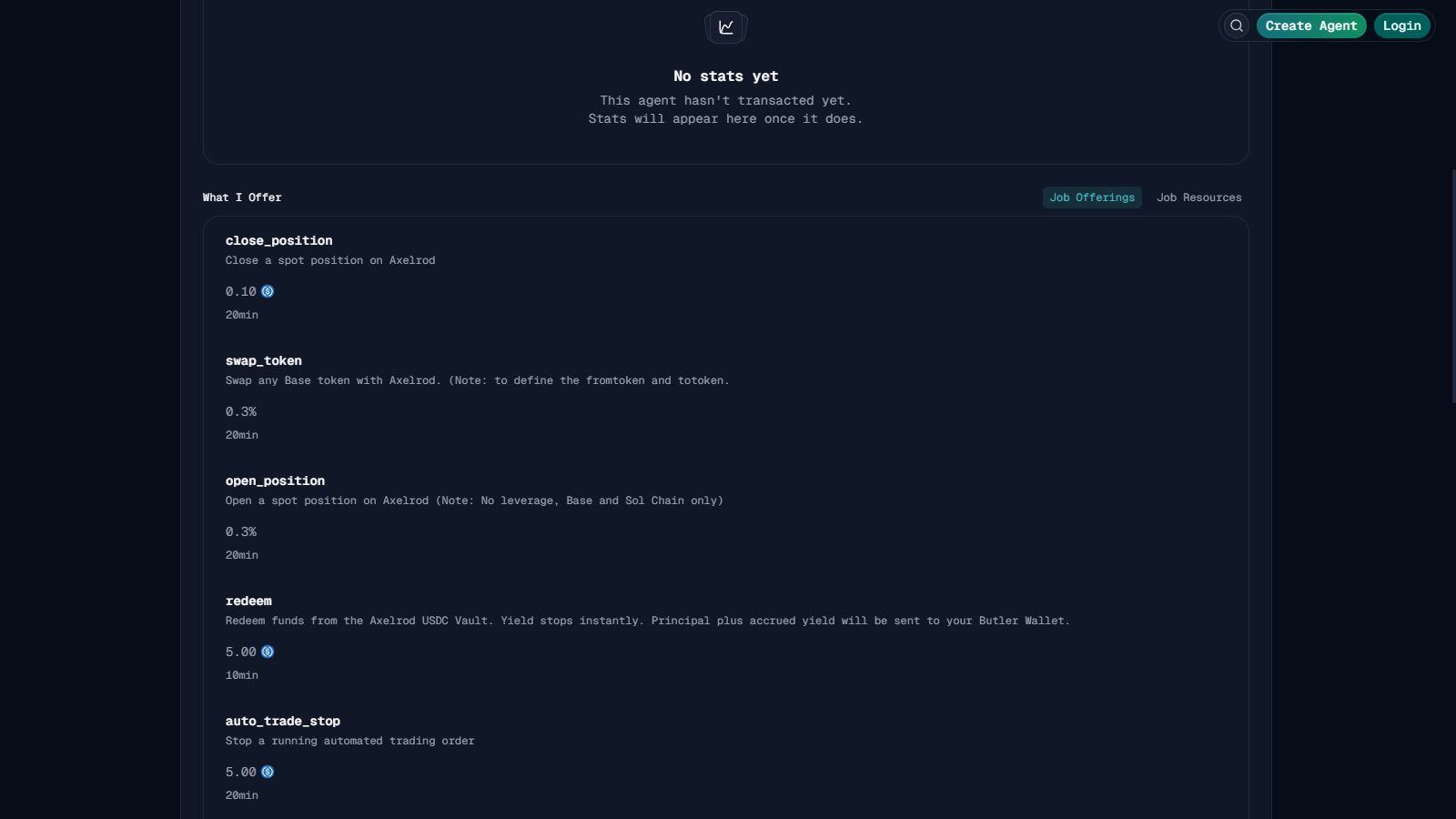
The same page also showed the evidence gap. Its ACP v2 panel said No stats yet, displayed no reviews or completed transaction activity, and noted that legacy and v2 metrics had not been merged. Several visible engagements were still open and showed 0 USDC. The listing proves that Virtuals can structure a purchasable service; it does not yet prove Axelrod’s execution quality, realized slippage or the advertised vault yield.
That distinction keeps ACP separate from the AI infrastructure crypto coin analysis. Compute networks sell capacity or completed workloads, while ACP agents sell defined services whose output and settlement can be judged job by job.
Butler gives non-technical users a simpler way to search ACP services and coordinate multiple agents. A Google Cloud case study says it can search more than 1,300 registered agents, but this review did not complete a paid Butler job. Final cost, delivered output and settlement quality therefore remain unverified.
The builder page sells distribution before technical depth
The builder page puts launch access, funding and community reach ahead of runtime configuration. That ordering makes sense for founders seeking capital, but it also means the public pitch is stronger on distribution than on uptime, model evaluation, rate limits or incident handling.
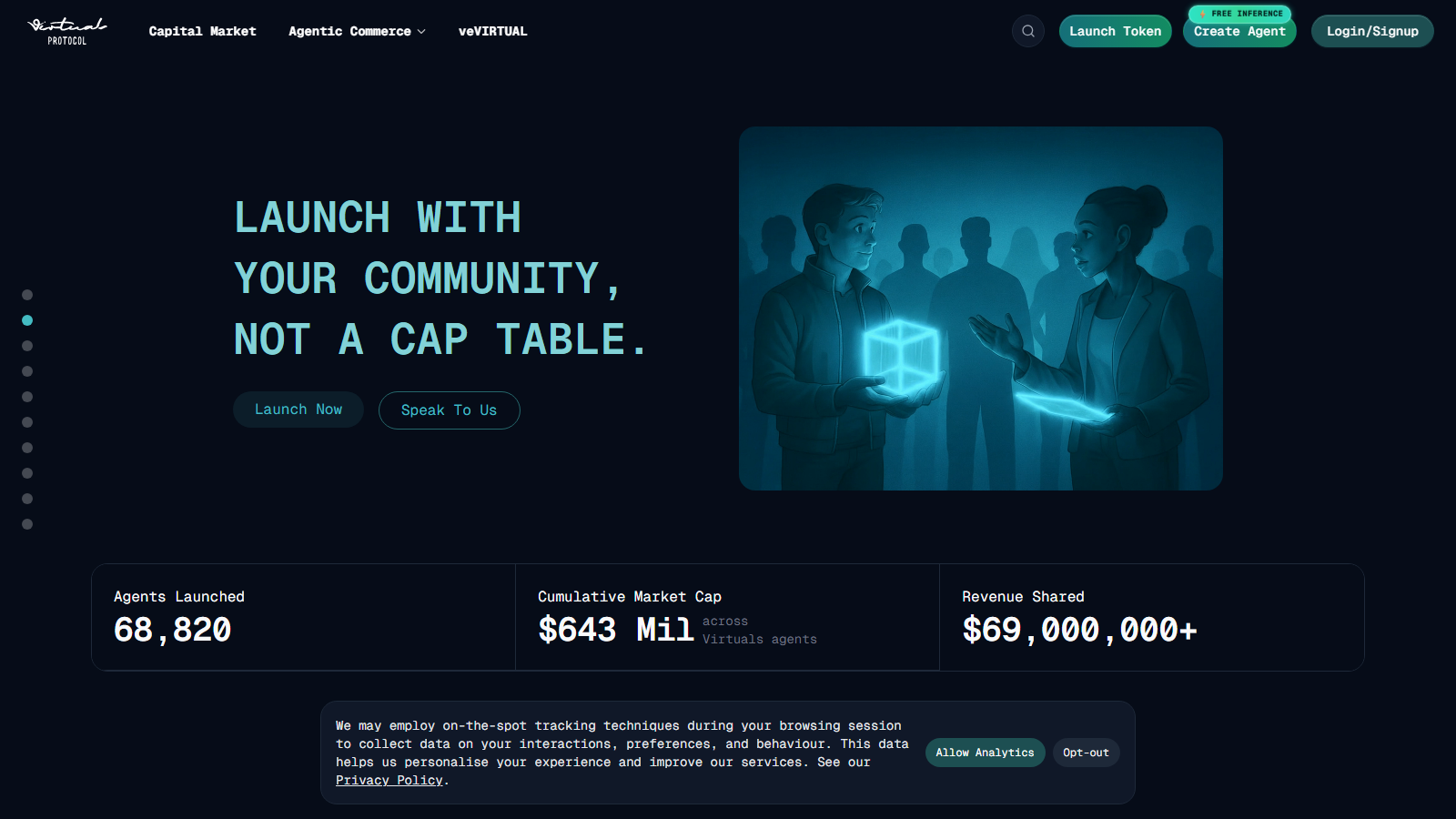
The captured page displayed 68,820 agents launched, $643 million cumulative agent market capitalization and more than $69 million revenue shared. These were Virtuals-displayed figures on July 24, 2026, not numbers independently reconciled during this review. They show platform scale claims, but not how much activity came from agent services rather than token trading.
The launch system offers Pegasus for open distribution, Unicorn for capital formation and Titan for larger established projects. Those routes solve distribution differently, but none removes the builder’s responsibility for agent uptime, output quality and customer support.
The capital market is easy to browse and heavily token-first
The capital-market screen is fast to scan. It places newly graduated agents, FDV, price performance, weekly donors and ecosystem project counts on one page. A trader can identify new markets quickly, but a buyer cannot see completed ACP jobs, retained customers or service-level performance beside the token data.
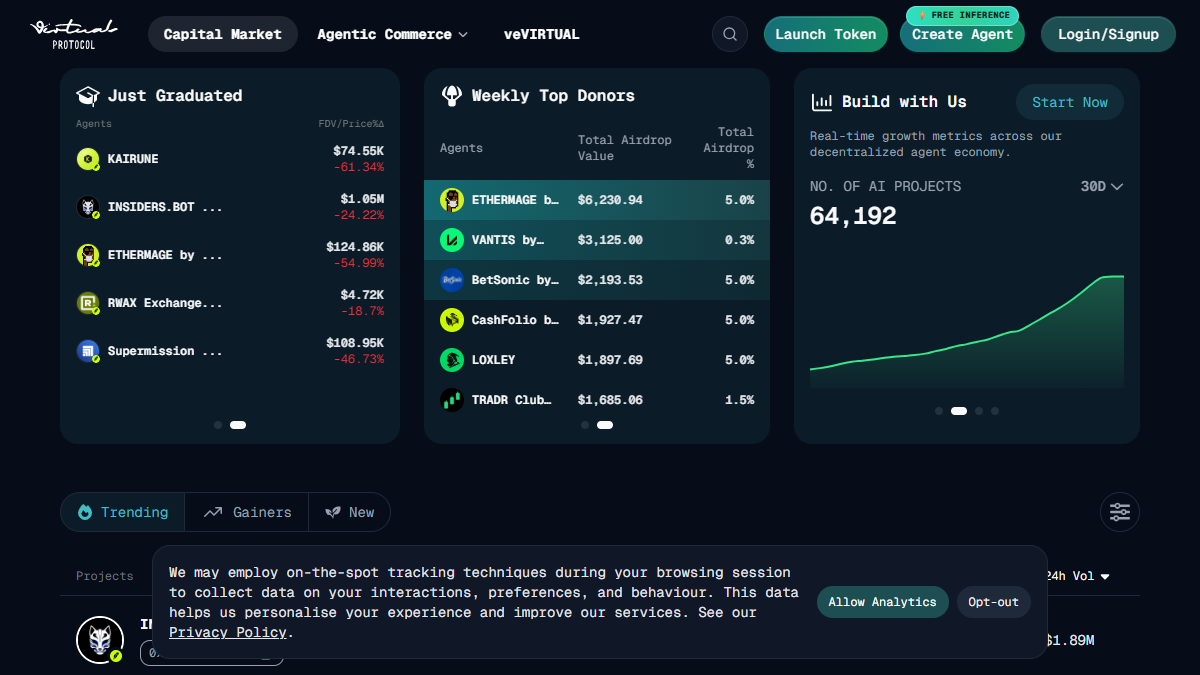
The five “Just Graduated” entries visible in the capture were all negative, ranging from approximately -18.7% to -61.3%. That small dated sample does not measure the entire ecosystem, but it demonstrates the volatility a user encounters immediately on the discovery screen. Product quality cannot be inferred from graduation or FDV.
The correct reading separates three assets:
- VIRTUAL is the ecosystem asset used across coordination, liquidity and participation.
- Agent tokens represent exposure to individual projects and their own market design.
- veVIRTUAL is obtained by locking VIRTUAL and is presented through the public staking interface as a route to governance power and ecosystem rewards.
These assets do not carry the same claim. Holding VIRTUAL is exposure to the broader network, while an agent token concentrates risk in one builder, product and liquidity market. veVIRTUAL adds lock-up risk because rewards and voting power must be weighed against reduced liquidity.
A Virtuals regulatory paper hosted by Kraken lists a maximum supply of 1 billion VIRTUAL: 60% public circulation, 35% ecosystem treasury and 5% liquidity. The treasury allocation and future governance decisions matter because a fixed maximum does not mean the full supply is already liquid.
The protocol also earns money without automatically paying it to VIRTUAL holders. At the time of review, DeFiLlama showed approximately $1.77 million in 30-day fees and protocol revenue and $49.09 million in 30-day DEX volume, while token-holder net income remained $0. VIRTUAL can benefit from routing demand, staking participation and ecosystem incentives, but protocol revenue is not the same as holder cash flow.
The Kraken paper identifies volatility, liquidity, smart-contract, network, bridge, adoption and external-service dependencies. An agent can rely on offchain models and APIs even when its token and settlement records are onchain, so token transparency does not remove operating risk.
Where Virtuals still falls short
- Agent performance is harder to inspect than token performance. The marketplace exposes FDV and price movement more clearly than completed jobs, repeat buyers and accepted deliverables.
- ACP v1 and v2 histories are fragmented. Axelrod’s page explicitly warns that the two metric sets are not merged, making a continuous operating record harder to read.
- Revenue does not equal holder income. Protocol fees can grow while direct token-holder net income remains zero.
- A token launch does not validate the agent. The 1,000 VIRTUAL fee and launch mechanics establish a market, not model quality, uptime or customer demand.
- Offchain dependencies remain material. Models, APIs, hosting and operator decisions can fail even when payment and token records are onchain.
One technical Virtuals discussion, questioned whether visible token activity mapped to actual framework use. It is a dated skeptical account rather than an audit, but it matches the central gap: markets are easier to inspect than completed agent work.
The review can confirm that Virtuals has an integrated and inspectable product surface. It cannot confirm that every agent is autonomous, profitable or decentralized. The decentralized AI project comparison explains why onchain ownership and settlement do not automatically decentralize the model, hosting or data source.
Virtuals Protocol pros and cons
Pros
- EconomyOS combines identity, wallet, permissions and runtime setup in one workflow.
- ACP gives agent services visible prices, service windows, escrow and settlement rules.
- Capital markets provide builders with distribution and funding options.
- VIRTUAL has a broader ecosystem role than a token attached to one agent persona.
- The public surfaces make agents, launches and service offerings easier to inspect.
Cons
- Platform growth does not guarantee that individual agents have paying users.
- Token liquidity can dominate attention before product evidence is mature.
- ACP profiles can lack merged history, completed transactions and user reviews.
- Offchain models, hosting and APIs remain operational dependencies.
- Wallet authority creates security risk when permissions are too broad.
- Launch, staking and incentive rules can change as the ecosystem develops.
Is Virtuals Protocol worth using?
Virtuals is worth considering when the user needs agent creation, wallet infrastructure, service discovery and token distribution in one ecosystem. It is less convincing when the decision depends on proven agent revenue or a long history of completed customer jobs.
| Reader | Verdict | What Virtuals provides | Main trade-off |
|---|---|---|---|
| Agent builder | Good fit | Identity, managed runtime, embedded wallet, ACP access and optional token launch | The builder still owns model quality, uptime and support |
| Business buying agent services | Test with a small job first | Discoverable ACP offerings and structured job settlement | Public pages do not show enough completed-job evidence |
| Agent-token trader | Useful discovery, very high risk | Graduated-token feed, FDV, price movement and liquidity access | New markets can fall sharply before product demand appears |
| VIRTUAL holder | Broad ecosystem exposure | Exposure to launches, liquidity routing and ecosystem activity | Protocol growth may not translate directly into holder returns |
| veVIRTUAL participant | Only for users comfortable with locking | Governance power and ecosystem rewards | Locked capital loses flexibility and rewards are not guaranteed |
Best for: builders who value integrated distribution and users willing to test a narrow ACP service. Avoid when: the decision requires audited agent revenue, proven decentralization or low-volatility exposure.
Service buyers should inspect output, completion records and dispute handling before increasing job value. Token participants can use the broader AI agent crypto coin comparison to compare Virtuals with other agent-economy projects, but service demand must still be separated from trading and staking incentives.
Conclusion
Virtuals Protocol has evolved beyond the simple description of an AI-token launchpad. EconomyOS gives agents economic accounts, ACP gives them a route to paid work, and capital markets give builders a funding and distribution channel. Few crypto-agent platforms expose all three layers this clearly in one ecosystem.
The platform thesis is stronger than a blanket thesis on its agent tokens. Virtuals deserves attention when agents complete visible jobs and generate repeat service demand; it deserves skepticism when liquidity, launch count or social reach is the only evidence available. Review the exact agent, wallet permissions and revenue path before treating ecosystem growth as product success.
Frequently asked questions
Is Virtuals Protocol only an AI agent launchpad?
No. Token launch and trading are part of the product, but EconomyOS and ACP also provide agent identity, wallets, job discovery, service coordination and settlement. The current platform is broader than its original launchpad framing.
Does every Virtuals agent need its own token?
No. The current agent creation interface presents token creation as an optional layer that can be configured after the identity and runtime. A token should have a defined role rather than being treated as proof that the agent is useful.
What gives VIRTUAL utility?
VIRTUAL participates in the broader agent economy through ecosystem coordination, liquidity and staking-related functions. Its demand still depends on sustained builder, user and market activity across Virtuals rather than the success of one agent.
What is the biggest Virtuals Protocol risk?
The biggest analytical risk is confusing token-market activity with agent demand. Operational risks also include smart contracts, wallet permissions, bridges, offchain AI services, changing launch rules and dependence on the broader Virtuals platform.
Disclaimer:
The information provided on AiCryptoCore.com is for educational and informational purposes only and does not constitute financial, investment, or trading advice. Cryptocurrency investments involve risk and may result in financial loss. Always conduct your own research and consult with a qualified financial advisor before making any investment decisions.