
How to Spot a Crypto Project That Only Wears an AI Label: Five Checks, Tested on Real Tokens
NewsCoinGecko tags 1,413 coins as AI. We ran five simple checks on six large projects and a random sample of 20 small ones.


"AI" is now a tag that crypto projects attach to themselves, much like "metaverse" in 2021. Some of them build real systems. Many do not. This guide gives you five checks that take about ten minutes per project and need no technical background, then shows what happened when we ran them on real tokens on 23 November 2026.
What to know first
- On 23 November 2026, CoinGecko's "Artificial Intelligence" category held 1,413 coins with a combined market value of about $19.08 billion.
- The ten largest made up 68.5% of that value. The single largest, NEAR, was 20.5%.
- 1,220 of the 1,413 (86%) were worth under $10 million each. 1,020 (72%) were worth under $1 million.
- 1,137 (80%) were more than 90% below their all-time high.
- Passing these checks does not make a token a good investment. Failing them is a reason to slow down.
Our reading: the label is cheap and the real work is rare. The size of the category tells you that most "AI" tokens are small and thinly traded. It does not tell you which ones are real, which is why the checks below look at the project itself.
How we chose what to cover
Our search tool returned nothing in this session, so we went to primary pages and public data instead. We pulled the full CoinGecko category list through its public API, then looked up each project's own website and GitHub page. We checked six large projects we picked because they are among the biggest in the category and come from different parts of it: NEAR, Bittensor, Venice, Internet Computer, Render and Virtuals. We also took a random sample of 20 tokens worth under $1 million (random seed 2611) and checked only what CoinGecko lists for them. We do not name the 20, because a missing link is not proof of wrongdoing and the sample is too small to judge any single project. An earlier article on this site compared agent and infrastructure tokens by price. This one is about a different question: is the project real?
Terms used in this guide
| Term | Plain meaning |
|---|---|
| Market cap | Price times the number of coins in circulation: a rough size measure |
| Token utility | What the token is actually used for inside the product, such as paying fees or staking |
| GitHub repository (repo) | A public folder of a project's code, with a history of changes |
| Commit / push | A saved change to the code. A recent push date shows the code is being worked on |
| Archived repo | A repo its owner has locked as read-only, usually because work moved elsewhere |
| ATH | All-time high price |
| 24h volume | The value traded in the past 24 hours |
| Liquidity | How easily you can sell without moving the price |
The five checks
Check 1: Can you see a working product?
Open the project's own website and look for something you can use or try, not only a roadmap and a token page. A real product has a sign-in, a demo, an app or documentation you can follow.
Of our six large projects, all six list a website on CoinGecko. We looked at the front page of Venice, which shows a chat box and sign-up button for a private AI assistant. We only looked at the landing page and did not sign up or run it, so we cannot say how well it works.

For the random sample, every one of the 20 tokens lists a homepage, so having a website means little. The question is whether the site shows a product or only a pitch.
Check 2: Is the code public, recent and not archived?
AI projects that build real systems usually publish code. On GitHub, look at three things: the date of the last change, whether the repo is marked archived, and whether the commit messages describe real work.
What we saw on 23 November 2026:
- NEAR (listed repo
nearcore): last push 23 November 2026, 2,623 stars, not archived. - Internet Computer (
dfinity/ic): last push 23 November 2026, 1,813 stars, not archived. - Render: CoinGecko links the organisation page, not a single repo. Its most recently updated repo was pushed on 19 November 2026.
- Virtuals Protocol: CoinGecko links the organisation page, which lists 50 repos. The most recent changes were on 23 November 2026, but several repos on its front page carry "deprecated" labels.
- Bittensor: this is the useful surprise. The repo CoinGecko links to was archived by its owner on 10 July 2026 and is now read-only. A note in its history says development moved to a separate repo called subtensor, which had a push on 23 November 2026. A quick look at only "last push date" on the old link would have been misleading in the other direction: it looks dead, but the work continues elsewhere.
- Venice: CoinGecko lists no GitHub link. We did not search further, so we cannot say whether it publishes code.
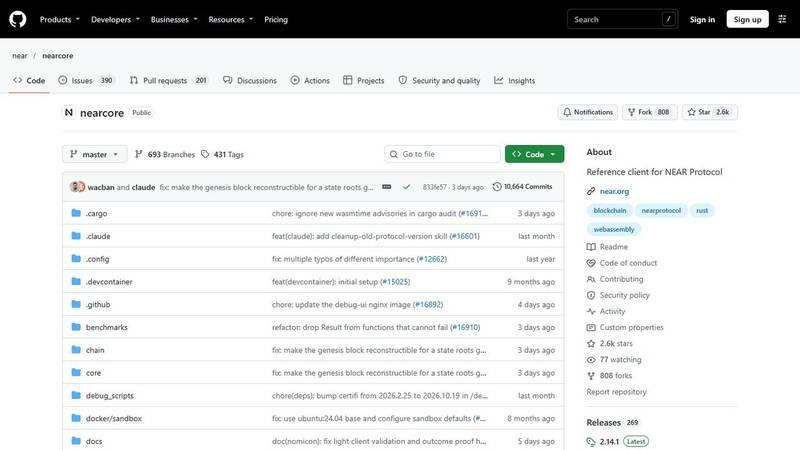
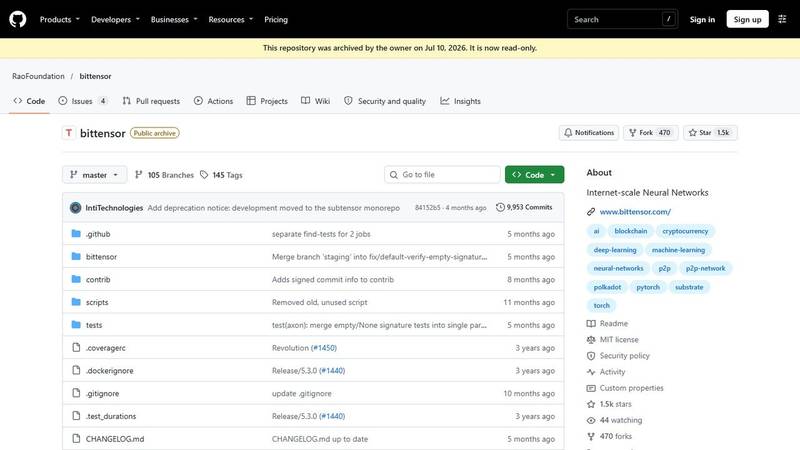
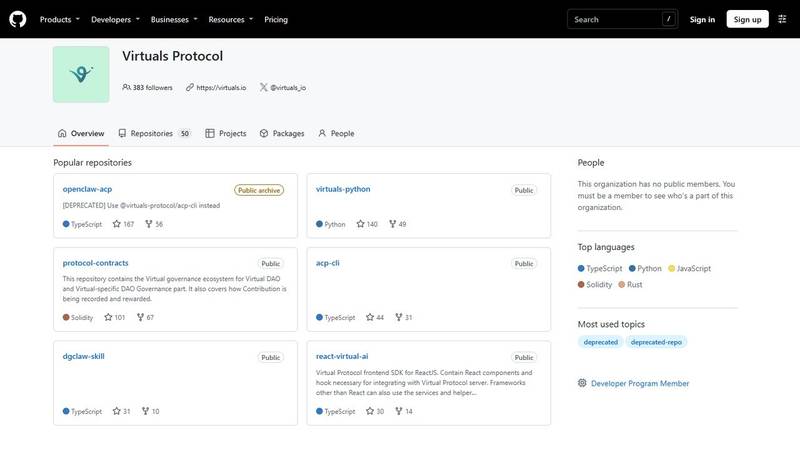
Our reading: always check whether a repo is archived and where the work moved, in both directions. An old date can hide an active project, and a project with a recent date can hide only small documentation edits.
Check 3: Does the listing itself point to real code?
Aggregator sites such as CoinGecko show a project's links. If a token that calls itself an AI network lists no code link at all, ask why.
In our random sample of 20 tokens worth under $1 million, 14 listed no GitHub link, 4 listed only a GitHub organisation or user page with no specific repo, and 2 listed a specific repo. Of those two, one had its last push on 9 September 2025, about 14 months earlier, and the GitHub data for the other was not readable for us. Treat this as a prompt for questions, not a verdict. A project can publish code somewhere that CoinGecko does not list, and a link can be missing because nobody updated the listing. The sample is also small and random, so it says nothing about any one token.
Check 4: Does the token have a job?
Open the project's documentation and find the page on the token, often called tokenomics. You want a plain answer to three questions: what do users pay for with the token, what do holders do with it (staking, voting, fees), and where does the token's demand come from besides new buyers. If the answer is only "it will list on more exchanges" or "holders will benefit", that is a label, not a use.
We did not read the token documentation of the six large projects for this check, so we make no claim about their utility. Do this check yourself on any token you consider.
Check 5: Is there real trading and size behind it?
Market cap and 24h volume are on every price page. Dividing volume by market cap shows how much of the token changes hands in a day. Thin trading means you may not be able to sell.
Across all 1,413 coins in the category, the median volume was 0.06% of market cap (0.0006). For a token worth $1 million, that is about $600 traded a day. Here are the six large projects at the time we pulled the data (23 November 2026, around 10:00 UTC):
| Project | Market cap | 24h volume | Volume / market cap | Code evidence we saw |
|---|---|---|---|---|
| NEAR | $3.91B | $412M | 10.5% | Active repo, pushed 23 Nov 2026 |
| Bittensor (TAO) | $2.24B | $59M | 2.6% | Listed repo archived 10 Jul 2026; successor repo pushed 23 Nov 2026 |
| Venice (VVV) | $1.27B | $53M | 4.2% | No GitHub link on CoinGecko |
| Internet Computer | $1.12B | $31M | 2.8% | Active repo, pushed 23 Nov 2026 |
| Render | $744M | $19M | 2.6% | Org repo pushed 19 Nov 2026 |
| Virtuals (VIRTUAL) | $252M | $13M | 5.2% | Org repos updated 23 Nov 2026, some marked deprecated |
Figures are rounded and come from CoinGecko's public API. The 24h volume changes every minute, so use the table to see the pattern, not as a quote.
Our reading: even among the big names, daily trading is a few percent of market value, and the category's median is far lower. A token that fails Checks 1 to 3 and also trades at a tiny share of its value is the combination to be most careful with.
Putting the five checks together
- See a product you can try, not only a pitch.
- Look at the code: public, recent, not archived, and check where work moved.
- Check whether the listing links to real code.
- Read what the token is used for.
- Look at trading volume relative to size.
A project does not need to pass every one. A closed-source company can be legitimate, and Check 3 may fail for an honest project with an out-of-date listing. But a token that fails most of them has given you little to rely on.
What we did not check
- We did not use any of the six products, only looked at public front pages and GitHub pages.
- We did not read tokenomics documents, audits, team backgrounds or on-chain usage for any project.
- We did not read the code, so a recent push tells you the repo is active, not that it is good.
- The 20 sample tokens are a small random sample, not a ranking or a finding about any named project.
- Venice may publish code that CoinGecko does not list. We did not search beyond CoinGecko and its homepage.
- CoinGecko's category is its own tagging and may include projects with only a weak AI link.
- We did not check whether any of these tokens are available or legal to buy in your country.
FAQ
How can I tell if an AI crypto project is real?
Look for a product you can try, public code with recent changes, a token with a stated use, and trading volume that is not tiny for its size. No single sign is proof, but missing all four is a warning.
Does a recent GitHub push mean the project is good?
No. It shows the repo is being updated. Updates can be small, and the code can be poor. It is a sign of activity, not of quality.
Why did the Bittensor repo look old?
The repo that CoinGecko links to was archived on 10 July 2026, and a note in it says development moved to another repo. That other repo, subtensor, had a push on 23 November 2026.
Is a missing GitHub link a red flag?
It is a reason to ask questions. The project may publish code elsewhere, or the listing may be incomplete. Check the project's own site and docs.
Is the AI category a good place to find investments?
We make no recommendation. In the data we pulled, most tokens in the category were small and far below their old highs, so liquidity and survival are real risks.
This article is for information only and is not financial or investment advice. Market data is a snapshot from CoinGecko on 23 November 2026. GitHub observations were made on the same date and may have changed.


