Veda Review 2026: Complete Beginner’s Guide to Veda Vaults, BoringVault, Embedded Earn and Where the Yield Comes From
ReviewVeda Review 2026 explains Veda Vaults, BoringVault and Embedded Earn, where yield comes from, key risks, and why there is no public Veda deposit app.


Who This Guide Is For
This guide is for someone who keeps seeing the name Veda next to big brands such as Kraken, ether.fi, Lido or MetaMask and wants to know what it actually does. It is also for a person who holds a “vault token” and wants to know who is behind it. We explain each term as it comes. You do not need to know what a vault, a curator or a Merkle proof is before you start.
Here is the surprise. Most people will never visit a Veda website to deposit money, because there is no Veda app for the public. Veda sells its technology to other companies, and those companies show it to their customers under their own names. So reviewing Veda means reviewing a back office. We did that in two ways. We read and captured Veda’s own site, and we connected a wallet to a partner front end that Veda powers, Lido Earn, to see what a user meets.
How We Tested Veda
| Step | What we did | Result |
|---|---|---|
| Read the Veda site | Opened veda.tech, the Earn, Security, Ecosystem, Console and Kraken pages | Pages loaded, mostly sales material |
| Look for a public app | Tried app.veda.tech | The address does not exist |
| Open ether.fi Earn | Followed the Liquid link | Redirected to a general ether.fi page, no Veda branding seen |
| Open Lido Earn | Loaded stake.lido.fi/earn on desktop | Loaded, with a Connect wallet button |
| Connect a wallet | MetaMask demo wallet, ticked the Lido terms box, approved only the connection | Connected, address 0x5363…c7A0cD |
| Open vaults | EarnETH, EarnUSD and Lido GGV pages | All loaded, GGV is the one that names Veda |
| Deposit test | Looked for a deposit box | GGV has none, because it has been wound down |
| Docs and security | Read docs.veda.tech and the Security page | Audit and control descriptions |
| Public data | DefiLlama, GitHub, CoinGecko | Pulled on November 26, 2026 |
The demo wallet holds no money. We never signed a message and never confirmed a transaction. Because the only Veda powered vault we could reach was closed to deposits, we could not preview a deposit at all. We say so wherever it matters.
Quick Verdict
Veda is a serious piece of infrastructure with a minimal vault design, published controls and a long audit list. It is also a business to business product whose public numbers are self reported, whose value locked has fallen sharply from its peak, and whose headline customer, Kraken, appears to hold a very large share of what is left.
| Item | Our view |
|---|---|
| Best for | Companies that want to add a yield feature, and technical users who want to read how a vault works |
| Not for | A person looking for a Veda app to deposit into, or anyone who wants a token to buy |
| Ease of use | Not applicable. There is no public app. The partner front end we tested was clear |
| Transparency | Good on design and audits, weaker on live data and on who holds the risk |
| Main risk | Smart contract risk, strategy risk, customer concentration and reliance on partners |
| Our editorial score | 7 out of 10 |
The score is ours and rests on what we could verify. It would be higher if we could have tested a live deposit and withdrawal.
What Is Veda (Plain English)
Think of a restaurant supplier that runs a huge central kitchen. Many restaurants put their own name on the menu, but the food is cooked in the same kitchen with the same recipes and the same safety rules. Customers eat at the restaurant and never see the kitchen.
Veda is the central kitchen for yield. A yield product is any service that takes your crypto, puts it to work in lending markets, staking or trading, and pays you the result. Building one from scratch is hard. A company has to write safe contracts, handle prices, move money across several blockchains and manage risk. Veda provides that infrastructure to other companies. An exchange or a wallet can then offer an “Earn” button without building the engine.
Three words are worth learning now.
A vault is a smart contract that holds many users’ deposits together and follows a set of rules. When you deposit, you get a receipt token that stands for your share. As the vault earns, each share becomes worth more.
A curator is the specialist who decides where the vault’s money goes, for example into a lending market or a staking product. The curator picks the strategy, and the vault’s rules limit what the curator can do.
Key Facts
| Fact | Detail | Source |
|---|---|---|
| What it is | Vault infrastructure for other companies | Veda docs |
| Founded | 2024, per the About page | veda.tech |
| Core contract | BoringVault | Veda docs and GitHub |
| Chains | 13 listed on DefiLlama, including Ink, Ethereum, Optimism, Monad, Plasma and Hyperliquid | DefiLlama |
| TVL | About $1.45 billion | DefiLlama |
| Biggest chains by TVL | Ink about $715 million, Ethereum about $421 million, Optimism about $188 million | DefiLlama |
| Named customers | Kraken, Plasma, MetaMask, ether.fi | veda.tech |
| Audits claimed | 12 or more | veda.tech/security |
| Bug bounty | $1 million, on Immunefi | veda.tech/security |
| Token | None found | CoinGecko search |
| Investor named | Coinbase Ventures | veda.tech/about |
| Code license | Listed as NOASSERTION on GitHub | GitHub |
The Site, Page by Page
The home page
The home page is written for companies, not for savers. The headline says your users already hold the capital and that you should give them a reason to keep it with you. It lists four benefits for a business customer: more retention, more deposits, new revenue and a launch without building infrastructure. A small widget shows a user balance “now earning” $12,000. It is an illustration, not live data.

Enterprise Earn
The Earn page says “Build the earn products your customers want” and shows a mock up of an app balance of $12,840.67, a 6.25% APY and a split of yield sources into 70% lending protocol and 30% reserve funds. These are example figures for a sales demo. Nothing on this page is a live rate, and a reader should not take 6.25% as a Veda return.
Security
The Security page is called the Trust Center. At the top it claims 12 or more third party audits, $32 billion or more in volume handled and a $1 million bug bounty. Below that it describes four pillars: the vault contract, access controls, monitoring and third party audits. The most useful part is a table of roles. It says nobody can make an arbitrary transfer of customer funds, that strategy execution must match pre approved on chain permissions, that exchange rate updates are limited in how often and how far they can move, that sensitive changes are timelocked and that an emergency pause can stop activity but cannot redirect funds.
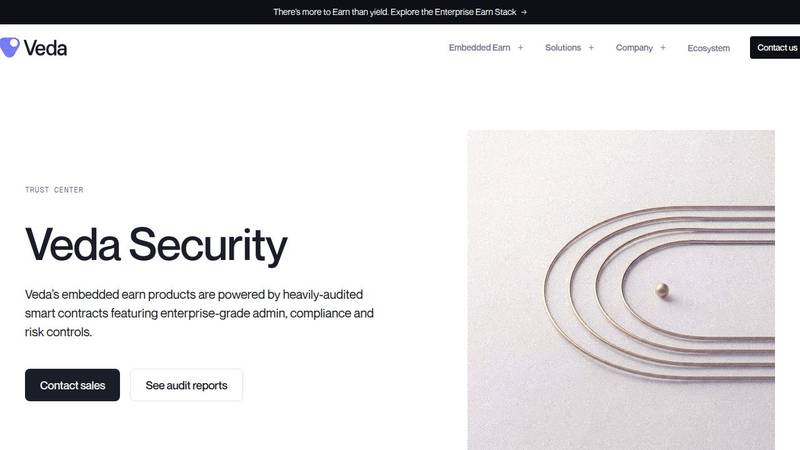
Those are good design claims. They are claims. We read the page and the contract description, and we did not verify the permissions on chain.
Ecosystem
The Ecosystem page lists the assets, chains and protocols that Veda vaults touch. Assets include ETH, wBTC, USDC, USDT, USDe, USDS, GHO, HYPE and ether.fi tokens. Chains include Ethereum, Arbitrum, Base, Berachain, BNB Chain, Hyperliquid, Ink, Linea, Monad, Optimism and Plasma. The page claims $32 billion or more in total deposits, $100 million or more in yield generated and more than 300,000 total users.
Console
Console is described as “Mission Control for Embedded Earn”. It lets a customer monitor vault deployments, adjust positions and watch deposits. It is a sales page with a Book a demo button. The same page claims $16 billion or more in deposits through Veda, $100 million or more in yield distributed and more than 200 integrations. Note that the deposit figure here is $16 billion, while the Ecosystem page says $32 billion. The two pages may measure different things, and neither says how. We could not reconcile them, so we do not rely on either one.

The Kraken case study
This is the strongest proof point. The page says Kraken has $900 million in Veda powered Earn balances, more than 90,000 active depositors and three asset classes: stablecoins, Bitcoin and tokenized equities. A quote from a Kraken product director calls the multichain, multiprotocol design Veda’s superpower. If the $900 million is counted on the same basis as DefiLlama’s $1.45 billion, Kraken alone is about 62% of Veda’s value locked. We cannot confirm that the two numbers match, so treat it as a question and not a finding.
A Real Veda Vault Through a Partner: Lido Earn
To see what a user actually meets, we went to Lido Earn at stake.lido.fi/earn, one of the partner front ends Veda names in its docs. The connect window listed Browser wallets, MetaMask, OKX Wallet, Ledger, WalletConnect and Bitget Wallet, with a box to tick for the terms of use and privacy notice. We ticked it, picked MetaMask and approved only the connection. The header then showed our address and a balance of 0.0 ETH.
The Earn page showed two main vaults. EarnETH had a 14 day average APY of 3.4% and TVL of $162.1 million. EarnUSD showed 7.1% and $62.4 million. Both carried a “Protected” label and a note that losses are absorbed first by a layer called Firelight and then by the Lido DAO’s own loss protection. Here is the finding that matters for this review. On the vault pages, the curator for both was Mellow, the audit listed was by Nethermind dated March 2, 2026, and the fee line read 0.2% AUM plus 15% performance. Neither page named Veda. Neither page named Veda as its infrastructure provider.
Veda appears on a third page, Lido GGV, the Golden Goose Vault. It said “Curated by Veda” and “Infra provider Veda”, with TVL of $1.8 million and a vault created on May 22, 2025. A notice said the vault has been sunset, positions are held in WETH and withdrawals are in WETH only. The fee table showed a 10% performance fee and a 1% platform fee, deposits immediately with a 24 hour lock on withdrawals, and an instant withdrawal period. A line said the service relies on third party infrastructure provided by Veda, under Veda’s terms of service. Our position showed 0.0 GG and $0.00.
What this tells a beginner. Lido’s main ETH and USD vault pages named Mellow, and the Veda vault that is left is closed to new deposits and holds $1.8 million. That is a single data point, not a trend, and we did not find out why Lido made the change. Still, it is a reminder that infrastructure partners can switch providers, which is a business risk for Veda.
What It Costs
Veda does not charge a retail user directly. The fees come from each partner’s vault. The GGV vault showed a 1% platform fee and a 10% performance fee. The EarnETH vault, whose page did not name Veda, showed 0.2% AUM and 15% performance. The Earn mock up on the Veda site mentions that a business can “capture a share of the yield”, so a partner can add its own margin on top. The practical rule is to read the fee line on the vault page before you deposit. We saw no gas or network cost because we did not open a deposit.
A Worked Example: What a Vault Fee Does
This is an illustration with round numbers, using the GGV fee table. We could not run it because the vault is closed.
Say you put 10 ETH in a vault that earns 4% gross in a year, so 0.4 ETH. A 1% platform fee on assets is 0.1 ETH, taken from the whole 10 ETH. A 10% performance fee on gains is 0.04 ETH. You would keep about 0.26 ETH, a 2.6% net return, down from 4%. The result is that more than a third of the gross yield went to fees. If the vault earns 2%, the same fees would take 0.1 ETH plus 0.02 ETH from a 0.2 ETH gain, leaving 0.08 ETH. Fixed percentage fees on assets bite hardest when yields are low.
The second lesson is about timing. A 24 hour lock on withdrawals after deposit means you cannot treat the vault as a checking account. And a vault being sunset means the choice of when to leave may be taken from you.
How the Vault Design Limits Risk
Here is the Veda design, in plain terms, as the docs and the Security page describe it.
The strategist, the person or team choosing the strategy, does not get a free hand. The vault only lets them call approved contracts, with approved functions and parameters. This is checked with Merkle proofs, a way of proving that an action is on a pre approved list without storing the whole list in each transaction. A strategist who tries something off the list is blocked by the contract.
The share price of a vault is updated by a “rate updater”. Veda says updates are bounded in frequency and size and that out of range changes can pause updates. That matters because a wrong price can let one person withdraw more than they put in.
Sensitive changes are timelocked, so users get a window to see them coming. An emergency pause can stop activity but, per the Security page, cannot send funds anywhere.
The weak spot is that these controls protect against a rogue operator and not against a flawed strategy. If a curator sends money to a lending market and that market fails, the vault still loses. The Lido page said as much, listing smart contract risk, impermanent loss from liquidity provision and liquidation risk from leverage.
The Four Layers Behind an Earn Button
Veda publishes a 22 page guide called the Enterprise Earn Stack, gated behind a sign up form that we did not fill in. The page that describes it lists four layers, and they make the whole business easier to understand.
The first layer is the distributor, the app or exchange that faces the customer and handles deposits. Kraken, a wallet or a neobank sits here. The second layer is the vault, which is where Veda sits. It connects assets, chains, curators and yield sources. The third layer is the curator, the specialist who picks strategies, allocates capital and manages risk. The fourth layer is the protocol, where yield is actually produced, such as a lending market, a staking system or tokenized real world assets.
For a saver, this means that your return depends on four different parties, and a failure in any one can hurt you. The distributor can freeze your access to the app. The vault can have a bug. The curator can choose badly. The protocol can be hacked. A single clean Earn button hides all four. This is not a flaw unique to Veda, but a beginner should know the button is a summary.
How to Check a Veda Powered Vault Yourself
Because you will meet Veda through someone else’s product, here is a short routine we would use before depositing anywhere.
First, find the vault page and read who the curator and infrastructure provider are. On the Lido GGV page this was printed at the top, which is good practice. If a product does not tell you, ask.
Second, read the fee line. Look for both a fee on assets and a fee on gains. Do the arithmetic on a low yield year, as in the worked example above.
Third, look at the withdrawal rules. The GGV page showed a 24 hour lock after deposit and instant withdrawals after. Others may have a wait of days. If you may need the money quickly, this matters more than the APY.
Fourth, open the block explorer link on the vault page and confirm that the contract exists, when it was created and how much it holds. The Lido pages gave Etherscan and DeBank links for this. We did not follow them.
Fifth, check whether the vault is open to you. Lido’s disclosure says EarnETH is not available to U.S. persons or residents or people in other restricted places.
Who Should and Should Not Use Veda
Veda fits a company that wants to launch a yield product, and the Console and Enterprise Earn pages are built for that buyer. It also fits a technical reader who wants to study a clean vault design in open source code, and a saver who already uses a partner product and wants to understand the machinery under it.
It is a poor fit for a first time crypto user who wants a simple app, since there isn’t one. It is also a poor fit for someone looking for a token to speculate on, because we found none. And it is a poor fit for someone who needs numbers they can verify on their own, since the deposit figures on the Veda site are self reported and do not agree with each other.
Risks, Audits and Incident History
| Risk | What it means | What we saw |
|---|---|---|
| Smart contract risk | A bug in a vault or in a strategy target | Minimal vault design and many audits claimed |
| Strategy risk | The curator picks a bad destination | Lido disclosures list liquidity provision and leverage |
| Oracle or rate risk | A wrong share price is used | Updates are bounded and can pause |
| Partner concentration | A few customers hold most deposits | Kraken case study cites $900 million |
| Partner churn | A partner moves to another provider | Lido’s main vaults used Mellow |
| Admin risk | Privileged roles can change settings | Timelocks described, not verified on chain |
| Regulatory risk | Some vaults exclude U.S. persons | Lido disclosures say so for EarnETH |
| Data risk | Headline numbers are self reported | $32 billion and $16 billion deposit figures differ |
Audits. DefiLlama links three 0xMacro reports, an audit folder in the BoringVault repo and a Certora report on a Yield Streaming module dated April 27, 2026. The Veda site claims 12 or more audits. We did not open any report. We cannot say what they found, whether findings were fixed or whether the audited code matches what runs today.
Bug bounty. Veda links an Immunefi program with a $1 million bounty. We saw the Immunefi page title and the Veda claim and did not extract more detail.
Incidents. The docs say Veda has operated “for years” at billion dollar scale with zero security incidents. We searched the DefiLlama hacks list for Veda and found no entry. A zero incident claim is a claim, and an empty list is not proof.
Value locked. DefiLlama showed about $1.45 billion now, about $1.82 billion a month earlier and a peak of about $6.15 billion at the end of September 2025. That is a fall of about 76% from the peak and about 20% in the last month. The data does not say why. Lower token prices, withdrawals or a partner leaving could all cause it.
Code. The Veda-Labs organization has several public repos. BoringVault was pushed on November 2, 2026. A UI repo and a Solana version were pushed in October and September 2026. One repo called Earn-Vault was pushed the day before our check. This looks like active development. We did not review the code.
Is There a Veda Token?
We found none. A CoinGecko search for “veda” returned unrelated projects such as veDAO, MedicalVeda and an Ink USDT vault token, and none of them is Veda. The Veda docs and site do not mention a governance token that we could find. If someone offers you a “Veda token”, treat it as a warning sign until the team announces one through veda.tech.
How Veda Compares
This is a design comparison from public information. We did not test the others for this review.
| Product | How it differs |
|---|---|
| Yearn | Public vaults with its own app and a long history, aimed at savers as well as partners |
| Morpho Vaults | Lending vaults with curators on a single lending network |
| Mellow | A direct competitor in curated vault infrastructure, used by Lido for EarnETH and EarnUSD |
| Enzyme | Vault tooling aimed at asset managers |
We reviewed Yearn earlier in this series. The main difference is the customer. Yearn serves depositors directly. Veda serves companies, and depositors reach it through someone else’s product.
What We Verified and What We Did Not
| Item | Status |
|---|---|
| Veda home, Earn, Security, Ecosystem, Console and Kraken pages | Verified, captured on desktop |
| Wallet connection with MetaMask on Lido Earn | Verified, connection only |
| Lido GGV page naming Veda, with sunset notice | Verified as displayed |
| Lido EarnETH and EarnUSD pages | Verified as displayed. Veda involvement not established |
| A Veda vault deposit preview | Not verified. The only reachable Veda vault was closed |
| A deposit or withdrawal | Not verified |
| Kraken Earn and ether.fi Liquid vaults | Not tested |
| Audit reports and bounty terms | Not verified |
| On chain permissions and timelocks | Not verified |
| Deposit totals of $32 billion, $16 billion and $900 million | Not verified. Self reported |
| TVL and GitHub figures | Taken from DefiLlama and GitHub on November 26, 2026 |
FAQ
Is there a Veda app I can use?
No public one. We tried app.veda.tech and it does not exist. You use Veda through partners.
Is Veda safe?
It has a minimal vault design, many claimed audits and a bounty. It also has smart contract and strategy risk like any yield product. Only use money you can lose.
What is BoringVault?
Veda’s open source vault contract. It holds deposits and only lets the strategist take pre approved actions.
Does Veda have a token?
We found none.
Does Veda hold my money?
The docs say vaults are non custodial and funds sit in smart contracts. The risk is in the contracts and strategies, not a company account. We did not verify this on chain.
Which partners use Veda?
The site names Kraken, Plasma, MetaMask and ether.fi. The docs also name Lido Earn, Binance Web3 wallet and Bybit Web3 wallet. We tested only a Lido vault that has been wound down.
Why do the deposit numbers differ?
The site shows $32 billion on one page and $16 billion on another, and DefiLlama shows about $1.45 billion locked. They likely measure different things, such as lifetime volume or current balance, and the pages do not say.
Can I use MetaMask?
On the Lido Earn front end, yes. MetaMask connected in our test.
Quick Links
- Veda: https://veda.tech
- Security: https://veda.tech/security
- Ecosystem: https://veda.tech/ecosystem
- Docs: https://docs.veda.tech
- Bug bounty: https://immunefi.com/bug-bounty/veda/information/
- BoringVault on GitHub: https://github.com/Veda-Labs/boring-vault
- DefiLlama: https://defillama.com/protocol/veda
- Lido Earn: https://stake.lido.fi/earn
This is an independent editorial review written on November 26, 2026. We have no commercial relationship with Veda. It is not financial advice. Yield vaults can lose money, and rates, partners and features change quickly. Check every figure on the live product before you act.